Team6 · October 14, 2026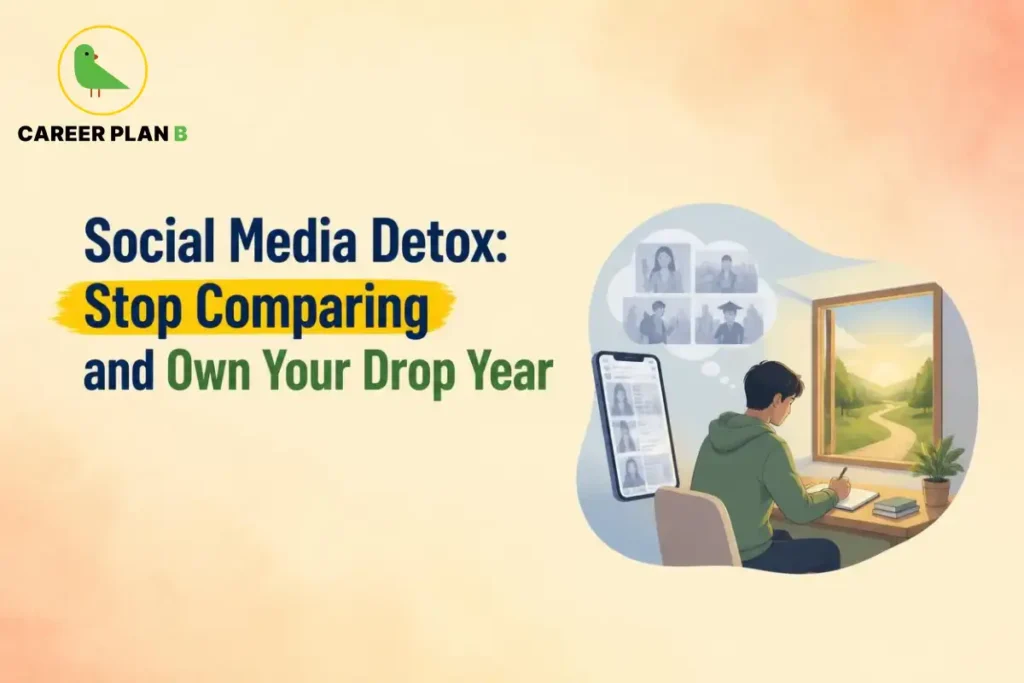
Introduction
It’s 11 PM and you’re still awake, phone glowing in the dark, thumb moving on its own. Then it happens. A friend’s post pops up. New college ID card. Campus photos. “Best decision of my life,” the caption says. Your stomach drops. You close the app, but the feeling stays with you long after the screen goes dark. This is exactly why so many CUET 2026 droppers are now choosing a Social Media Detox Drop Year as their first real step toward CUET 2027.
If you appeared for CUET 2026 and are now gearing up for another attempt, you know this feeling too well. A Social Media Detox Drop Year isn’t about vanishing from the internet forever. It’s about taking back your attention so this year works for you instead of against you. This blog walks you through why comparison hits so hard right now, what a real detox actually looks like, and how you can turn this gap year into the strongest chapter of your CUET 2027 story.
Why Does a Drop Year Feel So Heavy on Social Media?
Here’s the thing nobody tells you about a drop year: the calendar doesn’t pause for everyone else. Your batchmates move forward. They post hostel room tours, freshers’ party photos, group selfies outside lecture halls. You’re still home, with your books, your doubts, and your phone sitting right next to your notes.
Research on Indian college students backs up what your gut already knows. Studies have found that excessive social media use is closely linked to higher stress, anxiety, and even disturbed sleep among students, with comparison and fear of missing out emerging as two of the biggest triggers. One scoping review of student social media habits found that problematic use pushes people into constant comparison, which only deepens feelings of being left behind.
For a dropper, this comparison hits differently. It’s not just “they have a nicer phone” or “they went on a better trip.” It’s “they’re already in college and I’m not.” That thought, repeated every time you open Instagram, chips away at your motivation bit by bit.
So What’s Actually Happening in Your Brain?
When you see someone else’s success, your brain reacts as if you’ve personally lost something. Psychologists call this social comparison, and it’s wired into us from childhood. The problem is, social media shows you a highlight reel, not real life. Nobody posts their backlog of unfinished mock tests or their 2 AM doubts about whether they made the right choice. You’re comparing your full story to someone else’s trailer.
What Is a Social Media Detox Drop Year, Really?
Let’s clear up a common myth first. A Social Media Detox Drop Year does not mean deleting every app and disappearing from your friend group. That’s not realistic, and honestly, it’s not even necessary.
A social media detox, in the context of drop year planning, means creating intentional boundaries around when, how, and why you use these platforms. It means scrolling on your terms, not the algorithm’s terms.
It’s Not Punishment, It’s a Strategy
Think of it like training for a race. Athletes don’t avoid food entirely before a big match; they plan their meals around performance. Similarly, a smart Social Media Detox Drop Year isn’t about cutting yourself off from the world. It’s about fueling your CUET 2027 preparation with focus instead of distraction.
The Comparison Spiral: A Closer Look
Why Does Everyone Else’s Life Look Better Than Yours?
Picture this. Riya appeared for CUET 2026 along with her friend Ananya. Riya didn’t get the score she hoped for. Ananya did. Now Riya scrolls past Ananya’s college fest photos every other day, and each photo feels like a tiny gut punch.
What Riya doesn’t see is Ananya’s late-night anxiety about fitting into a new city, or her struggle to make friends in a new place. Riya only sees the polished, filtered version. This is the comparison spiral, and it’s one of the most common emotional struggles among CUET droppers during their drop year.
Here’s a simple breakdown of how an old, scroll-heavy habit compares to a healthier, detox-friendly one:
| Old Habit | New Habit | 2026 Focus & Dopamine Hygiene Impact |
|---|---|---|
| Checking Instagram first thing in the morning | Reviewing one CUET topic first, phone stays away for the first hour | Protects morning cortisol and dopamine baselines, preventing cognitive fragmentation before deep study blocks. |
| Endless scrolling during study breaks | Short, screen-free breaks like stretching or a quick walk | Allows true nervous system recovery rather than sensory overload, boosting afternoon study endurance. |
| Comparing scores and college posts late at night | A fixed “no phone after 10 PM” rule for better sleep | Enhances REM sleep consolidation, memory retention, and emotional regulation for next-day problem solving. |
| Following every batchmate’s update | Unfollowing or muting accounts that trigger comparison anxiety | Eliminates external peer pressure and maintains intrinsic motivation throughout your 10-month prep timeline. |
| Using social media to “relax” for hours | Replacing scroll time with music, journaling, or a short nap | Restores mental energy reserves efficiently without feeding algorithmic loops that drain attention span. |
Small shifts like these don’t erase your feelings overnight, but they slowly retrain your daily rhythm.
How to Plan Your Social Media Detox During a Drop Year
Ready for the practical part? Here’s a step-by-step approach that actually works, without requiring superhuman willpower.
1. Set app timers, not just intentions: Most phones now let you set daily limits on specific apps. Start with a realistic number, maybe one hour a day, and let the phone enforce it for you.
2. Identify your trigger accounts: Notice which accounts make you feel worse after scrolling. You don’t have to unfollow friends, but muting their stories for a while is a kind, low-conflict way to protect your headspace.
3. Create a “no-phone” study zone: Keep your phone in another room during deep study sessions. Out of sight genuinely does mean out of mind.
4. Replace scroll time with something restorative: Walking, listening to a podcast, or even just sitting quietly for ten minutes resets your brain better than another fifteen minutes of scrolling ever could.
5. Schedule social media like a subject: Sounds strange, but allotting a fixed 20-30 minute slot for social media, just like you’d allot time for Maths or English, removes the guilt and the randomness.
6. Tell a friend or family member about your plan: Accountability makes detox plans stick. Someone checking in on your progress, even casually, makes a real difference.
Use Tools, Not Willpower Alone
Willpower runs out by evening, especially after a long study day. That’s why screen time trackers, app blockers, and even simple tricks like switching your phone to grayscale mode during study hours work better than sheer determination. You’re not weak for needing these tools. You’re smart for using them.
Have Any Doubts?
Turning Drop Year Into a Growth Year
Here’s a mindset shift that changes everything: a drop year isn’t a year lost. It’s a year invested, provided you use it with intention.
Think about it. You now have something most first-attempt CUET aspirants don’t, a full understanding of the exam pattern, your weak areas, and what the test day actually feels like. The official CUET examination is conducted by the National Testing Agency (NTA), and staying updated on its notifications, syllabus, and registration timelines through their official portal is one of the smartest things you can do during your drop year prep. Knowing your exam inside out, instead of guessing, builds genuine confidence rather than anxious confidence.
This is also a year to rebuild emotionally, not just academically. The University Grants Commission has officially recognised how much academic stress affects students, and its guidelines on student health and well-being specifically call out the importance of addressing career-related stress and building supportive systems around students. If a national regulatory body acknowledges that this stress is real and worth addressing seriously, you don’t need to feel guilty for prioritising your mental health alongside your books.
How Career Plan B Helps
Career Plan B helps students navigate a drop year with clarity, structure, and personalized support, especially when comparison, uncertainty, and pressure start to feel overwhelming:
- Personalized Career Counselling: Helps students process comparison anxiety, evaluate their goals realistically, and build a CUET 2027 preparation strategy that matches their individual journey rather than someone else’s timeline.
- Psycheintel & Career Assessment Tests: Provides data-backed insights into aptitude, personality traits, interests, and learning styles, helping students understand their strengths and make more confident academic decisions.
- Admission & Academic Profile Guidance: Supports students in strengthening their academic profile, identifying suitable universities and courses, and aligning their efforts with future admission goals.
- Career Roadmapping: Creates a structured, step-by-step plan that connects drop-year preparation with long-term academic and career aspirations, giving students clear milestones and direction.
- End-to-End Guidance: Assists students throughout the year so their progress feels intentional, manageable, and aligned with their personal goals rather than external expectations.
For Latest Information
Frequently Asked Questions
1. Is taking a drop year for CUET actually beneficial?
Yes, when used with structure. A drop year gives you extra time to strengthen weak subjects, understand the exam pattern deeply, and approach CUET 2027 with more preparation and less panic. The key is having a clear plan rather than an open-ended pause.
2. How much social media use is too much during exam preparation?
There’s no universal number, but if scrolling regularly leaves you feeling anxious, restless, or behind in life, that’s a sign to cut back. Research on Indian students has linked heavy daily use, especially beyond two to four hours, with higher anxiety and sleep disruption.
3. Will quitting social media completely help me study better?
Not necessarily, and it’s rarely sustainable. A balanced Social Media Detox Drop Year approach, with set time limits and mindful usage, tends to work better long-term than an all-or-nothing quit that often leads to burnout or relapse.
4. How do I deal with FOMO when friends post college life updates?
Start by muting, not unfollowing, accounts that consistently trigger comparison. Remind yourself that you’re seeing edited highlights, not their full reality. Journaling your own small wins each day also helps shift focus back to your own progress.
5. Can a counsellor really help with drop year planning?
Absolutely. A counsellor helps you separate emotional overwhelm from practical planning, something that’s hard to do alone. They can help structure your study schedule, address comparison anxiety, and keep you accountable through the months ahead.
Conclusion
A drop year was never meant to be measured against everyone else’s timeline. It’s your time, your pace, and your second shot at something you genuinely want. The comparison you feel scrolling at midnight doesn’t reflect your worth or your potential, it just reflects an app designed to keep you hooked.
Start small this week. Mute one trigger account, set one app timer, protect one study hour from your phone. Your CUET 2027 journey deserves your full attention, not a divided one constantly pulled toward someone else’s highlight reel. This year is still yours to write.