Careerplanb · July 7, 2026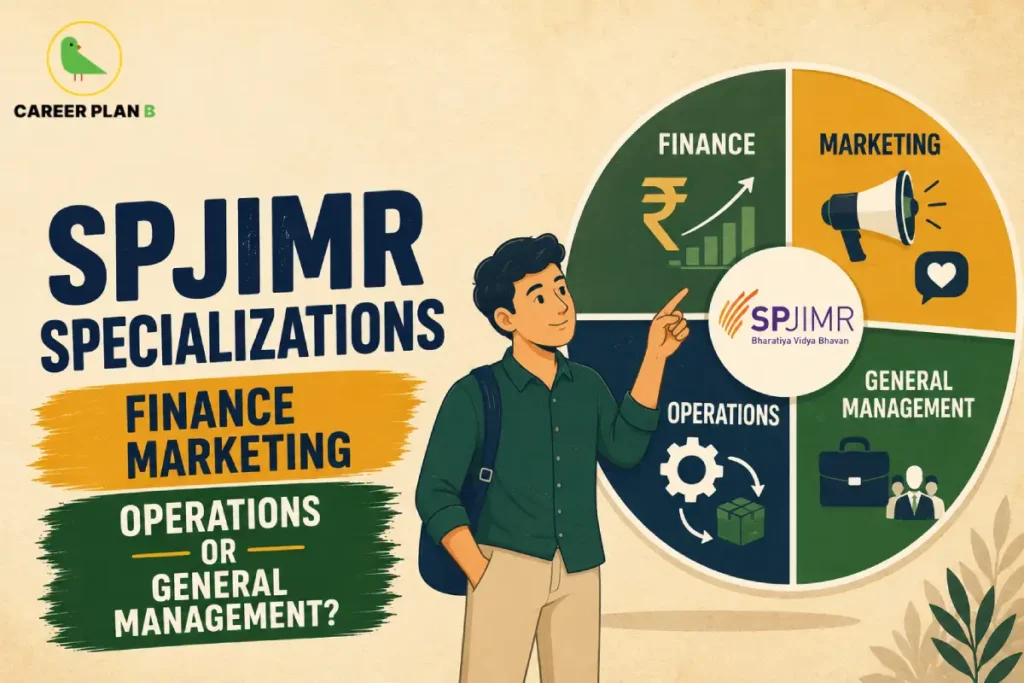
Introduction
You have cleared the SPJIMR shortlist. The GD and PI are behind you. The offer letter is in your hand. Now comes the question that most SPJIMR aspirants spend surprisingly little time considering before they arrive on campus: which specialization should you choose?
It is easy to treat this as a secondary decision. After all, getting into SPJIMR feels like the achievement, while the specialization seems like a detail.
However, it is not a detail. In fact, it is one of the most consequential academic choices you will make during your PGDM. Getting it wrong can mean spending two years studying content that does not align with your professional goals, followed by placements in roles that do not excite you.
S.P. Jain Institute of Management and Research (SPJIMR) is one of India’s most respected and globally accredited management institutions. It holds AACSB accreditation and consistently ranks among India’s top ten management institutions in the NIRF Rankings published by the Ministry of Education, Government of India. Moreover, its PGDM programme is built around a distinctive values-based educational philosophy, and its specialization options reflect a careful balance between academic depth and industry relevance.
According to AICTE (All India Council for Technical Education), SPJIMR’s PGDM programmes hold full approval and enjoy recognition equivalent to MBA degrees under India’s higher education framework. Furthermore, the specialization you choose at SPJIMR directly influences your recruiter pool, elective curriculum, peer learning groups, and ultimately your first job and long-term career trajectory.
In this blog, we will walk through every major SPJIMR specialization honestly, including Finance, Operations, Marketing, and the General Management track. Additionally, we will cover what each specialization includes, the careers it leads to, who it genuinely suits, and how placement outcomes differ across tracks.
How SPJIMR Structures Its PGDM Specializations
Before comparing individual specializations, it is worth understanding how SPJIMR structures its programme because the architecture differs from that of most Indian B-schools.
SPJIMR’s PGDM is a two-year programme. In the first year, students complete a core management curriculum shared across the batch. Then, in the second year, they pursue specialization through elective clusters, domain-specific projects, and specialization-aligned placements. As a result, every SPJIMR student graduates with a strong general management foundation regardless of specialization, while the chosen specialization adds domain expertise on top of that foundation.
SPJIMR also has a distinctive institutional feature that shapes the entire PGDM experience. Programmes such as DISHA (a social awareness immersion), EKTHA (a rural village immersion), and ACE (an ethics and corporate responsibility module) form an integral part of the curriculum for all students. Moreover, these programmes are not optional. They are mandatory components of an SPJIMR education and help distinguish SPJIMR graduates in leadership roles.
The major specialization areas in SPJIMR’s PGDM include Finance, Operations, Marketing, Information Management, and General Management. Furthermore, each specialization attracts a different student profile, connects to a different recruiter base, and builds a different kind of career foundation.
Official portal of SPJIMR (SPJIMR PGDM)
Have Any Doubts?
SPJIMR Finance Specialization
What It Covers
The Finance specialization at SPJIMR is one of the most rigorous and industry-respected tracks on offer. The elective curriculum covers Corporate Finance and Valuation, Investment Banking, Financial Modelling, Derivatives and Risk Management, Mergers and Acquisitions, Portfolio Management, Private Equity, and Financial Statement Analysis.
SPJIMR’s Mumbai location is the Finance specialization’s most significant asset. As India’s financial capital, Mumbai gives Finance students direct access to internships and live projects at leading Indian and global BFSI organisations throughout the programme. Moreover, proximity to these institutions enhances the quality of guest lectures, industry interactions, and case material.
Career Paths and Placement Outcomes
SPJIMR Finance graduates secure placements across investment banking, corporate finance, equity research, treasury management, consulting (finance practice), and financial services strategy. Moreover, key recruiters that consistently hire Finance graduates from SPJIMR include Goldman Sachs, JP Morgan, Kotak Mahindra Bank, HDFC Bank, Avendus Capital, Bain Capital, and Deloitte Financial Advisory.
The Finance track at SPJIMR also consistently delivers some of the highest individual placement packages on campus. In particular, top offers in investment banking and private equity roles often exceed the programme average by a significant margin.
Who Should Choose Finance
Finance is the right SPJIMR specialization for you if you have genuine analytical strength, feel comfortable with high-level quantitative problem-solving, and have a clear career direction toward BFSI, investment banking, corporate finance, or financial consulting. However, it is not the right choice if you are selecting it primarily because finance salaries are high. The curriculum demands both real aptitude and genuine interest. Without them, the two years can become a grind rather than a springboard for your career.
Official website (SPJIMR Finance)
SPJIMR Operations Specialization
What It Covers
SPJIMR’s Operations specialization is one of the most technically sophisticated management tracks available at any Indian B-school. The elective curriculum covers Supply Chain Strategy, Procurement and Vendor Management, Operations Analytics, Lean and Six Sigma Methodologies, Project Management, Technology Operations, Manufacturing Strategy, and Service Operations Management.
What makes SPJIMR’s Operations track particularly valuable in 2026 is the integration of digital operations content. Supply chain disruptions, e-commerce fulfilment complexity, and AI-driven manufacturing management have all dramatically elevated the strategic importance of operations leadership. SPJIMR’s Operations curriculum has evolved to reflect these industry changes, covering digital supply chain platforms and data-driven operations decision-making alongside traditional operations fundamentals.
Career Paths and Placement Outcomes
SPJIMR Operations graduates are placed across supply chain management, procurement leadership, consulting (operations practice), manufacturing management, logistics strategy, and project management. Key recruiters include Amazon Supply Chain, Mahindra Logistics, L&T, Tata Motors, McKinsey Operations Practice, Deloitte Supply Chain, and Accenture Operations.
Operations placements at SPJIMR tend to be very strong in manufacturing, logistics, and consulting sectors, with average CTCs competitive with Finance placements at the mid-to-senior band. The growing demand for operations-trained management professionals in India’s expanding manufacturing and e-commerce sectors makes this track increasingly valuable.
Who Should Choose Operations
Operations is the right SPJIMR specialization for you if you think systematically, find process optimization intellectually engaging, and want to build a career in supply chain, manufacturing, logistics, or operations consulting. Engineering graduates often find the Operations track particularly well-aligned with their analytical background. It is not the right choice for candidates who are primarily people and communication oriented and find process and systems work tedious.
Official website by the SPJIMR SPJIMR Operations
SPJIMR Marketing Specialization
What It Covers
SPJIMR’s Marketing specialization is among the most respected in India, reflecting the institution’s deep connections with India’s FMCG, consumer goods, and digital marketing sectors. The elective curriculum covers Consumer Behaviour and Insights, Brand Management, Digital Marketing Strategy, Marketing Analytics, Sales and Distribution Management, Product Management, B2B Marketing, and Integrated Marketing Communications.
The Marketing track at SPJIMR benefits from the institution’s strong FMCG and consumer goods recruiter relationships, which have been built over decades of consistent graduate placement in these sectors. SPJIMR Marketing graduates are among the most sought-after profiles at India’s leading FMCG organisations, and the curriculum reflects a deep understanding of what these companies actually need from management hires.
The integration of Marketing Analytics into the specialization is particularly timely. In 2026, every major FMCG, e-commerce, and technology company expects marketing managers to be as comfortable reading a campaign data dashboard as they are developing a brand positioning framework. SPJIMR’s Marketing curriculum prepares graduates for exactly this dual capability.
Career Paths and Placement Outcomes
SPJIMR Marketing graduates are placed across brand management, product management, digital marketing, consumer insights, sales and distribution leadership, and marketing analytics. Key recruiters consistently hiring Marketing graduates from SPJIMR include Hindustan Unilever, P&G, Nestlé, Marico, ITC, Amazon, Flipkart, and several leading digital marketing and media organisations.
The Marketing track consistently delivers strong average CTCs at SPJIMR, with brand management roles at top FMCG companies representing some of the most coveted placement outcomes on campus.
Who Should Choose Marketing
Marketing is the right SPJIMR specialization for you if you are genuinely curious about consumer behaviour, are a natural communicator and storyteller, and are drawn to roles where you build products and brands that millions of people interact with. It is particularly well-suited for candidates with strong communication skills who also want to develop analytical competencies. It is not the right choice for candidates who find consumer-facing work uninteresting or who prefer back-office quantitative roles.
Official website by the SPJIMR (SPJIMR Marketing)
SPJIMR General Management Track
What It Covers
The General Management track at SPJIMR is the deliberate choice of students who want breadth over depth, flexibility over specialisation, and the ability to recruit across multiple functional areas rather than committing to a single domain at the start of their MBA.
Students on the General Management track take electives across Finance, Marketing, Operations, and Strategy, building a cross-functional management perspective that is particularly valued in consulting, entrepreneurship, and general management roles. The track produces graduates who can understand and contribute to every function of a business rather than being the expert in one.
SPJIMR’s values-based education philosophy aligns particularly well with the General Management track. The emphasis on ethical leadership, social awareness, and holistic decision-making that runs through all of SPJIMR’s programmes is most fully realised in students who have engaged broadly across all management domains.
Career Paths and Placement Outcomes
General Management track graduates are placed in management consulting, strategy roles, general management trainee programmes at large corporations, entrepreneurship, and cross-functional leadership positions. Key recruiters include McKinsey, BCG, Bain, Deloitte Consulting, Accenture Strategy, and several large Indian conglomerates with structured management trainee programmes.
Consulting placements at SPJIMR are consistently among the most prestigious outcomes on campus, and the General Management track’s breadth of elective exposure is well-aligned with what consulting firms are looking for in their associate-level hires.
Who Should Choose General Management
General Management is the right SPJIMR track for you if you are drawn to consulting, are not yet certain about your domain specialization, or want to keep your career options as broad as possible for the first few years post-MBA. It is also the natural home for candidates with entrepreneurial ambitions who need management fundamentals across every function before launching a venture. It is not the right choice for candidates who already have a clear, committed domain direction and want deep expertise in it.
Official website by the SPJIMR (SPJIMR PGDM General Management)
Quick Comparison — SPJIMR Specializations at a Glance
| Factor | Finance | Operations | Marketing | General Mgmt |
| Core Strength | BFSI, Investment | Supply Chain, Mfg | FMCG, Digital | Consulting, Strategy |
| Best Academic Background | Commerce, Economics | Engineering | Any | Any |
| Top Recruiters | Goldman Sachs, JP Morgan, HDFC | Amazon, L&T, McKinsey Ops | HUL, P&G, Nestlé | McKinsey, BCG, Bain |
| Avg. CTC Range | Rs. 22 to 30 LPA (top offers) | Rs. 18 to 26 LPA | Rs. 18 to 26 LPA | Rs. 20 to 28 LPA |
| Career Flexibility | Moderate (BFSI focused) | Moderate (Ops focused) | Moderate (FMCG focused) | Highest |
| Right for Freshers? | Yes (with Quant strength) | Yes (Engineering preferred) | Yes (all streams) | Yes (all streams) |
Placement data sourced from SPJIMR official placement reports at spjimr.org.
How to Make the Final Decision
Four honest questions that cut through the noise:
Question 1 — Where does your aptitude genuinely lie? Not where you wish it lay, and not where your parents think it should. If numbers energise you, Finance or Operations. If people and brands energise you, Marketing and if you are equally engaged by everything, General Management.
Question 2 — What industry do you want to spend the first five years of your career in? BFSI and investment means Finance. Manufacturing and logistics means Operations. FMCG and technology means Marketing. Consulting and cross-sector leadership means General Management.
Question 3 — What kind of work do you want to do every day? Financial models and deal analysis. Process improvement and supply chain optimisation. Brand campaigns and consumer research. Cross-functional strategy and stakeholder management. Each specialization produces a very different day-to-day professional reality.
Question 4 — Are you choosing based on genuine interest or salary tables? Salary tables at SPJIMR are competitive across all specializations. The candidate who chooses Finance purely for salary and has no quantitative aptitude will be outperformed and under-satisfied by the candidate who chose Marketing out of genuine passion and is extraordinary at it. Choose the work you want to do, not just the salary you want to earn.
How Career Plan B Helps
Choosing the right SPJIMR specialization requires honest self-assessment, clear career direction, and an understanding of how each track maps to specific industries and roles.
Career Plan B offers Personalized Career Counselling to help SPJIMR aspirants and admits identify the specialization that genuinely aligns with their aptitude, interests, and long-term career vision.
Through Psycheintel Career Assessment Tests, you gain a data-backed picture of your professional strengths and ideal work environment.
With Admission and Academic Profile Guidance and a structured Career Roadmap, Career Plan B ensures that the two years you invest at SPJIMR are built on a foundation of genuine self-knowledge and strategic direction.
Get In Touch With Us
Frequently Asked Questions (FAQs)
Q1. Which specialization at SPJIMR has the best placements?
All four major specializations at SPJIMR deliver strong placement outcomes, but the highest individual packages consistently come from Finance (investment banking and PE roles) and General Management (top-tier consulting). Marketing placements are strongest in FMCG brand management, and Operations delivers competitive CTCs in supply chain and consulting practices. The “best placement” question is less useful than asking which specialization delivers the best placements for the specific roles and industries you are targeting.
Q2. Can I switch specializations after joining SPJIMR?
Specialization selection at SPJIMR typically happens during the first year, giving students time to experience core curriculum across all domains before committing. Some flexibility exists for students whose interests evolve after exposure to first-year content. Check the current specialization selection process and flexibility options directly with SPJIMR’s academic office at the time of joining, as programme structures can evolve between admissions cycles.
Q3. Is SPJIMR Finance better than SPJIMR Marketing?
Neither is universally better — they serve entirely different career paths and candidate profiles. Finance is better if you want BFSI, investment banking, or financial consulting careers and have strong quantitative aptitude. Marketing is better if you want FMCG, e-commerce, or digital marketing careers and have strong communication and consumer insight skills. The question is not which is better in the abstract. The question is which is better for you specifically, given your strengths and career goals.
Q4. Does SPJIMR offer a Business Analytics specialization?
SPJIMR integrates analytics content across multiple specializations rather than offering it as a standalone track. Finance, Marketing, and Operations all include analytics electives and data-driven decision-making modules. Candidates specifically seeking a dedicated Business Analytics MBA may also want to evaluate programmes like IIM Bangalore’s Analytics track or Great Lakes PGDM in Business Analytics as complementary options.
Conclusion
SPJIMR does not have a bad specialization. Every track is well-designed, well-resourced, and well-connected to a specific set of India’s best recruiters. The question is never which specialization is best. The question is which specialization is best for you.
Finance builds precise, analytically rigorous financial leaders for India’s BFSI and investment ecosystem. Operations builds systematic, process-intelligent professionals who make complex supply chains and manufacturing organisations run better. Marketing builds consumer-obsessed, data-fluent brand and product leaders for India’s FMCG, e-commerce, and digital economy. General Management builds adaptable, cross-functional thinkers who thrive in consulting, strategy, and leadership roles that require breadth over depth.
Spend as much time choosing your specialization as you spent preparing for the SPJIMR interview. It deserves it. The two years you are about to invest will build the foundation of a career. That foundation should be laid on honest self-knowledge, genuine interest, and strategic clarity.
Ready to make this decision with expert guidance?
Connect with Career Plan B today for a personalised career assessment, specialization recommendation, and academic roadmap designed specifically around your aptitude, your goals, and the professional you are working towards becoming.