Careerplanb · July 7, 2026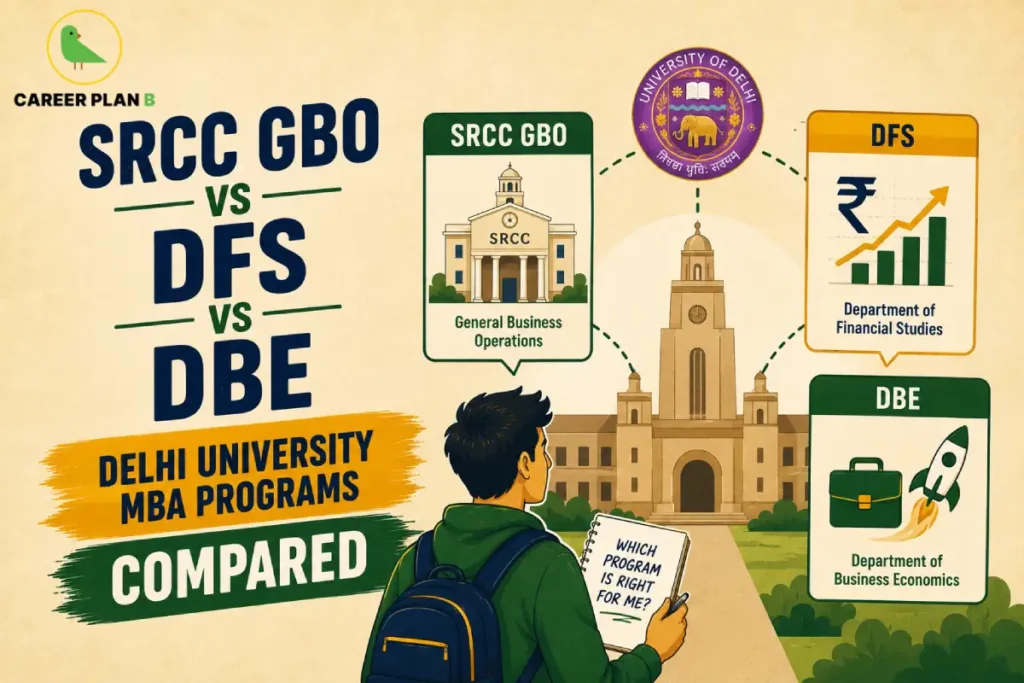
Introduction
Three of India’s most underrated MBA programs sit inside one of its most famous universities, and most aspirants outside Delhi have never seriously considered any of them.
Delhi University’s South Campus hosts three distinct postgraduate management programs that share almost nothing except their university affiliation and their remarkable cost-to-outcome ratio. SRCC’s Post Graduate Diploma in Global Business Operations (PGDGBO, commonly called GBO) is a two-year diploma-equivalent to an MBA in International Business, offered by India’s most prestigious commerce college. The Department of Financial Studies (DFS) offers an MBA in Finance with a total tuition fee of approximately Rs 97,000 for two years and an average placement package of Rs 19.12 LPA. The Department of Business Economics (DBE) offers an MBA in Business Economics with a total fee of approximately Rs 1.01 lakh and a 2025 average package of Rs 15.12 LPA.
Delhi University ranks 18th overall in the NIRF 2025 framework with a NAAC A++ grade. [NIRF Rankings 2025] The programs housed within it carry the weight of that institutional brand at fees that are a fraction of what private B-schools charge for comparable or weaker placement outcomes.
This blog compares all three across the admission process, eligibility, fees, placement outcomes, and the career paths each program genuinely opens.
The Programs at a Glance
SRCC GBO (Post Graduate Diploma in Global Business Operations): Offered by Shri Ram College of Commerce, one of India’s most renowned undergraduate commerce institutions, the GBO program is a two-year full-time residential program with an approved intake of 90 students. It is explicitly designed for global business careers, with a curriculum covering international trade, cross-border operations, global finance, and international marketing. The program has its own dedicated entrance exam, separate from CAT, conducted annually with GD and PI rounds. SRCC’s institutional brand carries enormous weight in India’s corporate recruiting market. [SRCC GBO Official]
DFS (Department of Financial Studies) MBA Finance: Established in 1987, DFS Delhi is a government department of Delhi University offering a two-year full-time MBA in Finance (formerly called MFC, Master of Finance and Control). It admits through CAT with a general category cutoff of approximately 95 percentile, followed by PI. The program has 69 seats and is one of India’s most ROI-efficient MBA Finance programs, with a total fee of approximately Rs 97,000 and an average placement exceeding Rs 19 LPA. [DFS Official]
DBE (Department of Business Economics) MBA Business Economics: Established in 1973, DBE is one of Delhi University’s oldest management departments, offering an MBA in Business Economics through CAT admission with a general category cutoff of approximately 90 to 95 percentile. It has 129 seats and a total fee of approximately Rs 1.01 lakh. The 2025 placement data shows an average of Rs 15.12 LPA and a highest package of Rs 30.25 LPA. [DBE Official]
Have Any Doubts?
Admission: Three Very Different Processes
Understanding how each program selects its students is critical, because the admission route shapes everything from who you study with to what the recruiter’s perception is.
SRCC GBO Admission: SRCC GBO uses its own dedicated entrance exam, not CAT. The exam is conducted in online CBT mode across approximately 20 cities in India, testing Quantitative Ability, English Comprehension and Language Ability, Data Interpretation, and Logical Reasoning. Shortlisted candidates attend GD and PI rounds in Delhi only. The selection weightage is distributed across the entrance exam, GD, and PI. No CAT score is required or accepted.
The batch profile reflects this distinct admission route: approximately 40% engineers, 30% commerce graduates, 20% arts graduates, and 10% from science backgrounds, with 0 to 3 years of work experience. This diversity is a genuine differentiator from DFS and DBE, which skew more toward commerce and economics backgrounds due to the CAT admission route.
DFS Admission: DFS admits through CAT scores. The general category cutoff is approximately 95 percentile. Shortlisted candidates appear for a Personal Interview in Delhi. The final selection considers CAT percentile, Class 10 and 12 board marks, graduation marks, and gives additional weightage to female candidates. Maths or Business Maths at Class 12 level is mandatory for DFS admission. Work experience is preferred but not mandatory.
DBE Admission: DBE also admits through CAT. The general category cutoff is approximately 90 to 95 percentile. Shortlisted candidates appear for a Group Discussion, Extempore round, and Personal Interview in Delhi. Maths or Business Maths at Class 12 level is mandatory for DBE MBA admission as well. The additional 40,000 rupees per year student body fund for placement and activities brings total effective fees above the headline number.
Fees: The ROI Case for All Three
The fees at all three institutions are extraordinary by any standard of Indian management education. This table summarises the full picture.
| Parameter | SRCC GBO | DFS MBA Finance | DBE MBA BE |
| Total Tuition Fees (2 years) | Rs 3.20 lakh | Rs 97,000 | Rs 1.01 lakh |
| Additional Costs | Hostel and living costs in Delhi | Hostel separately (Rs 37,000 for DU hostel) | Rs 40,000 per year student body fund |
| Total Effective Cost (est.) | Rs 5 to 7 lakh (with hostel) | Rs 2 to 3 lakh (with hostel) | Rs 2.5 to 3.5 lakh (with fund) |
| Admission Exam | SRCC GBO own exam | CAT (95 percentile) | CAT (90 to 95 percentile) |
| Batch Size | 90 students | 69 students | 129 students |
DFS holds the strongest ROI position in India among MBA Finance programs at its level of placement performance. A total investment of approximately Rs 2 to 3 lakh for a program that delivers Rs 19.12 LPA average placement is structurally difficult to match anywhere else in the country at this fee point.
Placements: The Data That Matters Most
SRCC GBO Placements
SRCC GBO placements have shown consistent and improving trends. The 2024 average placement package was Rs 12.5 LPA, with a reported figure of Rs 10.61 LPA for an earlier reported cycle. Internship stipends average Rs 60,000 to 70,000 for two months, with strong PPO conversion from summer internships.
Key SRCC GBO placement highlights:
- Average package (2024): Rs 12.5 LPA
- Internship average stipend: Rs 60,000 to 70,000 per month
- PPO culture: Strong, with internships regularly converting to full-time offers
- Top recruiters: McKinsey, BCG, EY, Deloitte, Google, Adani, DE Shaw, Flipkart, and international trade companies
- Career focus: Global business, international trade, consulting, BFSI, FMCG
The presence of McKinsey and BCG as recruiters at an institution with a total fee of Rs 3.20 lakh is the most striking fact on this list, and it reflects the combined weight of the SRCC brand and the quality of candidates the GBO program produces.
DFS MBA Finance Placements
DFS is the strongest placement performer of the three on average. The 2025 placement data released by DFS shows:
- Average package (2025): Rs 19.12 LPA
- Highest package (2025): Rs 32 LPA, up 9.2% year on year
- Median package (2025): Rs 14.47 LPA
- Lowest package: Rs 10.78 LPA
- Top 25% average: Rs 20.75 LPA
- Summer internship: Core Finance roles led at 39%, followed by Analytics and Strategy at 12%
- Top recruiters: DeShaw, Arcesium, Deloitte, EY, KPMG, Axis Bank, SBI Capital Markets, Mahindra Group
[DFS Official Placement Report 2025]
The De Shaw and Arcesium presence is particularly notable. These are quantitative finance and financial technology firms that recruit selectively from a very short list of programs in India. Their presence at DFS reflects the program’s deep finance domain credibility that no fee-based comparison can fully capture.
DBE MBA Business Economics Placements
DBE’s 2025 placement data shows solid outcomes:
- Average package (2025): Rs 15.12 LPA
- Highest package (2025): Rs 30.25 LPA
- Median package (2025): Rs 12.95 LPA
- Top 10% average: Rs 23.47 LPA
- Top 25% average: Rs 19.09 LPA
- Placement rate: 96% plus annually
- Top recruiters: American Express, Barclays, ICICI Bank, Axis Bank, Airtel, Cognizant, Dalmia
- Career focus: Business analytics, finance, consulting, marketing
DBE’s programme breadth in Business Economics, covering econometrics, finance, and marketing specialisations, attracts a more diverse recruiter base than DFS’s pure Finance focus. American Express and Barclays are consistent visitors, reflecting DBE’s strength in analytics-driven BFSI roles.
Head-to-Head Comparison
| Parameter | SRCC GBO | DFS MBA Finance | DBE MBA BE |
| University | Delhi University (NAAC A++) | Delhi University (NAAC A++) | Delhi University (NAAC A++) |
| Credential | PG Diploma (MBA equivalent, UGC recognised) | MBA (Finance) | MBA (Business Economics) |
| Admission Exam | Own SRCC GBO exam | CAT (95 percentile cutoff) | CAT (90 to 95 percentile cutoff) |
| Total Fees | Rs 3.20 lakh | Rs 97,000 | Rs 1.01 lakh |
| Avg Package (latest) | Rs 12.5 LPA | Rs 19.12 LPA | Rs 15.12 LPA |
| Highest Package (latest) | Not publicly stated | Rs 32 LPA | Rs 30.25 LPA |
| Batch Size | 90 | 69 | 129 |
| Domain Focus | International Business, Global Trade | Finance, Investment, Capital Markets | Business Economics, Analytics, Finance |
| Key Differentiator | SRCC brand, own exam, global focus | Highest ROI MBA Finance in India | Widest domain breadth among the three |
Which Program Should You Choose?
The answer depends on what you want your MBA to do for your career, and which of the three admission routes you can access.
Choose SRCC GBO
if you want a career in international business, global trade, cross-border consulting, or FMCG with international operations, and you have a strong enough aptitude profile to clear the SRCC GBO entrance exam. The own-exam admission route means you do not need a CAT score, which makes GBO accessible to aspirants from engineering, arts, and science backgrounds who might find CAT preparation suboptimal for their strengths. The Rs 3.20 lakh total fee for a program that attracts McKinsey, BCG, and EY as recruiters is one of India’s most compelling management education propositions.
Choose DFS
if your career target is Finance, specifically investment banking, capital markets, quantitative finance, or financial consulting, and you have the CAT score and maths background to access it. DFS’s Rs 97,000 total fee with Rs 19.12 LPA average placement and De Shaw as a recruiter represents an ROI that is genuinely unmatched anywhere in India at this program level. The mandatory Class 12 Maths eligibility filters the batch toward quantitatively strong candidates, which is part of what sustains the program’s finance recruiter relationships.
Choose DBE
if you want domain flexibility, a broader Business Economics foundation, and access to analytics, consulting, marketing, and finance roles from a single program. DBE’s larger batch (129 seats) and accessible CAT cutoff (90 percentile) make it the most reachable of the three for aspirants scoring in the 90th to 94th percentile range. The Rs 1.01 lakh total fee with Rs 15.12 LPA average makes it one of India’s strongest ROI MBA options for aspirants who want breadth rather than Finance specialisation depth. [Learn more about how to choose the right MBA program for your career goals]
How Career Plan B Helps
Choosing between SRCC GBO, DFS, and DBE requires clarity on your career domain, your admission exam strategy, and how each program’s placement ecosystem maps to your specific target roles.
Career Plan B’s Personalized Career Counselling helps aspirants identify which Delhi University management program genuinely aligns with their career goals and academic profile.
Psycheintel Career Assessment Tests surface your natural aptitudes and working style, helping you choose between the international business focus of GBO, the finance depth of DFS, and the domain breadth of DBE with data-backed confidence.
Admission and Academic Profile Guidance helps you prepare for the SRCC GBO entrance exam and PI alongside the CAT-based DFS and DBE admission processes, while Career Roadmapping gives you a structured plan from entrance exam to your first management role.
Get In Touch With Us
Frequently Asked Questions
Q1. Is SRCC GBO a valid MBA degree?
SRCC GBO is a Post Graduate Diploma in Global Business Operations, not a degree. However, it is recognised by the UGC as equivalent to an MBA with specialisation in International Business. For government employment purposes and higher education applications, the UGC equivalence provides the same standing as a formal MBA degree from most perspectives. The credential carries the SRCC brand and Delhi University affiliation, which carry significant weight with corporate recruiters.
Q2. What is the CAT cutoff for DFS and DBE?
The general category CAT cutoff for DFS Delhi MBA Finance is approximately 95 percentile. The general category cutoff for DBE Delhi MBA Business Economics is approximately 90 to 95 percentile. Both institutions shortlist candidates from their CAT scores for Personal Interview rounds, with final selection based on a combination of CAT percentile, board marks, and PI performance.
Q3. Does SRCC GBO require CAT scores?
No. SRCC GBO has its own dedicated entrance exam, separate from CAT. Admission is based on the SRCC GBO entrance exam score, followed by a GD and PI round in Delhi. CAT scores are not accepted or required. This makes GBO accessible to aspirants from any discipline background who have not taken CAT.
Q4. Which program has the best placement among the three?
DFS leads on average at Rs 19.12 LPA (2025), followed by DBE at Rs 15.12 LPA, and SRCC GBO at Rs 12.5 LPA (2024). However, the ROI picture is different. DFS delivers the highest average at the lowest fee (Rs 97,000 total), making it the strongest ROI program of the three and among the strongest in India at any fee level. All three programs attract genuinely premium recruiters relative to their fee points.
Conclusion
SRCC GBO, DFS, and DBE are three of India’s most underappreciated management programs. They share a university address, a South Campus location in Delhi, and a cost-to-outcome ratio that most private B-school brochures would struggle to replicate. Beyond those similarities, they are distinct programs serving distinct career paths.
GBO is for the globally minded aspirant who wants a SRCC brand and international business career without needing a CAT score. DFS is for the Finance aspirant who wants De Shaw, Arcesium, and SBI Capital Markets as recruiters for Rs 97,000 in tuition. DBE is for the aspirant who wants domain breadth, analytics and BFSI access, and the Delhi University MBA credential at Rs 1.01 lakh.
All three are worth taking seriously. The question is which one takes you where you want to go.
Want help deciding which Delhi University MBA program fits your profile and career goals?
Connect with Career Plan B for personalised guidance, from SRCC GBO entrance preparation to CAT strategy and interview readiness.