Team Career Plan B · October 13, 2026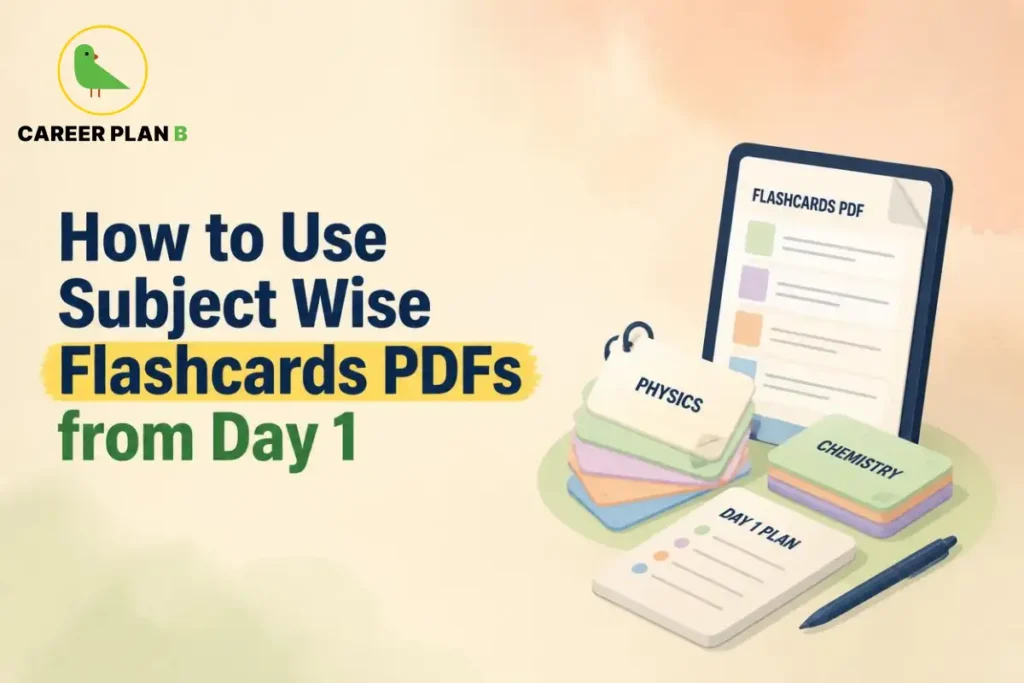
Introduction
It was the first week of June, and Ananya had just shut her Class 12 board exam chapter for good. Relief lasted about three days. Then her phone buzzed with a message from a senior: “Have you started CUET prep yet?” She hadn’t even opened her books, let alone made a subject wise flashcards PDF, and panic crept in quietly, the way it does for thousands of students every year.
If you are reading this, you are probably standing exactly where Ananya stood. CUET 2027 planning feels distant until it suddenly feels urgent, and that gap is where most students lose precious weeks. This blog walks through her journey, and yours, showing exactly how a subject wise flashcards PDF can turn scattered revision into a calm, structured routine right from day one.
What Exactly Is a Subject Wise Flashcards PDF?
Ananya’s first instinct was to make notes the old way: long paragraphs, highlighters, sticky notes falling off her desk by evening. It didn’t take long for her to realize this wasn’t sustainable for an exam that tests speed and recall across multiple subjects at once.
A subject wise flashcards PDF is simply a digital, organized set of short revision cards grouped by subject, each one holding a single concept, formula, date, or definition. Instead of flipping through a 200-page notebook, a student opens one PDF and sees only what matters for that subject, broken into bite-sized pieces. For an exam structured around domain subjects and a general aptitude paper, this format fits naturally because each subject can be revised in isolation without confusion.
Why CUET 2027 Planning Should Start With Flashcards, Not Last-Minute Cramming
Here’s something Ananya didn’t know until her counsellor pointed it out: CUET draws its domain subject content directly from the Class 12 syllabus, and the official subject list itself spans more than 30 domain options, from Accountancy to Sociology. That breadth is exactly why cramming in the last month rarely works. There is simply too much ground to cover in too little time.
What Does the Official CUET Syllabus Tell Us?
According to the official syllabus page published by the National Testing Agency, CUET (UG) covers languages, domain-specific subjects, and a General Aptitude Test, with each subject having its own detailed specification document. This means CUET 2027 planning is not about studying everything generally; it is about knowing precisely which topics, within which subject, deserve a flashcard.
Students preparing for 2027 can review the current subject structure and specifications directly on the official NTA CUET syllabus page, since the 2027 syllabus is expected to follow a similar pattern once formally released. The National Testing Agency’s main website also confirms that CUET serves as a single-window entrance test accepted by central, state, deemed, and private universities, which is why subject-wise clarity matters so much, your flashcard deck essentially becomes your passport across hundreds of institutions.
A Day in Ananya’s Flashcard Journey
Let’s go back to Ananya. After that nudge from her senior, she didn’t panic-buy ten reference books. Instead, she opened a blank document on day one and asked herself a simple question: “What are the five subjects I am choosing for CUET, and what does each really demand from me?”
She picked her domain subjects, set aside her General Aptitude prep separately, and began building one flashcard at a time. Two weeks in, her PDF had grown from a shaky ten cards to over a hundred, sorted neatly by subject and topic. The exam still felt big, but it no longer felt shapeless. That shift, from overwhelm to structure, is exactly what a subject wise flashcards PDF is meant to do.
How to Build Your Subject Wise Flashcards PDF From Day 1
You don’t need fancy design skills or expensive software to start. Here is the method Ananya eventually settled into, refined over a few weeks of trial and error.
- List your chosen subjects first: Before making a single card, write down your language paper, domain subjects, and the General Aptitude Test as separate sections.
- Pick one chapter at a time: Resist the urge to jump across subjects randomly; finish a chapter’s cards before moving on.
- Keep each card short: One concept, one formula, or one fact per card. If it needs three lines to explain, it probably belongs in your notes, not your flashcard.
- Use a consistent format: A simple front-and-back structure (question or term on one side, answer on the other) works far better than long descriptive cards.
- Compile into a single PDF per subject: This keeps your phone or laptop organized and lets you revise an entire subject without searching through folders.
- Revisit and revise weekly: Flashcards lose value if they’re made once and forgotten; treat them as a living document.
Subject vs Flashcard Focus Area
| Subject Type | What to Put on the Flashcard |
|---|---|
| Languages | Grammar rules, vocabulary, comprehension techniques |
| Domain Subjects (e.g., Economics, Biology, History) | Definitions, formulas, key dates, diagrams summarized in text |
| General Aptitude | Quantitative shortcuts, logical reasoning patterns, current affairs snippets |
This simple breakdown helped Ananya stop treating every subject the same way. A history flashcard looks nothing like a mathematics flashcard, and that’s exactly the point.
For Personalized Guidance
Common Mistakes Students Make With Flashcards
Are You Making Flashcards Too Long?
This was Ananya’s biggest early mistake. Her first few cards were practically mini-essays, defeating the entire purpose of quick recall. A good flashcard should take less than thirty seconds to read and answer.
Are You Mixing Subjects on the Same Card?
Mixing subjects might feel efficient, but it actually slows down revision because your brain has to switch context constantly. Keep your subject wise flashcards PDF strictly segregated.
Are You Skipping Regular Revision?
Making the cards is only half the job. Without weekly revisits, even the best-organized subject wise flashcards PDF becomes just another forgotten file.
How Career Plan B Helps
Career Plan B helps students approach CUET 2027 preparation with a strategy that connects daily study habits to long-term academic and career goals:
- Personalized Career Counselling: Helps students choose the right domain subjects based on their interests, strengths, target courses, and university aspirations.
- Psycheintel & Career Assessment Tests: Provides data-backed insights into aptitude, personality traits, interests, and learning styles, helping students identify the subjects and career paths that best match their abilities.
- Admission & Academic Profile Guidance: Supports students in strengthening their academic profile, understanding admission requirements, and ensuring their preparation aligns with future opportunities.
- Study Strategy Alignment: Helps students build effective preparation techniques and prioritize their efforts in ways that support their overall academic objectives, not just short-term exam performance.
- Career Roadmapping: Creates a structured, step-by-step plan that connects subject selection, CUET preparation, university admissions, and long-term career aspirations.
- End-to-End Guidance: Assists students throughout their preparation journey so every academic decision is informed, intentional, and aligned with their future goals.
For Latest Information
Frequently Asked Questions
Q1. When should I start making my subject wise flashcards PDF for CUET 2027?
Ideally right after your Class 12 boards end, similar to how Ananya began. Starting early spreads the workload and avoids last-minute stress.
Q2. Can flashcards replace my regular notes completely?
No. Flashcards work best as a revision layer on top of your detailed notes, not a replacement for understanding core concepts.
Q3. How many flashcards should I make per subject?
There’s no fixed number. Focus on covering every important topic rather than hitting a count; some chapters may need ten cards, others might need fifty.
Q4. Should I make digital or handwritten flashcards?
A digital subject wise flashcard PDF is easier to organize, search, and carry across devices, which is especially useful during travel or quick revision breaks.
Q5. Does the CUET syllabus change every year?
The subject list and pattern have remained largely consistent, but students should always confirm details through the official NTA CUET website closer to the application period.
Conclusion
Ananya’s story didn’t end with a magic shortcut. It ended with consistency, one flashcard at a time, one subject at a time, until CUET 2027 stopped feeling like an unclimbable mountain. That’s really the heart of good CUET 2027 planning: small, organized steps taken early, rather than a frantic sprint later.
If you’re standing where she once stood, unsure and a little anxious, start today. Build your first flashcard, however rough it looks, and let it grow with you. The exam will arrive either way; how prepared you feel when it does is entirely in your hands.