Team Career Plan B · July 22, 2026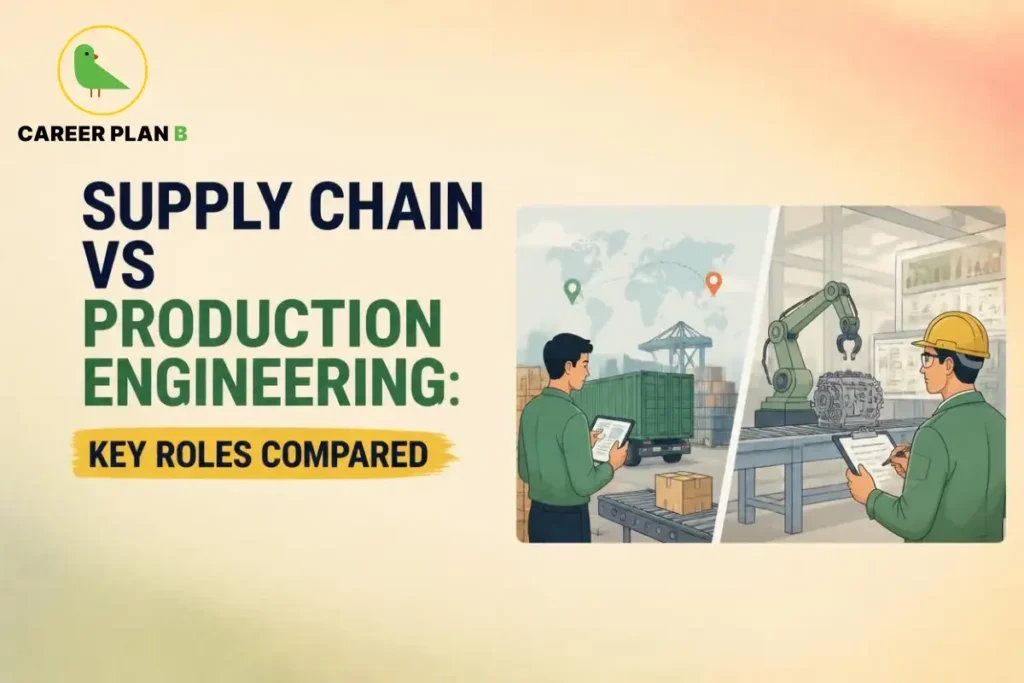
Introduction
India’s logistics sector now contributes nearly 14 per cent to the national economy, a scale that’s hard to overstate given how many industries depend on goods actually reaching the right place at the right time. This growth, backed heavily by the National Logistics Policy and PLI-driven manufacturing expansion, has made the debate around supply chain vs production engineering key roles genuinely relevant for students choosing between these two paths. Both fields deal, in some sense, with how products get made and delivered, and this surface-level similarity often leads students to conflate them entirely. However, once you look closely at what each role actually does day to day, the differences turn out to be substantial rather than cosmetic. This blog breaks down both fields in real depth, covering their core functions, eligibility routes, career scope, and salary, so you can choose with genuine clarity rather than surface-level assumptions.
What’s the Core Difference Between Supply Chain and Production Engineering?
Production Engineering: Optimising the Factory Floor Itself
Production engineering focuses specifically on what happens inside the factory: how a product actually gets manufactured, assembled, and quality-checked on the shop floor itself. A production engineer’s world revolves around machine cycle times, process layouts, quality control systems, and manufacturing efficiency within a single facility or production line. Consider a car factory as a concrete example: the production engineer’s job is to ensure the assembly line runs smoothly, that machines are calibrated correctly, that defects get caught before a vehicle leaves the line, and that the overall manufacturing process stays as efficient and cost-effective as possible. This work is fundamentally internal, meaning it’s largely concerned with what happens within the four walls of the plant.
Supply Chain Management: Coordinating the Bigger Picture
Supply chain management, by contrast, zooms out considerably, coordinating everything that happens before and after that factory floor. Using the same car factory example, a supply chain professional’s job involves ensuring that steel, electronic components, tyres, and thousands of other parts arrive at that factory on time, from the right suppliers, at the right cost, and then ensuring the finished vehicles get transported, warehoused, and distributed to dealerships efficiently. Therefore, while a production engineer might spend their day troubleshooting why a specific machine is running slower than expected, a supply chain professional might spend their day negotiating with a supplier in another state or analyzing shipment delays affecting multiple factories at once. This distinction, internal process optimization versus external coordination and logistics, is really the heart of the difference between these two fields.
Which Field Actually Suits You Better?
So how do you actually decide between these two genuinely different working styles? If you enjoy hands-on technical problem-solving, machine-level troubleshooting, and optimizing specific manufacturing processes in detail, production engineering scope is likely the better fit for your temperament. If you’re more drawn to coordinating across multiple teams, analyzing data to forecast demand, negotiating with suppliers, and thinking about a bigger, more interconnected system rather than a single factory floor, supply chain management probably suits you more naturally. It’s worth noting that production engineers tend to work with a narrower set of variables they can directly control, whereas supply chain professionals constantly juggle variables outside their direct control, like supplier reliability, transportation delays, or sudden shifts in demand. Neither approach is inherently better; the right choice depends on whether you prefer depth within a contained system or breadth across a constantly shifting network.
Eligibility and Entry Paths for Both Fields
Production Engineering: The Traditional Engineering Route
Production engineering requires Class 12 with Physics, Chemistry, and Mathematics, followed by entrance exams like JEE Main and a bachelor’s degree from a programme approved by the All India Council for Technical Education (AICTE), the Government of India’s apex technical education regulator. This is a fairly traditional, structured engineering pathway, similar to most other core engineering branches, with limited flexibility for entry from non-engineering backgrounds.
Supply Chain Management: A Genuinely Open Entry Field
Supply chain management, interestingly, has one of the lowest entry barriers among modern career fields. Entry into this field is genuinely accessible from a range of educational backgrounds, including engineering, commerce, business administration, and even arts degrees, since the field values analytical ability and operational thinking over a specific technical pedigree. This is a meaningful structural difference: while production engineering essentially requires you to have committed to an engineering path from Class 12 onwards, supply chain management remains open even to students who discover an interest in operations and logistics much later, during or after a commerce or business degree.
Career Scope: Where Each Path Leads
Production Engineering Scope in Indian Manufacturing
Production engineers find opportunities across manufacturing plants in the automotive, electronics, and industrial goods sectors, with demand strengthened considerably by government initiatives like ‘Make in India‘ and the Production Linked Incentive scheme. This scope tends to be sector-specific and plant-focused, meaning career growth generally happens by moving up within manufacturing operations, from shop-floor engineer to plant manager over time.
Supply Chain Scope Backed by National Logistics Policy
Supply chain management’s scope, however, is considerably broader and increasingly backed by dedicated government infrastructure. The National Logistics Policy, launched by the Department for Promotion of Industry and Internal Trade under the Ministry of Commerce and Industry, specifically aims to reduce India’s logistics costs and improve efficiency across the entire supply chain ecosystem. Under this policy, the Unified Logistics Interface Platform has already enabled over 160 crore digital transactions as of August 2025, reflecting just how digitized and data-driven this field has become. This means supply chain management career opportunities in India now span e-commerce, FMCG, pharmaceuticals, and manufacturing simultaneously, rather than being tied to a single sector the way production engineering typically is.
Salary Comparison: Supply Chain vs Production Engineering
| Career Stage | Production Engineering | Supply Chain Management |
|---|---|---|
| Entry-Level | INR 3-5 lakh (private), 6-8 lakh (GATE/PSU) | INR 3.5 – 6 lakh, 6 – 10 lakh at larger companies |
| Mid-Level | INR 7 – 12 lakh | INR 8 – 20 lakh |
| Senior-Level | INR 12 – 20+ lakh | INR 25 lakh – 1 crore+ (CSCO/VP roles) |
Interestingly, supply chain management shows a noticeably wider senior-level ceiling than production engineering. This happens largely because senior supply chain roles increasingly demand strategic, board-level decision-making around risk, cost, and international operations, responsibilities that command premium compensation in ways that plant-floor production management typically doesn’t. That said, production engineering salary figures in India through GATE-based PSU recruitment remain genuinely competitive and stable at the entry level, offering a more predictable early-career trajectory than supply chain’s private-sector-driven pay structure.
Have Any Doubts?
Career Roles and Growth Path
| Career Stage | Production Engineer | Supply Chain Professional |
|---|---|---|
| Entry-Level | Junior Production Engineer | Supply Chain Analyst Trainee / Procurement Executive |
| Mid-Level | Manufacturing Engineer / Process Engineer | Supply Chain Manager / Demand Planning Specialist |
| Senior-Level | Plant Manager / Quality Head | Chief Supply Chain Officer / VP Operations |
How Career Plan B Helps
Career Plan B helps students and professionals make informed career decisions by providing personalized guidance, assessments, and structured career planning for different career paths like supply chain management and production engineering.
Personalized Career Counselling: Provides expert guidance based on individual interests, skills, career goals, and understanding of career opportunities in manufacturing, logistics, and operations management.
Psychometric & Career Assessment Tests: Helps identify strengths, personality traits, analytical abilities, and suitable career opportunities aligned with technical, managerial, and operational roles.
Career Roadmapping: Creates a clear step-by-step plan covering education choices, skill development, certifications, internships, and long-term career growth strategies.
Admission & Academic Profile Guidance: Helps students select the right courses, colleges, and specialization pathways while improving their academic profile for better opportunities in production engineering, supply chain management, and related industries.
Get In Touch With Us
Frequently Asked Questions
- Which pays more, supply chain management or production engineering?
Supply chain management generally offers a higher senior-level pay ceiling, particularly in strategic leadership roles, though production engineering offers more predictable entry-level PSU pay through GATE.
- Do I need an engineering degree for supply chain management?
No, supply chain management is accessible from engineering, commerce, business administration, and other backgrounds, unlike production engineering’s structured engineering-only entry path.
- Which field offers more career flexibility?
Supply chain management offers considerably more flexibility, since professionals can move across e-commerce, FMCG, pharmaceuticals, and manufacturing sectors, unlike production engineering’s plant-specific focus.
- Which has more government-backed growth right now?
Both benefit from government support, but supply chain management is currently seeing particularly strong momentum through the National Logistics Policy and PM GatiShakti initiatives.
- Can a production engineer transition into supply chain roles later?
Yes, production engineers often transition into supply chain or operations management roles later in their careers, since their process knowledge translates well into broader logistics coordination.
Conclusion
Weighing supply chain vs production engineering: key roles ultimately come down to whether you prefer deep, hands-on optimization within a single manufacturing facility, or broader coordination across an entire network of suppliers, transporters, and distributors. Production engineering offers a more traditional, structured entry path with stable PSU opportunities, while supply chain management provides genuinely open entry points and a considerably higher long-term pay ceiling in strategic leadership roles. Rather than choosing based on which field sounds more modern or which pays more on paper, it’s worth reflecting honestly on whether you’re energized by solving concrete, contained technical problems, or by coordinating complex, interconnected systems across multiple stakeholders.
If you’re still unsure which path fits you best, a conversation with a Career Plan B counsellor can help you weigh your genuine interests and aptitude before you commit to either direction.