Team Career Plan B · August 13, 2026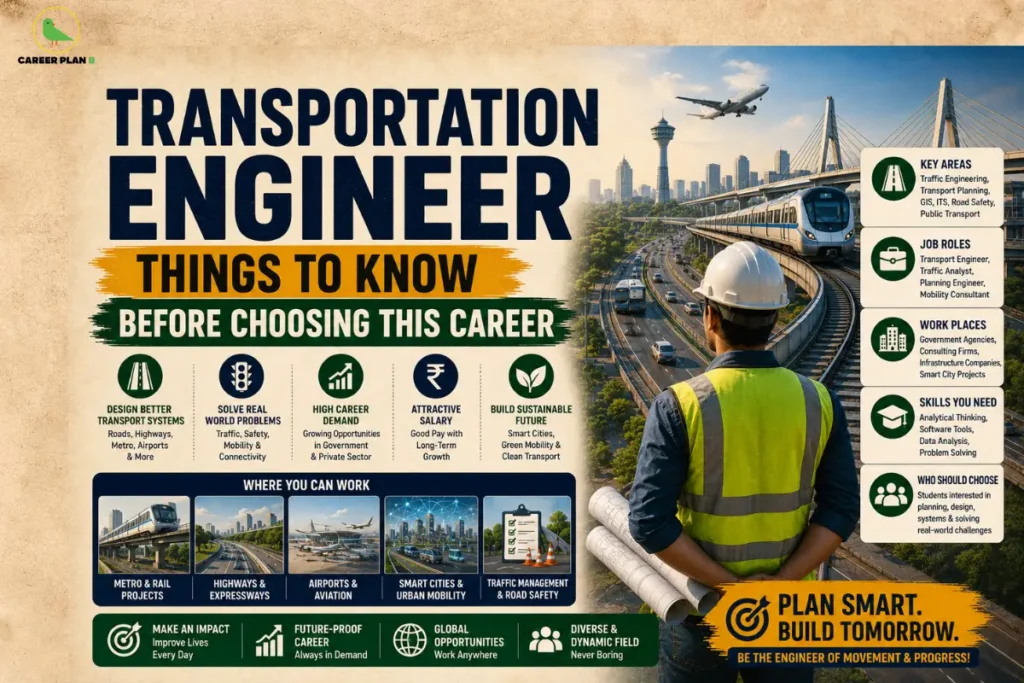
Introduction
Have you ever sat in bumper-to-bumper traffic and wondered who designed this road? Or looked at a flyover and thought about the mind behind it? If yes, you might already have the curiosity of a transportation engineer career and not even know it. Transportation engineering is one of the most impactful yet underrated branches of civil engineering. Every highway you drive on, every metro station you step into, and every airport runway you land on they are all the result of careful transportation engineering work. Yet, most students still know very little about this field before choosing it as a career.
What Does a Transportation Engineer Actually Do?
A transportation engineer career plans, designs, builds, and maintains systems that move people and goods safely and efficiently. This includes roads, highways, bridges, tunnels, railways, airports, and public transit systems.
On any given day, a transportation engineer might be:
- Analyzing traffic flow data to reduce congestion
- Designing safer intersections or pedestrian crossings
- Planning new metro corridors for a growing city
- Conducting environmental impact assessments for a highway project
- Coordinating with government bodies on urban mobility solutions
Types of Transportation Engineers
The field is broader than most people assume. Here are the major specialisations:
- Traffic Engineer – Focuses on managing and improving traffic flow
- Highway Engineer – Designs and maintains roads and expressways
- Rail and Transit Engineer – Works on metro, railway, and bus rapid transit systems
- Airport and Aviation Planner – Specialises in airside and landside airport infrastructure
- Urban Mobility Planner – Works on sustainable city transport systems
Educational Path: What Degree Do You Need?
The foundation of any transportation engineering career is a B.Tech or B.E. in civil engineering. Most universities in India offer transportation engineering as a specialisation within civil engineering at the postgraduate level.
Here is a typical academic path:
- 10+2 with Physics, Chemistry, Maths (PCM)
- B.Tech/B.E. in Civil Engineering (4 years)
- M.Tech in Transportation Engineering (optional but recommended for specialisation)
- GATE for admission to M.Tech at IITs and NITs
Skills You Need to Succeed in This Field
A strong transportation engineering career requires both technical and interpersonal skills. Here is what employers and government bodies look for:
Technical Skills
- Proficiency in AutoCAD, MicroStation, or Civil 3D
- Knowledge of traffic simulation software like VISSIM or SIDRA
- Understanding of GIS (Geographic Information Systems) for infrastructure planning
- Data analysis and statistical interpretation
- Familiarity with IRC (Indian Roads Congress)
Soft Skills Often Overlooked
Many students focus only on technical preparation and overlook these equally important transportation engineering skills:
- Strong written and verbal communication
- Team coordination across departments
- Problem-solving under time and budget pressure
- Adaptability to fieldwork environments
- Decision-making in high-stakes situations
Career Opportunities and Salary Outlook
This is where a transportation engineering career genuinely shines. The demand for skilled transportation engineer career in India is growing rapidly due to large-scale infrastructure projects under programmes like PM Gati Shakti and the National Infrastructure Pipeline.
Government Sector Civil Engineering Jobs
- National Highways Authority of India (NHAI)
- Ministry of Road Transport and Highways (MoRTH)
- Delhi Metro Rail Corporation (DMRC)
- Indian Railways (RailTel/RITES)
- State PWD (Public Works Department): Available through respective state government portals
Have Any Doubts?
Private Sector and Consultancies
Top firms like L&T, Afcons Infrastructure, AECOM India, and Jacobs Engineering regularly hire highway engineers and traffic specialists.
Salary Range
| Level | India (Per Annum) | Abroad (Per Annum) |
|---|---|---|
| Entry Level | ₹4–7 LPA | $55,000–$70,000 |
| Mid-Level | ₹9–15 LPA | $75,000–$95,000 |
| Senior Level | ₹18 LPA+ | $100,000+ |
Challenges No One Tells You About
Every career has a flip side. Here is what aspiring transportation engineers rarely hear before entering the field:
- Long project cycles: A single highway project can span 5–10 years from planning to completion
- Bureaucratic complexity: Government projects involve layers of approvals and clearances
- Fieldwork demands: Site visits in extreme weather conditions are a regular part of the job, especially during infrastructure planning phases
- Keeping up with urban mobility trends: With electric vehicles, smart traffic systems, and sustainable transit on the rise, engineers must continuously upskill
- Work-life balance: Deadline-heavy projects can mean irregular hours, especially near project milestones
Knowing these realities upfront helps you prepare mentally and professionally before committing to this path.
How Career Plan B Helps
Choosing the right engineering specialisation is not always straightforward. Career Plan B helps students and professionals navigate this decision with clarity. Whether you are unsure if transportation engineering suits your strengths, need guidance on selecting the right M.Tech programme, or want a structured career roadmap, Career Plan B offers personalised career counselling, Psycheintel Career Assessment Tests, and academic profile guidance to help you move forward with confidence. Their career roadmapping service is especially useful for engineering students exploring niche specialisations like transportation engineering.
For Latest Information
Frequently Asked Questions (FAQs)
- Is transportation engineering a good career in India?
Yes, absolutely. With India investing heavily in roads, metro networks, and smart city infrastructure, the demand for transportation engineers is growing steadily.
- What is the difference between a civil engineer and a transportation engineer?
Civil engineering is a broad field that includes structures, water resources, geotechnical work, and more. A transportation engineer career is a civil engineer who specialises in the planning, design, and management of transport systems and infrastructure.
- Do I need to study abroad to build a strong career?
Not necessarily. India has excellent institutions offering M.Tech. in transportation engineering, particularly IITs and NITs.
- What entrance exams are relevant for this field?
GATE (Civil Engineering) is the primary exam for M.Tech admissions at IITs and NITs.
Conclusion
Becoming a transportation engineer is not just about building roads; it is about shaping how millions of people move through cities and towns and across the country every day. It is a career that combines technical precision with real-world impact. If you have a passion for problem-solving, a curiosity about how infrastructure works, and the patience to handle complex, long-term projects, this career could be a deeply rewarding choice.
Before you take the leap, make sure you understand the full picture: the academic path, the skills required, the job landscape, and the challenges ahead. And if you want a personalised perspective on whether this path aligns with your strengths and goals, visit Career Plan B to explore their counselling and assessment services.