Team Career Plan B · September 7, 2026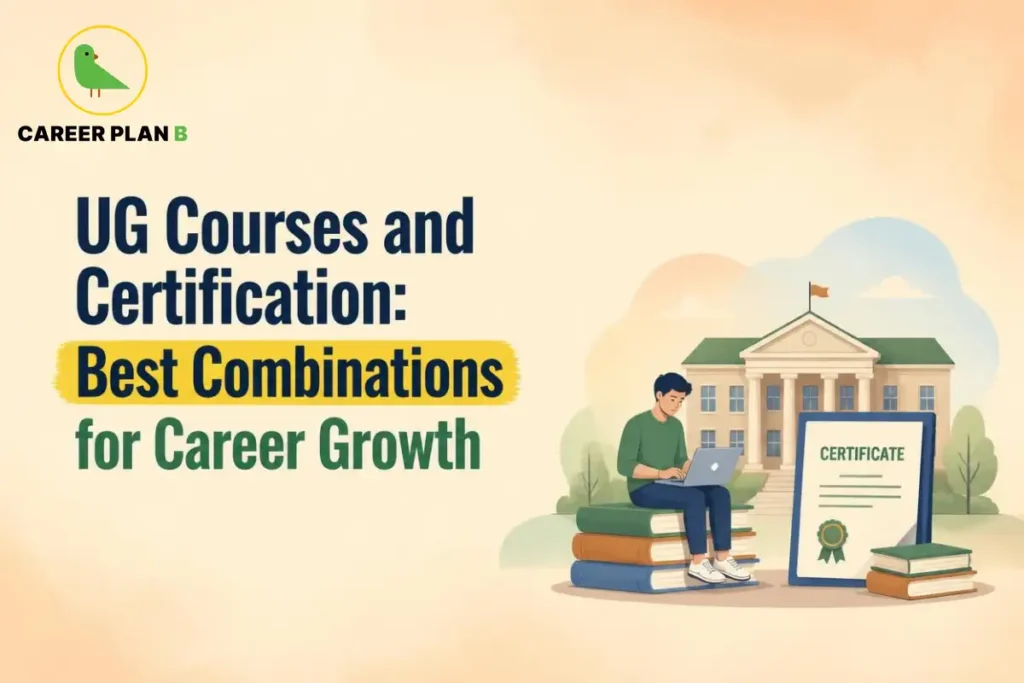
Introduction
Securing high-paying employment immediately after college graduation has become increasingly competitive across India. Consequently, pairing UG Courses and Certification programs has emerged as the most reliable strategy for ambitious students.
Many college entrants actively seek the best UG courses with certifications for career growth during their first year. Furthermore, students frequently evaluate the best degree and certification combinations for students to bridge college curricula with industry needs.
Higher education standards and degree accreditations across India are regulated by the University Grants Commission (UGC). Technical curricula and vocational frameworks are governed by the All India Council for Technical Education (AICTE). Additionally, sovereign online education and credit transfer programs operate through the SWAYAM Portal under the Ministry of Education (MoE). National skill development policies are led by the Ministry of Skill Development and Entrepreneurship (MSDE).
This comprehensive guide breaks down high-impact degree pairings, industry-endorsed certifications, academic credit rules, and corporate career opportunities.
The Value of Pairing UG Courses and Certification Programs
Traditional college lectures deliver foundational theoretical principles across conventional disciplines. However, campus curriculums often struggle to keep pace with rapid technological transformations in modern workplaces.
Pursuing an accredited UG degree with certification for better career opportunities addresses this specific institutional gap. By earning career boosting certifications, students demonstrate actionable technical competency to hiring managers from day one.
Moreover, recruiters prioritize candidates who build practical portfolios during their undergraduate studies. Consequently, earning a recognized degree with certification establishes a distinct competitive advantage during campus placement drives.
Why Choose a Degree Plus Certification Model Today?
Adopting a degree plus certification strategy changes how corporate interview panels assess your resume.
Standard undergraduate courses prove academic discipline, conceptual understanding, and consistent commitment over three to four years. Meanwhile, specialized job oriented courses demonstrate hands-on software fluency, execution speed, and practical problem-solving ability.
Furthermore, the National Education Policy and UGC guidelines now endorse parallel skill acquisition for enrolled undergraduates. As a result, students can complete skill based courses for students while fulfilling their regular semester requirements.
Therefore, combining theoretical knowledge with practical tools delivers optimal employment outcomes for young graduates.
Best Degree and Certification Combinations for Students
Selecting the best degree and certification combinations depends on your undergraduate academic stream:
| Undergraduate Degree Stream | Recommended Professional Certifications | Core Tools & Software Learned | High-Growth Target Roles |
|---|---|---|---|
| B.Tech / BCA (Computer Science) | AWS Solutions Architect, Microsoft Azure Fundamentals, Docker/Kubernetes | Linux CLI, Python, AWS Cloud, Git, Docker containers | Cloud Engineer, DevOps Trainee, Junior Backend Developer |
| B.Com / BBA (Commerce & Finance) | Certified Management Accountant (CMA), Financial Modeling, Tally Prime | Advanced Excel, Power BI, SQL, SAP FICO modules | Financial Analyst, Equity Research Associate, Junior Auditor |
| BBA / BMS (Marketing & Strategy) | Google Ads Search, Meta Certified Media Specialist, HubSpot Inbound | Google Analytics 4, SEMrush, Canva, CRM automation | Performance Marketer, Growth Associate, SEO Strategist |
| BA (Economics / Psychology / English) | Google Data Analytics Professional, Certified Associate in Project Management | Tableau, SQL, R programming, Agile Jira boards | Business Analyst, Policy Research Assistant, Content Strategist |
| B.Sc (Statistics / Mathematics / IT) | IBM Data Science Professional, Microsoft Certified Power BI Analyst | Python, Pandas, Tableau, Machine Learning algorithms | Data Scientist Trainee, Junior BI Developer, Quantitative Analyst |
Top Certifications to Complement Undergraduate Degree Programs
Finding the right certifications to complement undergraduate degree tracks requires evaluating industry demand:
Cloud Architecture & Cybersecurity
Cloud systems power modern enterprise operations globally. Therefore, earning AWS or Microsoft Azure credentials alongside technical undergraduate programs validates your infrastructure skills. Furthermore, these globally recognized credentials qualify students for high-paying remote cloud engineering roles.
Business Intelligence and Data Analytics
Every commercial sector now relies on data-backed decision processes. Consequently, pairing undergraduate degrees with SQL, Tableau, or Power BI certifications opens cross-disciplinary corporate pathways. Moreover, commerce and humanities students can transition into analytical corporate positions with these credentials.
Financial Modeling and Valuation
Relying solely on textbook accounting rarely satisfies corporate investment desks. In contrast, completing advanced spreadsheet modeling courses prepares students for boutique private equity and investment banking teams. Therefore, these credentials represent the best certification courses for ambitious commerce undergraduates.
How to Choose the Best Certifications to Pursue Alongside College
Selecting the best certifications to pursue alongside college requires careful analysis of curriculum relevance and personal bandwidth:
| Selection Criteria | Key Questions to Evaluate Before Enrolling | Best Academic Practice |
|---|---|---|
| Industry Accreditation | Does a recognized technology leader or statutory body back this credential? | Choose vendor-neutral or premier industry leaders (e.g., Google, Microsoft, AWS, NPTEL). |
| Hands-On Capstone Project | Does the coursework demand an independently developed portfolio project? | Avoid multiple-choice-only exams without portfolio outputs. |
| Semester Exam Alignment | Will weekly assignment schedules clash with your internal college exams? | Select self-paced learning programs during regular semester weeks. |
| Total Program Investment | Does the certification fee fit comfortably within your annual student budget? | Leverage free sovereign platforms like SWAYAM before buying private courses. |
Consequently, this structured evaluation ensures that your certifications alongside college produce maximum career returns without academic strain.
UGC Regulations on Pursuing Degree and Certification Simultaneously
Students frequently ask whether studying additional qualifications alongside full-time college violates university regulations.
Fortunately, statutory guidelines issued by the University Grants Commission officially permit dual learning tracks. Under current frameworks, college students can pursue:
- One full-time regular degree alongside an accredited online diploma or certificate.
- Two simultaneous academic programs, provided physical lecture timings do not clash.
- Up to 40% of standard semester course credits earned via approved SWAYAM online modules.
Therefore, building a UG degree with a certification profile is legally recognized and fully compliant with government standards.
Essential Certifications After 12th for Immediate Skill Upgrades
Ambitious school leavers do not need to wait until final-year campus drives to upskill. Enrolling in certifications after 12th during summer breaks establishes vital early technical momentum:
- Basic Full-Stack Development: Master responsive HTML5, CSS3, JavaScript, and GitHub repositories before semester lectures start.
- Modern Spreadsheet Analytics: Learn advanced formulas, pivot tables, and data visual dashboards in Microsoft Excel.
- Graphic and Visual Design: Master Figma and Adobe Creative Cloud to secure campus design internships early.
- English Business Communication: Develop formal corporate drafting, persuasive presentation, and technical writing skills.
As a result, completing these certifications for students builds noticeable confidence during early collegiate competitions.
For Personalized Guidance
Comparing Free vs Paid Professional Certifications
Evaluating course formats helps candidates maximize their educational budget:
| Feature / Metric | Sovereign Portals (e.g., SWAYAM / NPTEL) | Global Tech Platforms (e.g., Google, AWS, IBM) |
|---|---|---|
| Lecture Access Fee | 100% free lecture streaming and materials. | Subscription models or monthly course fees. |
| Examination Format | In-person proctored testing via authorized centers. | Online unproctored or remote webcam proctoring. |
| Academic Credit Transfer | Eligible for direct university credit transfer. | Valuable for industry resumes, rarely transferable for credits. |
| Industry Perception | Respected for rigorous academic and engineering depth. | Preferred by multinational recruiters for specific software stacks. |
Consequently, combining academic SWAYAM modules with global tech credentials delivers a well-rounded technical resume.
High-Growth Career Opportunities and Salary Scope
Graduates who complete structured career oriented courses secure higher starting salaries than peers with unadorned degrees:
| Professional Designation | Average Starting Package (Degree Only) | Starting Package (Degree + Certifications) |
|---|---|---|
| Junior Cloud Developer | ₹3,50,000 – ₹4,80,000 | ₹6,00,000 – ₹10,50,000 |
| Business Intelligence Analyst | ₹3,20,000 – ₹4,50,000 | ₹5,50,000 – ₹9,00,000 |
| Corporate Tax & Accounts Associate | ₹2,80,000 – ₹3,80,000 | ₹4,50,000 – ₹7,20,000 |
| Digital Performance Specialist | ₹2,50,000 – ₹3,60,000 | ₹4,20,000 – ₹6,80,000 |
| UI/UX Product Design Trainee | ₹3,00,000 – ₹4,20,000 | ₹5,00,000 – ₹8,50,000 |
Therefore, earning relevant professional certifications generates immediate, measurable financial return on investment.
How to Balance College Studies with Professional Certifications
Balancing college coursework with external certifications requires careful, consistent time management:
- Dedicate Fixed Daily Slots: Allocate forty-five to sixty minutes each morning to certification lectures before regular college classes begin.
- Build Portfolio Repositories: Apply weekly lesson concepts immediately by building independent projects on GitHub, Kaggle, or Behance.
- Utilize Semester Breaks: Schedule rigorous proctored examinations during summer or winter breaks when semester coursework is paused.
- Form Campus Study Cohorts: Collaborate with classmates pursuing similar technical credentials to share notes and stay accountable.
Following these practices ensures you earn credentials consistently without harming your university grade point average.
How Career Plan B Helps
Navigating thousands of online courses, evaluating industry credentials, and mapping certifications to career goals requires expert mentorship. Career Plan B assists ambitious college students across India through:
- Personalised Career Counselling: We evaluate your undergraduate degree, natural strengths, and long-term career aspirations. As a result, our mentors recommend the most profitable credential combinations tailored to your specific field.
- Psycheintel & Skill Assessments: Our scientific diagnostic evaluations identify whether your cognitive aptitudes align with data analytics, finance, software development, or corporate marketing. Consequently, you invest your study hours into high-yield specializations.
- Resume & Portfolio Audits: We review your technical project repositories, digital certifications, and case studies. Additionally, our mentors ensure your resume highlights your practical projects effectively for corporate recruiters.
- Career Roadmapping: Our mentorship extends far beyond course selection. Furthermore, we help you secure off-campus internships, prepare for technical interviews, and build competitive placement profiles.
Get In Touch With Us
Frequently Asked Questions
Q1. Can I earn university credits through online certification courses?
Yes, UGC regulations allow students to transfer up to 40% of their total semester credits using approved SWAYAM online courses.
Q2. Do certifications guarantee a job after graduation?
Certifications do not guarantee jobs on their own, but they help candidates clear automated resume screens and prove hands-on tool competency during interviews.
Q3. How many certifications should a college student complete?
Completing two to three high-quality, project-backed certifications throughout your degree is far more effective than accumulating numerous surface-level certificates.
Q4. Are free certifications valued by multinational corporations?
Yes, recruiters respect free courses from recognized providers like Google, Harvard CS50, and NPTEL, provided you demonstrate practical portfolio projects.
Q5. Can arts students pursue data analytics certifications?
Yes, data analytics tools like Excel, Tableau, and SQL do not require advanced coding or mathematics backgrounds.
Conclusion
Pairing UG courses with professional certifications can turn a traditional college education into a stronger career launchpad. While a degree builds essential academic knowledge and conceptual foundations, relevant certifications can help you develop practical, industry-focused skills that complement your chosen field.
With flexible learning options, students can pursue additional skill-based credentials alongside their degree, provided they meet the respective programme and institutional requirements. Starting early also gives you more time to build projects, gain practical experience, and develop a competitive professional portfolio.
Want to choose the right certification alongside your UG course? Connect with Career Plan B experts that can help you identify suitable certifications, align them with your career goals, and create a personalised skill-development roadmap.