Careerplanb · July 14, 2026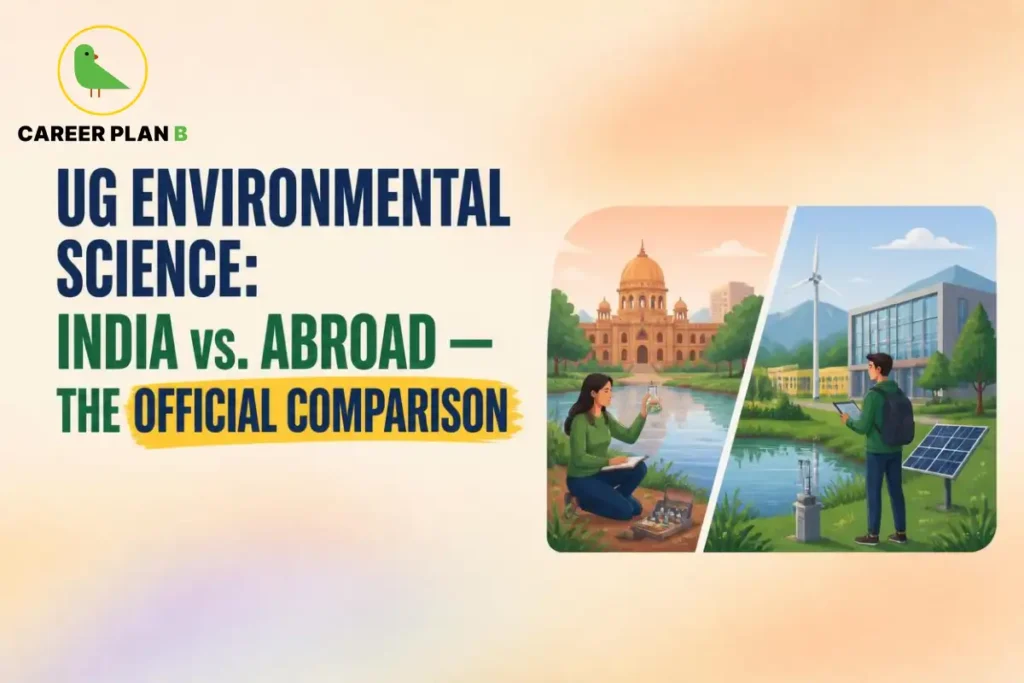
Introduction
Choosing between environmental science UG India vs abroad is an important decision for students interested in sustainability, climate change, and environmental policy. Environmental Science is one of the fastest-growing fields globally, driven by climate action, sustainability regulations, and corporate ESG initiatives. For Indian students, the choice involves two different official frameworks. Indian universities admit students primarily through the CUET system, while foreign qualifications must meet UGC and AIU equivalence requirements before they receive recognition in India. This guide explains how both frameworks work and what you should verify before making your decision.
Studying Environmental Science in India: The CUET Pathway
In India, a BSc in Environmental Science is offered as a regular undergraduate science degree at numerous central, state, and private universities. For central universities — including Delhi University, Jawaharlal Nehru University, Banaras Hindu University, and others — admission runs through CUET UG, conducted by the National Testing Agency (NTA)under the Department of Higher Education, Ministry of Education, Government of India. (Source: cuet.nta.nic.in)
Eligibility (general pattern, verify with specific university): Class 12 pass with Science subjects (typically Physics, Chemistry, Biology, or Physics, Chemistry, Mathematics), with the specific subject combination required varying by university and programme structure.
NTA’s role, as with all CUET-linked admissions, is limited to conducting the exam and declaring scores — eligibility, reservation, and final admission decisions rest entirely with each participating university, not NTA. (Source: NTA FAQs for CUET UG)
What Government-Backed Environmental Science Education Connects To
A degree from an Indian university positions you for direct entry into India’s environmental governance ecosystem, including:
- Central Pollution Control Board (CPCB) and State Pollution Control Boards
- Ministry of Environment, Forest and Climate Change (MoEFCC) and its attached offices
- Environmental impact assessment (EIA) consultancy roles, which require familiarity with Indian environmental law and regulatory frameworks specifically
Because these roles often require knowledge of India-specific environmental legislation (such as the Environment Protection Act, Water Act, Air Act, and the EIA Notification framework administered by MoEFCC), an Indian degree with India-specific coursework can offer a direct advantage for these particular career paths.
Studying Environmental Science Abroad: UGC’s Equivalence Framework Applies
If you choose to study environmental science abroad, your degree’s recognition in India is governed by the same general process that applies to any foreign qualification — there is no separate environmental-science-specific regulatory body for foreign equivalence.
The Official Verification Process
As per UGC’s standing advisory, contact the Association of Indian Universities (AIU) — AIU House, 16, Comd. Indrajit Gupta Marg (Kotla Marg), New Delhi – 110002, aiuweb.org — to verify accreditation status and equivalence potential of your shortlisted foreign institution before enrolling.
Equivalence itself is governed by the UGC (Recognition and Grant of Equivalence to Qualifications obtained from Foreign Educational Institutions) Regulations, 2025, which evaluate curricular content similarity — background courses, disciplinary core courses, electives, cross-disciplinary courses, and laboratory/field components — rather than just the degree title or duration. (Source: UGC — Draft Equivalence Regulations: ugc.gov.in/pdfnews/0348616_Draft_Equivalence_Regulations.pdf)
For environmental science specifically, field work and laboratory components documented clearly in your transcript matter for this evaluation, since environmental science is inherently a field-and-lab-heavy discipline.
Key exclusions to note: (Source: UGC — Draft Equivalence Regulations)
- Online/distance-mode environmental science degrees are not covered under UGC’s equivalence regulations
- Degrees completed via Home Studies/Private Candidate status are not eligible
- UGC can withdraw a previously granted Equivalence Certificate if false information was used
Side-by-Side Comparison
| Factor | India (CUET-based) | Abroad (General UGC Equivalence Framework) |
|---|---|---|
| Admission Process | Admission is based on CUET UG conducted by NTA, followed by university-specific counselling. | Each institution follows its own admission process. There is no centralised Indian entrance exam. |
| Degree Recognition in India | Recognition is automatic because an Indian university awards the degree. | Students should verify recognition independently through AIU or UGC. Recognition is not automatic. |
| Curriculum Focus | Programmes often emphasise Indian environmental law, policy, and regulatory frameworks. | Programmes usually focus on the destination country’s environmental regulations along with global and comparative perspectives. |
| Career Fit for Indian Government Roles | Provides strong preparation for roles in organisations such as CPCB and MoEFCC. | Graduates may need additional knowledge of Indian environmental laws and regulations. |
| Field and Laboratory Documentation | No separate equivalence documentation is normally required for Indian degrees. | Maintain detailed transcripts showing fieldwork and laboratory training to support any future equivalence assessment. |
| Cost | Government universities are generally more affordable. | Costs vary by country and institution but are generally higher. |
A Regulated Middle Path: UGC’s Twinning and Dual Degree Framework
If you want meaningful international exposure in environmental science while retaining a stronger India-recognition pathway, UGC’s Academic Collaboration between Indian and Foreign Higher Educational Institutions (Twinning, Joint Degree and Dual Degree Programmes) Regulations, 2022 allow approved Indian institutions to formally partner with foreign universities for collaborative degree structures. (Source: UGC — ugc.gov.in)
UGC publishes a list of eligible Indian institutions approved for such partnerships — check this list to see if any environmental science-relevant collaborations are currently approved, rather than relying solely on independent foreign enrolment. (Source: UGC — ugc.gov.in)
How Career Plan B Helps
Environmental science careers branch in genuinely different directions depending on whether you’re targeting Indian government/regulatory roles, international NGOs, corporate sustainability/ESG functions, or academic research — and the India-vs-abroad decision should follow from that target, not precede it. Career Plan B offers personalised career counselling, Psycheintel and career assessment tests to clarify which environmental science career track suits you, admission and academic profile guidance for CUET preparation or foreign institution verification via UGC’s framework, and career roadmapping to connect your undergraduate choice to your specific environmental career goals.
Get In Touch With Us
Frequently Asked Questions
01. Which exam do I need for Environmental Science admission at Indian central universities?
CUET UG, conducted by NTA. Final admission and eligibility criteria are set independently by each participating university. (Source: cuet.nta.nic.in)
02. Will a foreign Environmental Science degree be automatically recognised in India?
No. You must verify equivalence through AIU under UGC’s framework — recognition is not automatic for any foreign qualification.
03. Does an Indian Environmental Science degree give an advantage for government roles like CPCB?
Generally yes, since Indian degree programmes often include coursework on India-specific environmental legislation and regulatory frameworks directly relevant to these roles.
04. Are online Environmental Science degrees from abroad eligible for UGC equivalence?
No. UGC’s equivalence regulations explicitly exclude online and distance education modes. (Source: UGC — Draft Equivalence Regulations)
05. Is there a UGC-regulated way to study Environmental Science partly abroad?
Yes — UGC’s Twinning, Joint Degree, and Dual Degree Programme Regulations 2022 allow approved Indian institutions to offer collaborative programmes with foreign universities. Check UGC’s official list of eligible institutions. (Source: UGC — ugc.gov.in)
Have Any Doubts?
Conclusion
Environmental science in India, via CUET-based admission, offers a direct, automatically-recognised pathway with strong alignment to Indian government and regulatory career tracks. Studying abroad can offer broader global exposure but requires independent equivalence verification through AIU under UGC’s framework before you can be confident the degree will be formally recognised in India. Choose based on your target career — Indian regulatory/government roles favour the domestic route, while international NGO, research, or corporate sustainability roles may favour international exposure, provided you verify equivalence carefully.
For guidance on which environmental science career track and educational pathway fits your goals, [get personalised admission support from Career Plan B].