Team6 · July 15, 2026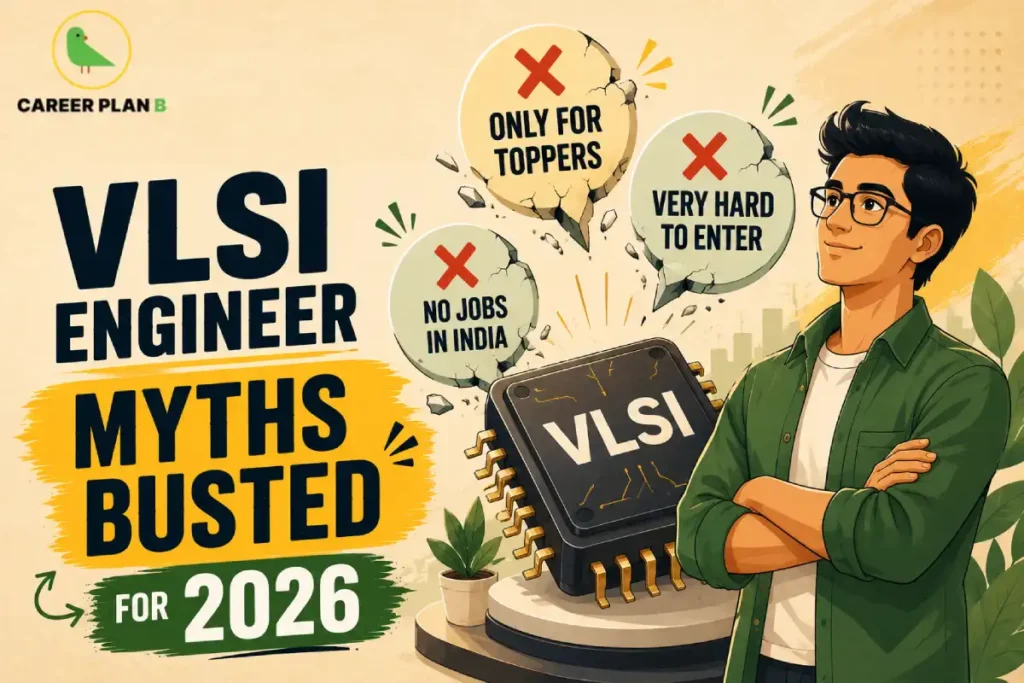
Introduction
Every time you make a phone call, stream a video, or use GPS, a tiny chip is working silently behind the scenes. That chip was designed by a VLSI engineer. Yet despite being at the heart of nearly every modern device, VLSI engineering remains one of the most misunderstood career paths in India.
The myths about becoming a VLSI engineer are everywhere in college corridors, on online forums, and even in well-meaning advice from seniors. These myths stop thousands of talented students from exploring one of the most rewarding and future-proof careers in technology.
Here is the truth: India is in the middle of a semiconductor revolution. The Government of India has committed ₹76,000 crore under the Semicon India Programme to build a thriving domestic semiconductor ecosystem. Companies like Intel, Qualcomm, Texas Instruments, and Samsung are actively expanding their India design centres. The demand for skilled VLSI professionals has never been higher.
So before a myth costs you a brilliant career, let us set the record straight.
What Is VLSI Engineering, And Why Does It Matter?
VLSI stands for Very Large Scale Integration, the process of designing and fabricating integrated circuits (ICs) by combining millions of transistors onto a single chip.
VLSI engineers work at the core of industries like consumer electronics, telecommunications, defence, automotive technology, and space research. Without VLSI, there are no smartphones, no laptops, no satellites, and no AI chips.
In short, it is the foundation of the entire digital world.
Common Myths About Becoming a VLSI Engineer
Let us tackle the most damaging myths about becoming a VLSI engineer one by one.
Myth 1: Only ECE Students Can Enter VLSI
This is perhaps the most widespread myth. Many EEE, instrumentation, and even computer science students assume VLSI is off-limits for them.
The Truth: While Electronics and Communication Engineering (ECE) is the most direct route, EEE and instrumentation graduates regularly transition into VLSI with the right upskilling. Even CS graduates with a strong interest in digital design and hardware description languages can break into VLSI verification and design automation roles.
What matters is your foundational knowledge and your willingness to learn, not just your branch name on a degree certificate. VLSI skills required cut across disciplines.
Myth 2: You Need a Master’s Degree to Get a VLSI Job
Many students believe a postgraduate degree is the only ticket into the VLSI industry.
The Truth: A large number of VLSI companies hire B.Tech graduates directly provided they have the right skills, certifications, and project experience. In fact, the right VLSI course after B.Tech, such as certification programmes in Verilog, VLSI design flow, or physical design, can open doors faster than waiting years for a master’s degree.
That said, an M.Tech or MS can accelerate your growth into senior design roles. It is an advantage, not a requirement.
Myth 3: VLSI Is Too Difficult to Learn
The mention of transistor-level design, timing analysis, and EDA tools intimidates many students into believing VLSI is only for “exceptional” engineering minds.
The Truth: VLSI, like any specialised domain, has a learning curve. But it is absolutely learnable with the right structured approach. Start with digital logic design, then move to HDL programming (Verilog/VHDL), then progress to EDA tools and physical design. Thousands of engineers have followed this path successfully.
Difficulty is often just unfamiliarity. Give it time and the right resources.
Myth 4: VLSI Has Very Few Job Opportunities in India
This myth may have had some truth a decade ago. Today, it is completely outdated.
The Truth: India’s semiconductor ambitions are enormous and government-backed. The India Semiconductor Mission (ISM), set up under the Ministry of Electronics and Information Technology (MeitY), is leading the country’s push to become a global semiconductor hub.
VLSI jobs in India are growing rapidly across Bengaluru, Hyderabad, Pune, Chennai, and Noida. Major employers include Intel, Qualcomm, Texas Instruments, Samsung Semiconductor, Nvidia, Micron, and ISRO, all of which have significant design and R&D centres in India.
Myth 5: VLSI Engineers Have a Low Salary
Many students compare VLSI salaries to software roles and assume they fall short.
The Truth: A VLSI engineer’s salary in India is among the highest in core engineering, and it grows steeply with experience.
| Experience Level | Average Annual Salary (INR) |
|---|---|
| Fresher (0–2 years) | ₹4 LPA – ₹8 LPA |
| Mid-Level (3–6 years) | ₹10 LPA – ₹20 LPA |
| Senior (7+ years) | ₹22 LPA – ₹40 LPA+ |
At top MNCs like Qualcomm and Nvidia, senior VLSI engineers often earn well above ₹50 LPA. Internationally, VLSI engineers in the USA earn between $1,00,000 and $1,60,000 annually, as reported by the U.S. Bureau of Labour Statistics Is VLSI a good career from a financial standpoint? The numbers say a clear yes.
Myth 6: VLSI Is a Dying Field Because of AI
With artificial intelligence dominating headlines, some believe traditional engineering fields like VLSI are becoming irrelevant.
The Truth: This is perhaps the most ironic myth of all. AI is actually one of the biggest drivers of VLSI demand. Every AI model from ChatGPT to autonomous vehicles runs on specialised chips. Designing those chips requires VLSI engineers. Edge computing, IoT devices, 5G infrastructure, and electric vehicles are all fuelling unprecedented demand for chip designers.
VLSI is not dying. It is evolving and growing faster than ever.
Myth 7: You Must Be From IIT or NIT to Get a VLSI Job
The brand-name college myth plagues almost every engineering specialisation in India.
The Truth: Top VLSI companies hire based on skills, project work, and internship experience, not just college names. A student from a tier-2 college who has hands-on experience with EDA tools, a strong understanding of digital design, and relevant certifications is far more employable than an IIT graduate who cannot write a basic Verilog module.
Your skills are your real resume in a VLSI engineering career in India.
Have Any Doubts?
What Skills Do You Actually Need to Become a VLSI Engineer?
Now that the myths are out of the way, here is what genuinely matters in how to become a VLSI engineer:
- HDL Programming: Verilog and VHDL are non-negotiable for digital design roles
- EDA Tools: Cadence, Synopsys, and Mentor Graphics are industry standards
- Digital Circuit Design: Combinational and sequential logic, timing, and clock domains
- Physical Design: Floorplanning, placement, routing, and timing closure
- Verification: UVM, SystemVerilog, and functional verification skills are in huge demand
- Programming: Python and C are useful for scripting and test environments
- Semiconductor Basics: Understanding of CMOS technology and device physics
How Career Plan B Helps
If you are an ECE, EEE, or related engineering student trying to navigate your way into VLSI, having the right guidance can save you years of confusion.
Career Plan B offers personalised career counselling to help you assess whether a VLSI engineering career in India aligns with your aptitude and interests. Their Psycheintel Career Assessment Tests go beyond grades to identify your true strengths. For students unsure about VLSI course after B.Tech options, Career Plan B provides structured course and certification guidance, helping you understand what to learn and in what order. Their Career Roadmapping service helps you build a clear, step-by-step path from your current position to your first VLSI job or a postgraduate programme abroad.
For Latest Information
Frequently Asked Questions (FAQs)
1. Can a non-ECE student get into VLSI?
Yes, EEE, instrumentation, and even CS students can enter VLSI, especially in verification, design automation, and embedded hardware roles, with the right upskilling and certifications.
2. Is VLSI a good career in India in 2025?
Absolutely. With India’s government-backed semiconductor mission and major global companies expanding their India design centres, VLSI jobs in India are growing steadily. It is one of the most future-proof careers in engineering.
3. What is the average VLSI engineer salary in India?
Freshers typically earn ₹4 LPA to ₹8 LPA. Mid-level engineers earn ₹10 LPA to ₹20 LPA, and senior professionals can earn ₹22 LPA to ₹40 LPA or more at top MNCs.
4. Which companies hire VLSI engineers in India?
Intel, Qualcomm, Texas Instruments, Samsung Semiconductor, Nvidia, Micron, Marvell, MediaTek, and ISRO are among the top employers of VLSI engineers in India.
5. What is the best VLSI course after B.Tech?
Courses in Verilog/VHDL, digital design, physical design, and VLSI verification from platforms like NIELIT, Maven Silicon, or university-affiliated programmes are well-regarded. Always prioritise hands-on tool experience.
6. Do I need a master’s degree to work as a VLSI engineer?
Not necessarily. Many companies hire B.Tech graduates with strong skills and relevant project experience. A postgraduate degree helps for senior or research-focused roles but is not a mandatory first step.
Conclusion
The myths about becoming a VLSI engineer have done enough damage. They have pushed talented students away from a field that is not only thriving but is also critical to India’s technological future.
The reality is clear: VLSI is accessible, rewarding, and growing. You do not need to be an IITian, hold a master’s degree, or have a photographic memory. You need curiosity, the right skills, and a structured plan.
If you are ready to explore a VLSI engineering career in India but are not sure where to begin, let Career Plan B help you cut through the noise and build a plan that actually works.
After all, the chip powering your future career was designed by someone who refused to believe the myths. Will you be next?