Team2 · May 9, 2026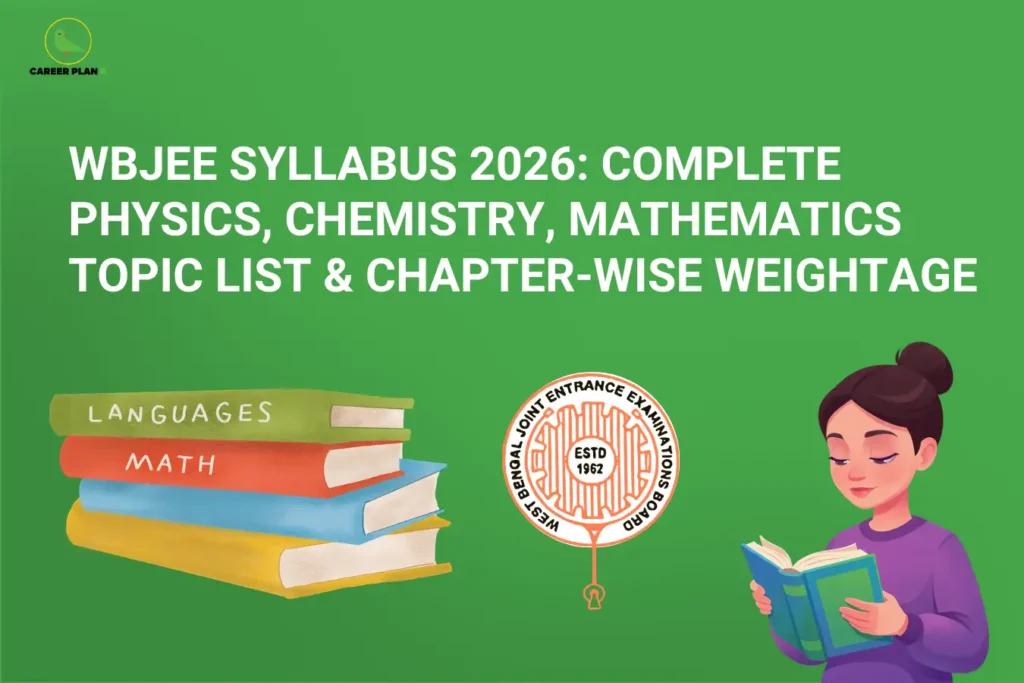
Introduction
Imagine sitting down to study for one of West Bengal’s most competitive engineering entrance exams — but without a map. You open your textbooks, stare at hundreds of pages, and wonder: Where do I even begin?
That’s exactly the problem thousands of WBJEE aspirants face every year. And it’s a problem that costs marks, time, and confidence.
Here’s a reality check: WBJEE 2026 will test you across 83 chapters spanning Physics, Chemistry, and Mathematics. Not every chapter carries the same weight. Not every topic deserves equal time. Knowing what to study and how much to prioritise is the difference between a rank in the top 500 and one in the top 5,000.
This guide gives you everything — the complete WBJEE syllabus 2026 broken down subject by subject, chapter-wise expected question distribution, a comparison with JEE Main, and a clear roadmap to plan your preparation intelligently.
Whether you’re just starting out or refining your strategy in the final months, this is the only WBJEE syllabus guide you’ll need.
What Is the WBJEE Syllabus 2026 Based On?
The West Bengal Joint Entrance Examination (WBJEE) syllabus is set by the West Bengal Joint Entrance Examinations Board (WBJEEB). The syllabus closely follows the NCERT curriculum for Classes 11 and 12, with some state board additions.
The exam covers three subjects:
- Physics — 40 questions (Paper 1)
- Chemistry — 40 questions (Paper 1)
- Mathematics — 75 questions (Paper 2)
Total: 155 questions | 200 marks
The paper is divided into three categories:
- Category 1: 1 mark per correct answer, –¼ negative marking
- Category 2: 2 marks per correct answer, –½ negative marking
- Category 3: 2 marks, no negative marking (multiple correct answers possible)
Understanding the syllabus in this context helps you not just learn topics but also strategise around the marking scheme.
WBJEE Physics Syllabus 2026: Chapter-Wise Breakdown & Weightage
Physics in WBJEE tests both conceptual clarity and numerical problem-solving. The subject has 24 chapters spread across Class 11 and 12 topics.
Class 11 Physics Chapters
| Chapter | Expected Questions | Weightage |
|---|---|---|
| Physical World & Measurement | 1 | Low |
| Kinematics | 2 | Medium |
| Laws of Motion | 2–3 | Medium |
| Work, Energy & Power | 2 | Medium |
| Motion of System of Particles & Rigid Body | 1–2 | Medium |
| Gravitation | 1 | Low |
| Properties of Bulk Matter | 1–2 | Medium |
| Thermodynamics | 2–3 | Medium |
| Kinetic Theory of Gases | 1 | Low |
| Oscillations & Waves | 1–2 | Medium |
Class 12 Physics Chapters
| Chapter | Expected Questions | Weightage |
|---|---|---|
| Electrostatics | 2–3 | Medium |
| Current Electricity | 3–4 | High |
| Magnetic Effects of Current & Magnetism | 2–3 | Medium |
| Electromagnetic Induction & AC | 3–4 | High |
| Electromagnetic Waves | 1 | Low |
| Optics (Wave + Ray) | 3–4 | High |
| Dual Nature of Matter & Radiation | 1–2 | Medium |
| Modern Physics (Atoms & Nuclei) | 2–3 | Medium–High |
| Semiconductor Electronics | 1–2 | Medium |
| Communication Systems | 1 | Low |
High-Priority Physics Chapters for WBJEE 2026
If you’re short on time, these are the chapters that give you the highest return on investment:
- Current Electricity — Kirchhoff’s laws, Wheatstone bridge, resistivity, potentiometer
- Electromagnetic Induction & Alternating Current — Faraday’s law, self and mutual inductance, LCR circuits, resonance
- Optics — Interference, diffraction, polarisation, mirrors, lenses, refraction
- Thermodynamics — Laws of thermodynamics, Carnot cycle, heat engines
- Laws of Motion — Newton’s laws, friction, circular motion
Tip: In WBJEE, numerical problems from Current Electricity and Optics are almost guaranteed every year. Master the formulas and practice at least 50 problems per chapter.
WBJEE Chemistry Syllabus 2026: Chapter-Wise Breakdown & Weightage
Chemistry is split into Physical, Organic, and Inorganic streams. With 37 chapters, it’s the most voluminous subject in the WBJEE syllabus – but also the most scoring if approached systematically.
Physical Chemistry Chapters
| Chapter | Expected Questions | Weightage |
|---|---|---|
| Some Basic Concepts of Chemistry | 1 | Low |
| States of Matter | 1–2 | Medium |
| Atomic Structure | 2 | Medium |
| Chemical Bonding & Molecular Structure | 2–3 | High |
| Chemical Thermodynamics | 2–3 | High |
| Solutions | 1–2 | Medium |
| Equilibrium | 2 | Medium |
| Redox Reactions | 1 | Low |
| Chemical Kinetics | 2–3 | High |
| Electrochemistry | 1–2 | Medium |
| Surface Chemistry | 1 | Low |
Organic Chemistry Chapters
| Chapter | Expected Questions | Weightage |
|---|---|---|
| Basic Organic Chemistry & Hydrocarbons | 2 | Medium |
| Haloalkanes & Haloarenes | 1–2 | Medium |
| Alcohols, Phenols & Ethers | 2–3 | High |
| Aldehydes, Ketones & Carboxylic Acids | 3–4 | High |
| Amines | 2–3 | High |
| Biomolecules | 1 | Low |
| Polymers | 1 | Low |
| Chemistry in Everyday Life | 1 | Low |
| Environmental Chemistry | 1 | Low |
Inorganic Chemistry Chapters
| Chapter | Expected Questions | Weightage |
|---|---|---|
| Classification of Elements (Periodic Table) | 1–2 | Medium |
| Hydrogen | 1 | Low |
| s-Block Elements | 1 | Low |
| p-Block Elements | 2–3 | High |
| d- and f-Block Elements | 2–3 | High |
| Coordination Compounds | 2–3 | High |
| Metallurgy (General Principles) | 1 | Low |
High-Priority Chemistry Chapters for WBJEE 2026
- Aldehydes, Ketones & Carboxylic Acids — Named reactions, mechanisms, conversions
- Amines — Structure, basicity, reactions, diazonium salts
- Coordination Compounds — IUPAC naming, Werner’s theory, isomerism, VBT/CFT
- Chemical Thermodynamics — Hess’s law, entropy, Gibbs energy
- Chemical Bonding — VSEPR, hybridisation, MO theory, dipole moments
- d- and f-Block Elements — Electronic configurations, oxidation states, properties
Organic Chemistry named reactions are a WBJEE favourite. Make a dedicated notebook of all named reactions – Aldol Condensation, Cannizzaro, Hoffmann Bromamide, etc.
WBJEE Mathematics Syllabus 2026: Chapter-Wise Breakdown & Weightage
Mathematics is the most heavily weighted subject in WBJEE, carrying 75 questions out of 155 total. It is also the area where students can maximise their rank if they prepare smartly.
The Mathematics syllabus has 22 chapters and is heavily Calculus-focused.
Algebra Chapters
| Chapter | Expected Questions | Weightage |
|---|---|---|
| Logarithms | 1 | Low |
| Quadratic Equations | 2–3 | High |
| Matrices & Determinants | 3–4 | High |
| Permutations & Combinations | 1–2 | Medium |
| Probability | 2–3 | High |
| Complex Numbers | 2 | Medium |
| Sequences & Series (AP, GP) | 1–2 | Medium |
| Sets & Relations | 1 | Low |
| Binomial Theorem | 1–2 | Medium |
Calculus Chapters
| Chapter | Expected Questions | Weightage |
|---|---|---|
| Differential Calculus (Limits & Continuity) | 3–4 | High |
| Differentiation | 4–5 | Highest |
| Application of Derivatives | 3–4 | High |
| Indefinite Integration | 3–4 | High |
| Definite Integration | 3–4 | High |
| Differential Equations | 2–3 | High |
Coordinate Geometry & Others
| Chapter | Expected Questions | Weightage |
|---|---|---|
| Straight Lines | 2 | Medium |
| Circles | 2–3 | High |
| Conic Sections (Parabola, Ellipse, Hyperbola) | 2–3 | Medium–High |
| 3D Geometry | 2–3 | High |
| Vectors | 2–3 | High |
| Trigonometry | 2–3 | High |
| Statistics | 1 | Low |
High-Priority Mathematics Chapters for WBJEE 2026
- Differentiation & Application of Derivatives — Chain rule, maxima-minima, monotonicity, tangents
- Integration (Definite & Indefinite) — Standard forms, substitution, by parts, properties
- Matrices & Determinants — Operations, inverse, solving linear equations
- Probability — Bayes’ theorem, conditional probability, distributions
- Vectors & 3D Geometry — Dot/cross product, lines and planes in space
- Circles & Conics — Equations, tangent-normal, chord of contact
Calculus alone accounts for approximately 40% of all Mathematics questions in WBJEE. If you master Differentiation and Integration, you’ve essentially secured the Mathematics paper.
Class 11 vs Class 12 WBJEE Syllabus: Question Distribution
One of the most overlooked aspects of WBJEE 2026 preparation is understanding how much of the exam comes from each class. Here’s a general breakdown:
| Subject | Class 11 Contribution | Class 12 Contribution |
|---|---|---|
| Physics | ~40% | ~60% |
| Chemistry | ~35% | ~65% |
| Mathematics | ~30% | ~70% |
Key insight: Class 12 topics dominate WBJEE. However, Class 11 concepts like Laws of Motion, Chemical Equilibrium, and Sequences & Series form the foundation for Class 12 chapters. Neglecting Class 11 entirely is a mistake.
WBJEE Syllabus vs JEE Main Syllabus: How Much Overlap Is There?
A very common question among students is, “If I’m preparing for JEE Main, do I need separate preparation for WBJEE?”
The honest answer: Not really — with a few additions.
There is approximately 85% overlap between the two syllabi. Here’s a comparison of key chapters:
| Topic | JEE Main | WBJEE |
|---|---|---|
| Calculus (Differentiation, Integration) | ✅ | ✅ |
| Matrices & Determinants | ✅ | ✅ |
| Organic Chemistry (Alcohols, Aldehydes, Amines) | ✅ | ✅ |
| Coordination Compounds | ✅ | ✅ |
| Current Electricity | ✅ | ✅ |
| Electromagnetic Induction | ✅ | ✅ |
| Modern Physics | ✅ | ✅ |
| Sets, Relations & Functions | ✅ | ✅ (higher depth) |
| Logarithms (as standalone) | ❌ | ✅ |
| Statistics (deeper coverage) | ❌ | ✅ |
| Communication Systems (minimal) | ✅ | ✅ (low weight) |
Have Any Doubts?
What WBJEE Has That JEE Main Doesn’t Emphasise
- Logarithms as a standalone chapter with direct questions
- Deeper Statistics coverage, including data interpretation
- State board additions in certain Inorganic Chemistry topics
Bottom line: If you’re a JEE Main aspirant, WBJEE requires only 2–3 weeks of additional focused preparation on the gap topics. Most of your preparation transfers directly.
WBJEE 2026 Official Syllabus PDF: Where to Download
The official WBJEE syllabus 2026 PDF is released by the West Bengal Joint Entrance Examinations Board. You can download it from:
🔗 Official Website: https://wbjeeb.nic.in/
Steps to download:
- Visit the official WBJEEB website
Click on “WBJEE 2026” under the Examination tab
- Select “Syllabus” from the dropdown
- Download the PDF for Physics, Chemistry, and Mathematics
Always cross-check your study material against the official syllabus PDF, especially if you’re using older editions of reference books.
Tip: Bookmark the official site and check regularly for any syllabus updates or exam date notifications for WBJEE 2026.
Smart Topic Prioritisation Strategy for WBJEE 2026
Knowing the syllabus is step one. Knowing how to attack it is step two. Here’s a priority framework based on chapter weightage, difficulty, and scoring potential:
Tier-1: High Weightage + Moderate Difficulty (Attempt First)
- Mathematics: Differentiation, Integration, Matrices, Probability
- Physics: Current Electricity, Optics, Electromagnetic Induction
- Chemistry: Aldehydes & Ketones, Amines, Coordination Compounds, Chemical Bonding
Tier-2: Medium Weightage + Conceptual Foundation (Attempt Second)
- Mathematics: Vectors, 3D Geometry, Circles, Quadratic Equations
- Physics: Thermodynamics, Laws of Motion, Modern Physics
- Chemistry: Chemical Thermodynamics, Kinetics, p-Block Elements, Organic Mechanisms
Tier-3: Low Weightage + Quick Revision (Attempt Last)
- Mathematics: Logarithms, Statistics, Binomial Theorem
- Physics: Communication Systems, EM Waves, Kinetic Theory
- Chemistry: Environmental Chemistry, Biomolecules, Polymers
This three-tier strategy ensures you’re not spending equal time on unequal chapters. Scoring in WBJEE is about smart allocation, not sheer volume of study hours.
How Career Plan B Helps
Navigating the WBJEE syllabus alone can feel overwhelming.
- Career Plan B simplifies this journey with personalized career counselling to help you identify your strengths and build a subject-wise strategy.
- Through Psycheintel and Career Assessment Tests, students gain clarity on aptitude and learning styles.
- Whether you need admission and academic profile guidance for engineering colleges or a complete career roadmap from Class 11 through entrance results — Career Plan B is your structured support system every step of the way.
For Any Queries
FAQ: WBJEE Syllabus 2026
Q1. Is the WBJEE 2026 syllabus the same as 2025?
The WBJEE syllabus remains largely consistent year to year. However, always verify against the official WBJEEB notification for 2026 to confirm there are no updates or additions, particularly in the Mathematics section.
Q2. How many chapters are there in the WBJEE syllabus in total?
The total WBJEE syllabus covers approximately 83 chapters — 24 in Physics, 37 in Chemistry, and 22 in Mathematics. Not all chapters carry equal weight, so chapter-wise prioritisation is essential.
Q3. Which subject has the highest weightage in WBJEE?
Mathematics carries the highest weightage with 75 questions out of 155 total, followed by Physics and Chemistry with 40 questions each. Within Mathematics, Calculus is the single most important area.
Q4. Is NCERT enough for WBJEE 2026 preparation?
NCERT forms a strong foundation, especially for Chemistry. However, for Physics numericals and Mathematics problems, you’ll need additional reference books like H.C. Verma, D.C. Pandey, and S.L. Loney for Trigonometry and Coordinate Geometry.
Q5. Can JEE Main preparation cover the WBJEE syllabus?
Yes, to a large extent. There is roughly 85% overlap between the two syllabi. WBJEE-specific additions include standalone Logarithms, deeper Statistics, and some state board Chemistry topics. A focused 2–3 week gap revision is sufficient for most JEE Main aspirants.
Q6. Which are the most scoring chapters in WBJEE Mathematics?
The most scoring Mathematics chapters are Differentiation, Definite Integration, Matrices & Determinants, Probability, and Vectors — collectively accounting for close to 50% of the Mathematics paper.
Conclusion
The WBJEE syllabus 2026 isn’t just a list of topics — it’s a blueprint for your rank. Every chapter has a role, every weightage tells a story, and every hour of preparation should be guided by data, not guesswork.
To recap the key takeaways:
- Mathematics is your rank-maker — prioritise Calculus above everything
- Chemistry Organic section (Aldehydes, Amines, Alcohols) is high-yield and very learnable
- Physics scoring hinges on Current Electricity, Optics, and Electromagnetic Induction
- Class 12 topics dominate but Class 11 foundations are non-negotiable
- JEE Main aspirants need only a small additional push to cover WBJEE gaps
Start with the Tier 1 chapters, build momentum, and layer in Tier 2 and Tier 3 as your confidence grows. Consistent, chapter-wise preparation — guided by the official syllabus — is what separates toppers from the rest.
Your WBJEE 2026 rank is built today, not the night before the exam.
Download the official syllabus PDF from WBJEEB’s website, mark your priority chapters, and begin. If you need a personalised plan or expert guidance on which colleges to target based on your expected rank, Connect with Career Plan B.