Team Career Plan B · July 18, 2026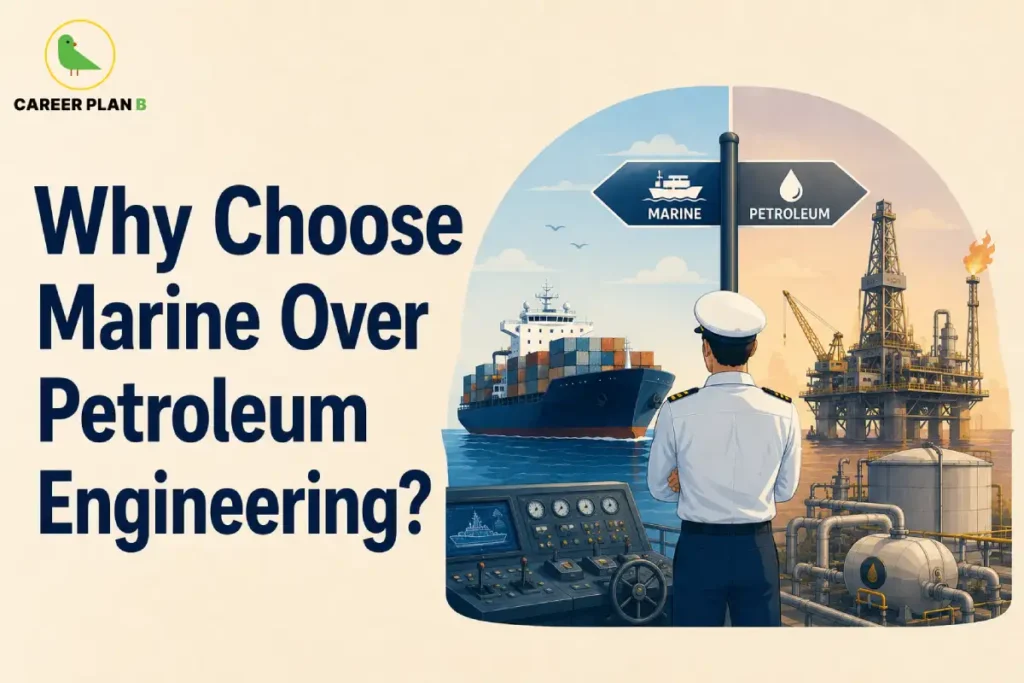
Introduction
Both fields offer adventure, technical depth, and strong early-career pay. They also involve working with heavy machinery in demanding environments. However, when considering why choose marine over petroleum engineering, one key difference stands out. Petroleum engineering depends on a resource that the world is gradually moving away from. Marine engineering, in contrast, supports global shipping and trade, which countries cannot simply phase out.
Petroleum engineering still offers genuine strengths, and this comparison should acknowledge them fairly. However, if you’re comparing marine vs petroleum engineering for long-term career resilience, marine engineering may have a structural advantage. Understanding this difference can help you make a more informed choice before committing to either career path.
The Core Difference: Demand That Isn’t Going Anywhere
Here’s the central argument: over 90% of global trade by volume moves by sea. International shipments of phones, car parts, garments, and food depend heavily on ships. In turn, ships rely on marine engineers to operate safely and efficiently. This is not simply a policy choice. It is a structural part of how the global economy functions.
Petroleum engineering, by contrast, depends heavily on fossil fuel demand. This demand remains substantial today, but the global transition toward renewable energy is gradually reshaping the sector. Oil and gas will remain relevant for years and potentially decades. However, countries are actively investing in reducing their dependence on fossil fuels. This transition creates long-term uncertainty that the shipping industry does not face in the same way.
Career Structure: A Clearer, More Defined Path
Marine engineering offers something petroleum engineering often lacks: a standardized, predictable career ladder. A marine engineer career scope follows a clear rank progression: 4th Engineer, 3rd Engineer, 2nd Engineer, and Chief Engineer, with defined certification exams at each stage, regulated by the Directorate General of Shipping (DG Shipping), India’s official maritime authority.
Why Does Marine Engineering Offer More Career Clarity?
Because the entire progression system is standardized and government-regulated. You know exactly what certification you need at each rank, and the path is largely the same regardless of which shipping company you work for. Petroleum engineering’s career path is less standardized. Progression depends heavily on whether you’re at a PSU (like ONGC) or a private company and on your sub-specialization (drilling, reservoir, or production engineering), meaning your trajectory can vary significantly based on your employer rather than a uniform national framework.
Salary and Early-Career Advantage
Marine engineering salaries in India are strong right from the entry level, boosted by sea allowances and favourable tax treatment on income earned during international voyages. This gives marine engineers a fairly predictable and competitive early-career salary trajectory. Petroleum engineering salaries are more variable. PSU roles offer stable but modest pay, while private sector drilling and service company roles can pay significantly more, but this variability makes early-career earnings less predictable compared to marine engineering’s more consistent rank-based pay structure.
Petroleum Engineering’s Real Challenges
In fairness, it’s worth naming the petroleum engineering challenges directly. The field is genuinely exposed to oil price volatility; hiring and layoffs in this sector often track global oil price cycles closely. Employment can also be sensitive to shifts in national and international energy policy, and long-term pressure from the renewable energy transition adds a layer of uncertainty that marine engineering doesn’t face nearly as much. That said, petroleum engineering does have a genuine strength: senior, specialized roles, particularly in reservoir engineering or drilling supervision, can command a higher pay ceiling than most marine engineering positions at equivalent seniority. This is a real trade-off worth acknowledging, not dismissing.
Marine Engineering’s Future Scope vs Petroleum’s Uncertain Horizon
Marine engineering’s future scope looks resilient for several reasons. Beyond merchant shipping, marine-trained engineers are increasingly finding roles in offshore energy, including offshore wind, which India is actively expanding, as well as defense shipbuilding, where indigenous naval programmes are creating new opportunities. These are genuinely transferable skills across growing sectors. Petroleum engineering’s long-term horizon is murkier. While global oil and gas demand remains significant today, sustained investment in renewables means the industry’s multi-decade trajectory is less certain than shipping’s continued dependence on global trade.
Is Marine Engineering More Future-Proof Than Petroleum Engineering?
In terms of structural demand, yes, global trade isn’t going anywhere, while fossil fuel demand faces a long-term, deliberate decline as part of global energy transition goals. That said, “future-proof” doesn’t mean risk-free; automation is gradually changing entry-level demand within shipping too.
Global Mobility and Merchant Navy Opportunities
Merchant navy jobs in India offer a level of global mobility that petroleum engineering typically doesn’t. Marine engineers work aboard vessels travelling to ports across the world, alongside international crews, gaining exposure to multiple countries and cultures as a routine part of the job. Petroleum engineering roles are more geographically fixed, tied to specific rigs, reserves, or regional operations which, while offering deep specialization, doesn’t provide the same breadth of international exposure that a career at sea naturally involves.
How Career Plan B Helps
Choosing between marine and petroleum engineering means weighing long-term industry stability against specialized earning potential. Career Plan B offers personalized career counselling, PsycheIntel and career assessment tests, and academic profile guidance to help you evaluate which path aligns with your risk tolerance and goals, backed by a clear career roadmap to move forward with confidence.
For Latest Information
Frequently Asked Questions
- Why choose marine over petroleum engineering?
Marine engineering offers more stable long-term demand tied to global trade, a clearer career structure, and broader transferable skills, compared to petroleum engineering’s exposure to energy transition risk.
- Is petroleum engineering a bad career choice?
No, it remains a solid choice for those specifically interested in energy exploration and can offer a higher pay ceiling in senior specialized roles. It simply carries more long-term uncertainty than marine engineering.
- Does marine engineering pay more than petroleum engineering?
Early on, often yes, due to sea allowances. Petroleum engineering can offer higher pay at senior, specialized levels, though with less predictability overall.
- Is marine engineering really unaffected by global energy trends?
Not entirely, automation is changing crew requirements on ships too, but this is a gradual shift rather than the structural decline facing fossil fuel demand.
- Which field offers better job security?
Marine engineering generally offers steadier demand tied to global trade, while petroleum engineering’s job security is more closely tied to oil price cycles and energy policy.
- Can I switch from petroleum to marine engineering later?
It’s possible but requires additional certification through DG Shipping-approved courses, since marine engineering has distinct regulatory requirements.
Conclusion
Why choose marine over petroleum engineering ultimately comes down to one thing: structural resilience. Marine engineering is tied to global trade, a dependency that isn’t going away, while petroleum engineering carries genuine long-term uncertainty tied to the global energy transition. That said, this isn’t a case of one field being universally “better”. Petroleum engineering remains a strong choice for those specifically passionate about energy exploration and willing to navigate its cyclical nature for potentially higher senior-level pay. But if you’re looking for a career with a clearer structure, steadier early-career earnings, and broader long-term relevance, marine engineering offers a more resilient path forward.
Whichever direction you’re leaning, it’s worth making the decision with clear eyes about both the opportunities and the trade-offs involved.