Team5 · August 7, 2026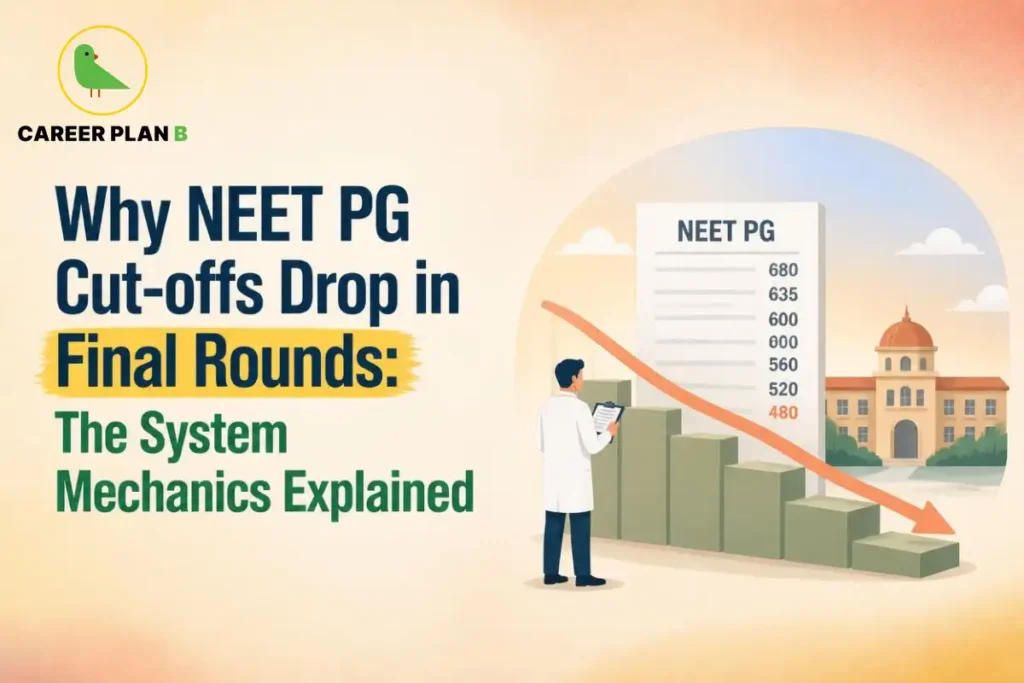
Introduction
Observing the trajectory of postgraduate medical admissions reveals a fascinating trend. As counselling advances toward later stages, closing ranks, NEET PG cut-offs consistently expand. Many medical aspirants mistakenly interpret this drop as a sign of reduced exam competition. However, the total number of applicants remains exceptionally high throughout the entire cycle.
Additionally, systemic seat recycling drives these significant cut-off adjustments. Late-stage adjustments occur due to complex administrative and behavioural factors. Therefore, understanding how these mechanics operate helps candidates navigate final counselling phases effectively.
Sequential Seat Allotment and Structural Cut-off Trends
Cut-off reductions follow a predictable structural sequence across successive counselling phases.
| Counselling Round | Typical Cut-off Drop Range | Dominant Driving Factor | Candidate Mobility Options |
|---|---|---|---|
| Round 1 | Baseline Benchmark | Prime Seat Allocation | Full Upgradation Allowed |
| Round 2 | 3%–7% Margin Drop | Upgradation & Exit Resets | Upgradation / Free Exit |
| Round 3 / Mop-Up | 10%–15% Margin Drop | Category Conversion & Exits | Fresh Registration / Binding |
| Stray Vacancy | Up to 25%+ Margin Drop | Leftover Vacancy Cleanup | Mandatory Acceptance / No Exit |
Consequently, understanding these numerical shifts prevents premature surrender during early phases. Candidates can monitor real-time seat matrices on the MCC counselling.
System Dynamics Driving Late Cut-off Drops
Upgradation Chains and Seat Recycling
Seat mobility creates extensive domino effects across the counselling matrix. For instance, a candidate securing MD Paediatrics in Round 1 may upgrade to MD Medicine in Round 2. Therefore, their previously allotted seat opens up for lower-ranked candidates.
Moreover, these cascading seat vacations continue through Round 3. As higher-merit candidates shift upward, vacated seats trickle down to lower ranks. Additionally, this continuous recycling lowers the entry threshold without diluting overall academic merit.
Multi-Exam Exits and Merit List Shrinkage
Furthermore, parallel admission processes pull top candidates away from the pool. Candidates securing seats through INI-CET or state quotas frequently exit central counselling.
- INI-CET Overlap: Top rankers vacate AIQ seats after securing central institute seats.
- DNB Direct Admissions: Aspirants shift toward hospital-based DNB seats during later rounds.
- State Quota Shifts: Candidates drop central allotments after securing home-state options.
Consequently, candidate exits leave premium seats unoccupied for subsequent rounds. Candidates can track entrance norms through the National Board of Examinations Portal.
Official Percentile Reductions and High-Cost Realities
Qualifying Percentile Adjustments by Authorities
When widespread seat vacancies persist, health authorities intervene to prevent seat wastage. For example, the Ministry reduces qualifying percentiles to expand candidate eligibility. Therefore, thousands of previously ineligible candidates suddenly join the active pool. Additionally, these percentile reductions create immediate downward shifts in final closing ranks. As a result, candidates with lower percentile ranks gain fresh admission opportunities.
Deemed University Fee Structures and Non-Clinical Trends
Furthermore, seat type variations heavily influence late-stage cut-off behaviours. High annual tuition fees in deemed universities discourage immediate seat acceptance.
- Financial Friction: Premium private fees lower competition, expanding rank cut-offs.
- Speciality Preferences: Non-clinical seats like anatomy or physiology see low initial demand.
- Stray Vacancy Processing: Final rounds fill remaining non-clinical and private seats rapidly.
Therefore, financial and speciality dynamics explain why certain branches show massive cut-off drops.
Strategic Rules: Forfeiture Risks and Binding Allocations
Navigating final rounds requires strict compliance with binding security deposit rules.
Security Deposit Forfeiture Mechanics
To prevent speculative choice filling, admission authorities enforce stringent penalty rules. For instance, failing to report after a Round 3 or Stray Vacancy allotment forfeits security deposits. Therefore, candidates must fill choices with extreme care during late phases. Additionally, candidates who join a Round 3 seat are barred from resigning. As a result, unjoined seats carry heavy penalties that reduce non-serious applications.
Data Sharing Across State and Central Pools
Moreover, central and state authorities share candidate databases during final rounds. For example, candidates holding state seats are automatically filtered out from central stray vacancy rounds. Consequently, cross-data weeding eliminates double bookings, ensuring seats reach genuinely unallotted candidates.
Have Any Doubts?
Strategic Framework: How to Leverage Late-Round Drops
Maximising your chances in final rounds requires careful planning and realistic choice lists.
- Track Live Seat Matrices: Analyse real-time vacancy lists continuously before locking choices.
- Avoid Purely Top-Tier Choices: Balance ambitious clinical preferences with realistic mid-tier options.
- Understand Exit Penalties: Enter final rounds only if you intend to join any allotted seat.
Therefore, aligning your choices with system mechanics improves final seat allotment prospects.
How Career Plan B Helps
Navigating NEET PG counselling requires a clear understanding of cut-off trends, seat movement patterns, percentile changes, and final-round decision-making. Late counselling phases involve complex factors like mop-up rounds, stray vacancy rules, seat upgrades, and financial considerations. Career Plan B supports medical aspirants through:
Personalised Career Counselling: Get guidance based on your NEET PG rank, preferred speciality, budget, and career goals to understand realistic admission possibilities across counselling rounds and make informed choices.
Psychometric & Career Assessment Tests: Identify your strengths, interests, and long-term medical career preferences to evaluate suitable branches, specialities, and institutional options.
Career Roadmapping: Build a structured roadmap covering NEET PG counselling strategy, branch selection, college evaluation, choice filling, seat upgrade planning, and future medical career growth.
Admission & Academic Profile Guidance: Receive expert support in analysing cut-off trends, understanding MCC seat allotment rules, evaluating fee structures, tracking vacancy opportunities, and making strategic counselling decisions based on your profile.
Get In Touch With Us
Frequently Asked Questions
- Why do NEET PG cut-offs drop significantly in stray vacancy rounds?
Cut-offs drop because remaining seats undergo final cleanup after higher-ranked candidates settle elsewhere.
- Does a cut-off drop mean the NEET PG exam was easier?
No, cut-off drops reflect seat recycling and candidate mobility rather than exam difficulty.
- Can I resign from a seat allotted during Round 3?
No, joining a Round 3 seat is final, and resignation is strictly prohibited.
- What happens if I do not join an allotted stray vacancy seat?
Failing to join results in security deposit forfeiture and potential debarment from future cycles.
- Do government college cut-offs drop as much as private colleges?
Government seats maintain higher demand, resulting in smaller cut-off drops compared to private institutions.
- Does percentile reduction guarantee a clinical seat?
Percentile reductions increase overall eligibility, but clinical seat availability depends on rank and budget.
Conclusion
Understanding why NEET PG cut-offs drop in final rounds clarifies the mechanics of medical admissions. Upgradation chains, parallel exam exits, and percentile adjustments drive these late-stage shifts. Meanwhile, strict penalty rules keep late rounds orderly and efficient. Ultimately, staying informed and planning strategically ensures you maximise your admission opportunities.
If you seek professional advice during late counselling rounds, platforms like Career Plan B can guide your choices effectively.