Team2 · June 19, 2026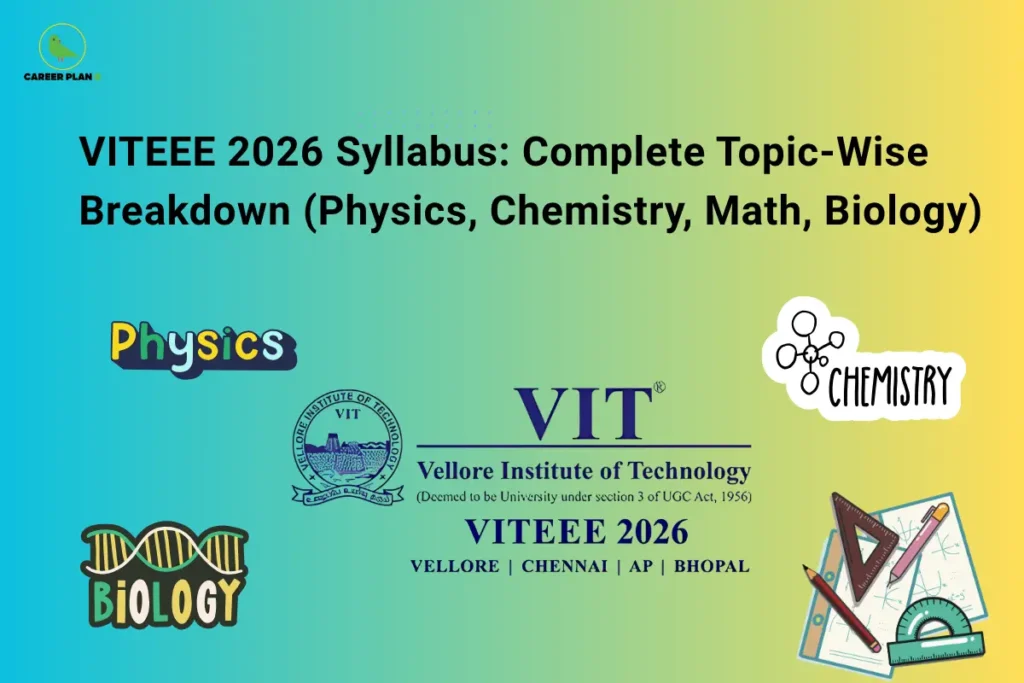
Introduction
Here’s a question that keeps thousands of VITEEE aspirants up at night: “Which topics should I actually focus on?”
You’ve probably heard that VITEEE is “NCERT-based,” but what does that really mean? And more importantly—which chapters carry the most weight? Which topics have appeared in almost every exam for the last five years?
The truth is, VITEEE 2026 isn’t as unpredictable as JEE Main. For a complete look at campus branches and choices, check out our master guide to VITEEE, fees, cutoff, and campus selection for VIT BTech admission 2026. Unlike JEE, which dives deep into advanced concepts, VITEEE is 90% NCERT-based and follows a clear, repeatable pattern. This means if you understand the exam structure and prioritize intelligently, scoring 100+ out of 125 marks is absolutely achievable.
In this guide, we’re breaking down the complete VITEEE 2026 syllabus topic-by-topic, revealing the weightage patterns from the last five years, mapping NCERT chapters to exam topics, and giving you a strategic preparation roadmap that separates high-yield content from time-wasters.
VITEEE 2026 Exam Structure Overview
Before jumping into individual subjects, let’s understand the framework. To map this structure to specific timing tactics and mark distributions, refer to our analysis on the VITEEE 2026 exam pattern, question distribution, and marking scheme. VITEEE isn’t a test of rote memorization—it’s a balanced framework that rewards consistency.
Here’s the breakdown:
| Section | Number of Questions | Time Allocation | Total Marks |
|---|---|---|---|
| Physics | 35 | ~50 minutes | 35 |
| Chemistry | 35 | ~50 minutes | 35 |
| Mathematics or Biology | 40 | ~60 minutes | 40 |
| Aptitude (Logical Reasoning & DI) | 10 | ~15 minutes | 10 |
| English | 5 | ~5 minutes | 5 |
| Total | 125 | 2.5 hours | 125 |
Marking scheme: +4 for correct answers, -1 negative marking. This means strategic guessing can actually work in your favour.
Key insight: Unlike JEE Main, which tests advanced problem-solving, VITEEE asks straightforward questions from NCERT with occasional application-based twists. Your job is to be accurate and complete, not clever.
VITEEE Physics Syllabus 2026: Complete Topic Breakdown
Physics accounts for 35 questions, and the good news? The topics are consistent year after year. Let’s break them down by weightage.
Mechanics & Kinematics (25% of Physics = 8-9 questions)
This is the foundation of physics, and VITEEE loves it.
Topics covered:
- Motion in one and two dimensions
- Laws of motion and applications
- Work, energy, and power
- Rotational motion and angular momentum
- Simple harmonic motion
- Circular motion
Why it matters: Mechanics appears in almost every VITEEE paper. In the last 5 years, 85%+ of exams included at least 8-9 questions from this section.
NCERT chapters: Class 11 Physics—Chapters 2-5, 7, 10, 14
Important formulas to master:
- v = u + at, s = ut + ½at²
- F = ma, Work = F·s·cosθ
- KE = ½mv², PE = mgh
- τ = I·α (torque and angular acceleration)
- Energy conservation in simple harmonic motion
Electricity & Magnetism (30% of Physics = 10-11 questions)
This is the highest-weightage section in physics—don’t overlook it.
Topics covered:
- Electrostatics (charges, fields, potential, capacitance)
- Current electricity (circuits, resistance, Kirchhoff’s laws)
- Magnetic effects of current
- Electromagnetic induction
- Alternating current (AC)
Why it matters: Electricity and magnetism are heavily tested. In the last 3 years, these topics accounted for 30-35% of all physics questions.
NCERT chapters: Class 12 Physics—Chapters 1-6
Critical reactions/concepts:
- Coulomb’s law and electric field strength
- Ohm’s law and Joule heating
- Faraday’s law of electromagnetic induction
- Transformer equations (Vs/Vp = Ns/Np)
- Power factor in AC circuits
Optics & Waves (20% of Physics = 6-7 questions)
Light behaves in predictable ways in VITEEE questions. This section tests your understanding of ray optics and wave phenomena.
Topics covered:
- Reflection and refraction of light
- Lenses and mirrors
- Interference and diffraction
- Doppler effect
- Sound waves and acoustics
Why it matters: Optics has a fixed weightage (~20%) and tests NCERT concepts directly—fewer surprises here.
NCERT chapters: Class 12 Physics—Chapters 8-10
Key concepts:
- Lens formula: 1/f = 1/v + 1/u
- Snell’s law: n₁sinθ₁ = n₂sinθ₂
- Young’s double-slit formula: λ = ax/D
- Diffraction grating: d·sinθ = nλ
Modern Physics & Quantum Mechanics (15% of Physics = 5 questions)
Modern physics is lighter in weightage but consistently tested. Think of it as “must-know but not must-master”.
Topics covered:
- Atomic structure and Bohr’s model
- Nuclear physics and radioactivity
- Photoelectric effect
- Matter waves and de Broglie wavelength
- Energy levels and transitions
Why it matters: These topics appear in 80%+ of exams but with straightforward questions—no trick twists.
NCERT chapters: Class 12 Physics—Chapters 11-13
Key formulas:
- E = hf (photon energy)
- E = -13.6/n² eV (Bohr’s energy levels)
- λ = h/p (de Broglie wavelength)
- Activity = λN (radioactive decay)
Thermodynamics (10% of Physics = 3-4 questions)
The least-weighted section in physics, but still important.
Topics covered:
- Heat and temperature
- First law of thermodynamics
- Second law and entropy
- Specific and latent heat
- Thermal expansion
Why it matters: Thermodynamics is straightforward NCERT content—if you’ve studied the chapter, you’ll answer these questions correctly.
NCERT chapters: Class 11 Physics—Chapters 12-13
VITEEE Chemistry Syllabus 2026: Detailed Topic List
Chemistry is equally weighted with physics (35 questions) but has a different distribution. Organic chemistry steals the show here.
Physical Chemistry (35% of Chemistry = 12-13 questions)
Physical chemistry bridges theory and application—VITEEE loves testing this.
Topics covered:
- Atomic structure and periodicity
- Bonding (ionic, covalent, coordinate)
- Thermodynamics and enthalpy
- Chemical kinetics and reaction rates
- Chemical equilibrium
- Redox reactions and electrochemistry
Weightage breakdown (last 5 years):
- Atomic structure: 3-4 questions
- Thermodynamics: 2-3 questions
- Equilibrium & kinetics: 3-4 questions
- Electrochemistry: 2-3 questions
NCERT chapters: Class 11 Chemistry (1-5, 7), Class 12 Chemistry (1-3, 5)
Critical concepts:
- Electron configuration and orbital diagrams
- Hess’s law (ΔH = Σ(products) – Σ(reactants))
- Ksp (solubility product) and precipitation
- Faraday’s laws of electrolysis
- Half-reactions in electrochemical cells
Inorganic Chemistry (30% of Chemistry = 10-11 questions)
Don’t let the term “inorganic” fool you—it’s not just memorization. VITEEE tests reasoning and trends.
Topics covered:
- Periodic table trends (ionization energy, electronegativity, atomic radius)
- s-block elements (alkali metals, alkaline earth metals)
- p-block elements (boron, carbon, nitrogen, oxygen, halogens, noble gases)
- d-block elements (transition metals, complexes, coordination compounds)
- f-block elements (lanthanides, actinides)
Weightage breakdown:
- Periodic table & trends: 3-4 questions
- p-block elements: 3-4 questions
- d-block & coordination compounds: 3-4 questions
NCERT chapters: Class 11 Chemistry (8-11), Class 12 Chemistry (6-8)
High-yield topics:
- Trends in periodic table (size, ionization energy, electronegativity)
- Hydrogen bonding and its effects
- Complex ion formation and VSEPR theory
- Stability of oxidation states in d-block
Organic Chemistry (35% of Chemistry = 12-13 questions)
This is the highest-weightage section in chemistry. Master organic, and you’ve won half the chemistry battle.
Topics covered:
- Nomenclature (IUPAC naming)
- Isomerism (structural, stereoisomerism, optical isomerism)
- Reaction mechanisms (SN1, SN2, E1, E2)
- Functional groups (alcohols, aldehydes, ketones, carboxylic acids, esters, amines)
- Polymerization and polymers
- Natural products (proteins, carbohydrates, fats)
Weightage breakdown:
- Functional groups & reactions: 6-7 questions
- Isomerism & nomenclature: 2-3 questions
- Polymers & natural products: 2-3 questions
NCERT chapters: Class 11 Chemistry (12-13), Class 12 Chemistry (10-12)
Critical reaction patterns:
- Oxidation of alcohols (PCC vs KMnO₄)
- Aldol condensation and Cannizzaro reaction
- Esterification and hydrolysis
- Nucleophilic addition (to C=O)
- Nucleophilic aromatic substitution (SNAr)
- Preparation of amines (Gabriel synthesis, Hofmann degradation)
Pro tip: Focus on reaction conditions and products, not just memorizing reactions. VITEEE often asks “what’s the product if…” rather than “how do you prepare…?”
Have Any Doubts?
VITEEE Mathematics Syllabus 2026: Topic-Wise Breakdown
Mathematics has the most questions (40) and the widest variety of topics. Here’s where precision matters.
Calculus (30% of Math = 12 questions)
Calculus dominates the mathematics section. Master it, and you’ve secured 12 guaranteed marks.
Topics covered:
- Limits and continuity
- Differentiation (rules, applications, optimization)
- Integration (indefinite, definite, techniques)
- Applications of calculus (maxima-minima, rate of change, area under curves)
- Differential equations (separable, linear)
Question patterns (last 3 years):
- Limits: 2 questions
- Differentiation: 4-5 questions
- Integration: 3-4 questions
- Applications: 2-3 questions
NCERT chapters: Class 11 Math (13), Class 12 Math (5-8)
Essential formulas:
- d/dx(xⁿ) = nxⁿ⁻¹
- ∫xⁿdx = xⁿ⁺¹/(n+1) + C
- ∫(1/x)dx = ln|x| + C
- Integration by parts: ∫u·dv = uv – ∫v·du
- Maxima/minima: f'(x) = 0, check f”(x) for nature
Algebra (25% of Math = 10 questions)
Algebra tests your understanding of equations, sequences, and logical thinking.
Topics covered:
- Quadratic equations and applications
- Sequences and progressions (AP, GP)
- Permutations and combinations
- Binomial theorem
- Matrices and determinants
- Linear programming
Question patterns:
- Quadratic equations: 2 questions
- Sequences/progressions: 2 questions
- Permutations & combinations: 2-3 questions
- Matrices: 2 questions
- Others (Binomial, LP): 1-2 questions
NCERT chapters: Class 11 Math (1-5, 9, 11), Class 12 Math (3-4)
Critical concepts:
- Discriminant (Δ = b² – 4ac) for nature of roots
- Sum and product of roots: x₁ + x₂ = -b/a, x₁·x₂ = c/a
- nth term of AP: aₙ = a + (n-1)d
- nth term of GP: aₙ = a·rⁿ⁻¹
- nCr = n!/(r!(n-r)!), nPr = n!/(n-r)!
- Binomial expansion: (a+b)ⁿ = Σ(nCr·aⁿ⁻ʳ·bʳ)
Vectors & 3D Geometry (20% of Math = 8 questions)
This section tests spatial reasoning and vector operations—skills highly valued in engineering.
Topics covered:
- Vectors (magnitude, direction, operations)
- Dot product and cross product
- Vector equations of lines and planes
- Distance formulas (point to line, line to plane)
- 3D coordinate geometry
Question patterns:
- Vectors & operations: 2-3 questions
- Lines in 3D: 2-3 questions
- Planes and distances: 2-3 questions
NCERT chapters: Class 12 Math (10-11)
Key formulas:
- Magnitude: |A| = √(x² + y² + z²)
- Dot product: A·B = |A||B|cosθ
- Cross product: |A × B| = |A||B|sinθ
- Distance between skew lines formula
- Distance from point to plane
Probability & Statistics (15% of Math = 6 questions)
Probability is lighter in weightage but increasingly common. Statistics focuses on mean, variance, and distributions.
Topics covered:
- Probability (basic concepts, conditional probability)
- Bayes’ theorem
- Random variables and distributions
- Mean, variance, and standard deviation
- Binomial distribution
- Normal distribution (bell curve)
Question patterns:
- Basic probability: 2 questions
- Distributions: 2 questions
- Statistics: 2 questions
NCERT chapters: Class 11 Math (15-16), Class 12 Math (13)
Essential formulas:
- P(A) = favorable outcomes / total outcomes
- P(A ∩ B) = P(A)·P(B|A)
- Mean (μ) = Σ(x·P(x))
- Variance (σ²) = E[X²] – (E[X])²
- Standard deviation (σ) = √variance
Trigonometry & Coordinate Geometry (10% of Math = 4 questions)
The smallest section in mathematics, but still worth knowing.
Topics covered:
- Trigonometric identities
- Inverse trigonometric functions
- Straight lines and circles
- Conic sections (parabola, ellipse, hyperbola)
Question patterns:
- Trig identities: 1-2 questions
- Conic sections: 2 questions
NCERT chapters: Class 11 Math (3, 10), Class 12 Math (10)
Have Any Doubts?
VITEEE Biology Syllabus 2026 (for Bio Students)
If you’re taking the biology stream, you’ll replace mathematics with biology (40 questions). The structure mirrors maths—comprehensive but NCERT-focused.
Botany Topics (50% of Biology = 20 questions)
Topics covered:
- Cell structure and organelles
- Plant physiology (photosynthesis, respiration, transpiration)
- Plant reproduction (sexual and asexual)
- Plant hormones and growth
- Ecology and ecosystems
- Plant biotechnology and tissue culture
High-weightage topics:
- Photosynthesis and light reactions (Calvin cycle): 3-4 questions
- Cell division (mitosis, meiosis): 2-3 questions
- Plant hormones: 2 questions
- Ecology and biodiversity: 3 questions
NCERT chapters: Biology Class 11 (1-5, 8-10), Biology Class 12 (1, 10)
Zoology Topics (50% of Biology = 20 questions)
Topics covered:
- Human anatomy and physiology (digestive, respiratory, circulatory, nervous systems)
- Genetics and heredity (Mendelian genetics, pedigree analysis)
- Evolution (mechanisms, evidence, human evolution)
- Ecology (food chains, population dynamics)
- Reproduction in humans
- Immunity and disease
High-weightage topics:
- Genetics and inheritance: 4-5 questions
- Human physiology (digestion, respiration): 4-5 questions
- Evolution: 2-3 questions
- Ecology: 2-3 questions
- Reproduction & development: 2-3 questions
NCERT chapters: Biology Class 11 (1-3, 7, 9, 13-16), Biology Class 12 (2-6, 8-9)
Key concepts:
- Monohybrid and dihybrid crosses
- Chromosomal inheritance and sex-linked traits
- Natural selection and adaptation
- Population growth models (exponential, logistic)
- Ecosystem energy flow and biogeochemical cycles
VITEEE Aptitude & English Section: Quick Wins
These two sections together account for 15 marks—and they’re relatively easy marks if approached correctly.
Aptitude Section (10 questions = 10 marks)
Topics covered:
- Logical reasoning (series, analogies, arrangements)
- Data interpretation (graphs, tables, pie charts)
- Quantitative problem-solving
- Spatial reasoning (pattern recognition, 3D visualization)
Why it’s a quick win: Aptitude questions in VITEEE are much easier than in management entrance exams (like CAT). Most questions reward pattern recognition and basic logic—no advanced tricks.
Sample high-yield topics:
- Number series: What comes next? (15% of aptitude)
- Analogies: A is to B as C is to __ (15%)
- Logical deduction: If A > B and B > C, then… (20%)
- Data interpretation: Read the graph and find the answer (30%)
- Odd one out: Which doesn’t fit? (10%)
Preparation strategy:
- Solve 2-3 aptitude papers per week (last month before exam)
- Focus on speed—aptitude should take 15 minutes max
- Memorize common number patterns (primes, Fibonacci, squares, cubes)
English Section (5 questions = 5 marks)
Topics covered:
- Grammar (subject-verb agreement, tense, prepositions)
- Reading comprehension (short passages, inference questions)
- Vocabulary (synonyms, antonyms, word usage)
- Sentence construction (jumbled sentences, error spotting)
Why it’s easy marks: These questions test basic English, not TOEFL-level complexity. Standard grammar rules and simple vocabulary suffice.
High-yield preparation:
- Focus on common grammar mistakes
- Practice one reading comprehension passage daily
- Review basic English rules (tenses, subject-verb agreement)
Quick fact: Over 95% of students score 4-5 marks in this section. With minimal effort, you should too.
NCERT Chapter-to-VITEEE Topic Mapping
Here’s the crucial insight: VITEEE follows NCERT almost verbatim. This table shows the direct mapping.
| Subject | NCERT Coverage | VITEEE Dependency | Strategy |
|---|---|---|---|
| Physics | 95% | 90% of exam questions | Master Class 11 & 12 NCERT thoroughly |
| Chemistry | 90% | 85% of exam questions | NCERT + additional organic reaction notes |
| Mathematics | 85% | 80% of exam questions | NCERT examples + 1–2 additional books |
| Biology | 100% | 95% of exam questions | 100% NCERT—nothing beyond |
Physics NCERT Mapping
Class 11 Physics (covers Mechanics, Thermodynamics, Waves):
- Chapter 2: Motion in a Straight Line → 2-3 VITEEE questions
- Chapter 3: Motion in a Plane → 2 questions
- Chapter 4-5: Laws of Motion → 3-4 questions
- Chapter 7: Systems of Particles → 2 questions
- Chapter 10: Rotational Motion → 2-3 questions
- Chapter 12-13: Thermodynamics → 2-3 questions
- Chapter 14: Oscillations → 2 questions
- Chapter 15: Waves → 1-2 questions
Class 12 Physics (covers Electricity, Magnetism, Optics, Modern):
- Chapter 1-3: Electrostatics → 4-5 questions
- Chapter 4-6: Current & Magnetism → 5-6 questions
- Chapter 8-10: Optics → 3-4 questions
- Chapter 11-13: Modern Physics → 3-4 questions
Chemistry NCERT Mapping
Class 11 Chemistry:
- Chapters 1-2: Atomic structure, Chemical bonding → 4-5 questions
- Chapters 3-5: Thermodynamics, Equilibrium, Redox → 4-5 questions
- Chapters 8-11: Periodic table, Hydrogen, s-block, p-block → 3-4 questions
- Chapter 12-13: Organic basics, Hydrocarbons → 3-4 questions
Class 12 Chemistry:
- Chapters 1-3: Solutions, Electrochemistry, Kinetics → 3-4 questions
- Chapters 6-8: d-block, Coordination compounds → 3-4 questions
- Chapters 10-12: Organic functional groups, Polymers, Biomolecules → 6-7 questions
Mathematics NCERT Mapping
Class 11 Math:
- Chapters 1-5: Sets, Relations, Trigonometry → 4-5 questions
- Chapter 9: Sequences & Series → 2 questions
- Chapter 11: Conic Sections → 1-2 questions
- Chapter 13: Limits & Derivatives intro → 2 questions
- Chapter 15-16: Statistics, Probability → 3 questions
Class 12 Math:
- Chapter 3-4: Matrices, Determinants → 2 questions
- Chapter 5-8: Continuity, Derivatives, Integration, Applications → 8-10 questions
- Chapter 10-11: Vectors, 3D Geometry → 6-8 questions
- Chapter 12: Linear Programming → 1 question
- Chapter 13: Probability → 2 questions
Have Any Doubts?
VITEEE Weightage Analysis: High-Yield vs Low-Yield Topics
Not all topics are equal. Some appear in 80%+ of exams; others show up once every few years. Here’s your priority roadmap.
High-Weightage Topics (>25% of questions in last 5 years)
These topics appear consistently and frequently. They deserve 60% of your study time.
Physics:
- Mechanics (especially circular motion, SHM): 8-9 questions
- Electricity & Magnetism (circuits, EMI): 10-11 questions
Chemistry:
- Organic Chemistry (functional groups, reactions): 12-13 questions
- Physical Chemistry (thermodynamics, kinetics): 5-6 questions
Mathematics:
- Calculus (differentiation, integration): 12 questions
- Algebra (sequences, permutations): 6-8 questions
Medium-Weightage Topics (10-25% in last 5 years)
These appear regularly but not every exam. Allocate 30% of study time.
Physics:
- Optics: 4-6 questions
- Thermodynamics: 2-3 questions
Chemistry:
- Inorganic Chemistry (p-block, d-block): 8-10 questions
- Physical Chemistry (electrochemistry): 2-3 questions
Mathematics:
- Vectors & 3D Geometry: 6-8 questions
- Probability & Statistics: 4-6 questions
Low-Weightage Topics (<10% in last 5 years)
These are “nice-to-know” rather than “must-know.” Allocate 10% of time.
Physics:
- Modern Physics (atoms, nuclei): occasionally asked
- Waves & Sound: rarely emphasized alone
Chemistry:
- Rare p-block elements (selenium, tellurium)
- Specialty organic reactions
Mathematics:
- Advanced linear programming
- Exotic probability distributions
Study Time Allocation (Weekly Schedule)
| Subject | High-Yield | Medium-Yield | Low-Yield | Total/Week |
|---|---|---|---|---|
| Physics | 12 hrs | 6 hrs | 2 hrs | 20 hrs |
| Chemistry | 12 hrs | 8 hrs | 2 hrs | 22 hrs |
| Math | 14 hrs | 6 hrs | 2 hrs | 22 hrs |
| Aptitude + English | – | – | – | 4 hrs |
| Total | 38 hrs | 20 hrs | 6 hrs | 68 hrs |
Previous Year Topic Frequency: What Actually Gets Tested
Data doesn’t lie. Here’s what VITEEE has actually tested in the last 5 years (2021-2025 papers analyzed).
Physics Topic Frequency (Last 5 Years)
| Topic | Appeared in # of Exams | Frequency % | Avg Questions |
|---|---|---|---|
| Circular Motion & Rotational Dynamics | 5/5 | 100% | 3.4 |
| Electricity (Circuits, Ohm’s Law) | 5/5 | 100% | 4.2 |
| Electromagnetic Induction | 5/5 | 100% | 2.8 |
| Laws of Motion | 5/5 | 100% | 3.1 |
| Work-Energy Theorem | 5/5 | 100% | 2.6 |
| Optics (Refraction, Lenses) | 5/5 | 100% | 3.8 |
| Atomic Structure & Photoelectric Effect | 4/5 | 80% | 2.4 |
| Waves & Sound | 3/5 | 60% | 1.8 |
| Modern Physics (Nuclei, Radioactivity) | 3/5 | 60% | 1.5 |
Key insight: Topics appearing in 100% of exams (mechanics, electricity, optics) are non-negotiable. Master these first.
Chemistry Topic Frequency (Last 5 Years)
| Topic | Appeared in # of Exams | Frequency % | Avg Questions |
|---|---|---|---|
| Organic Reactions & Mechanisms | 5/5 | 100% | 3.2 |
| Functional Groups (alcohols, aldehydes, etc.) | 5/5 | 100% | 2.8 |
| Atomic Structure & Periodicity | 5/5 | 100% | 2.6 |
| Equilibrium & Le Chatelier’s Principle | 5/5 | 100% | 2.2 |
| Redox & Electrochemistry | 4/5 | 80% | 2.4 |
| d-block Elements & Complexes | 4/5 | 80% | 2.2 |
| Thermodynamics & Enthalpy | 4/5 | 80% | 1.8 |
| p-block Elements | 3/5 | 60% | 1.6 |
| Polymers & Biomolecules | 2/5 | 40% | 1.2 |
Key insight: Organic chemistry questions are guaranteed. Chemistry = Organic. Study it like your life depends on it.
Mathematics Topic Frequency (Last 5 Years)
| Topic | Appeared in # of Exams | Frequency % | Avg Questions |
|---|---|---|---|
| Integration & Applications | 5/5 | 100% | 3.6 |
| Differentiation & Optimization | 5/5 | 100% | 2.8 |
| Limits & Continuity | 4/5 | 80% | 1.8 |
| Vectors & Dot/Cross Products | 4/5 | 80% | 2.4 |
| Lines & Planes in 3D | 4/5 | 80% | 2.2 |
| Sequences & Series (AP, GP) | 4/5 | 80% | 1.8 |
| Permutations & Combinations | 4/5 | 80% | 2.0 |
| Matrices & Determinants | 3/5 | 60% | 1.6 |
| Conic Sections | 3/5 | 60% | 1.4 |
| Probability & Distributions | 3/5 | 60% | 1.8 |
Key insight: Calculus is king. 100% of exams test integration and differentiation. Your math foundation depends on it.
Smart Preparation Strategy for 100/125 Marks
Now that you understand the syllabus and weightage, here’s how to study strategically. For an expanded timeline covering material selection and day-to-day tips, take a look at our specialized VITEEE 2026 preparation strategy and study plan to score 100+/125. This remains a highly reliable blueprint for high scorers.
Phase 1: NCERT Foundation (Months 1-3)
Objective: Complete understanding of NCERT, solid basics, no gaps.
Time commitment: 4-5 hours daily
What to do:
- Read NCERT chapters actively (don’t just passively read)
- Write down important formulas and concepts in a personal notebook
- Solve ALL NCERT examples (not just read them)
- Solve ALL NCERT exercises (both solved and unsolved)
- Create a formula sheet for each chapter
Physics (Phase 1 strategy):
- Month 1: Complete mechanics (Class 11, Chapters 2-5, 7, 10, 14)
- Month 2: Complete thermodynamics and waves (Class 11, Chapters 12-13, 15)
- Month 3: Start electricity (Class 12, Chapters 1-3)
Chemistry (Phase 1 strategy):
- Month 1: Atomic structure and bonding (Class 11, Chapters 1-4)
- Month 2: Thermodynamics, equilibrium, redox (Class 11, Chapters 5, 7)
- Month 3: Basic organic chemistry (Class 11, Chapters 12-13)
Mathematics (Phase 1 strategy):
- Month 1: Sets, relations, trigonometry basics (Class 11, Chapters 1-5)
- Month 2: Sequences, probabilities (Class 11, Chapters 9, 15-16)
- Month 3: Start calculus (Class 12, Chapters 5-6)
Expected outcome: 60-70/125 marks in a mock test Phase 1 indicator: You should solve NCERT exercises with 80%+ accuracy
Phase 2: High-Yield Topics Deep Dive (Months 4-5)
Objective: Master the topics that carry the exam weight. Move beyond NCERT into applications.
Time commitment: 5-6 hours daily (2-3 hours per subject)
What to do:
- Solve topic-wise previous year papers (2015-2025 at least 10 papers)
- Use a coaching material or guide for high-yield sections only
- Solve problems at increasing difficulty (basic → moderate → advanced)
- Time yourself—practice for speed and accuracy
- Maintain an error log (why did I get this wrong?)
Physics focus (Months 4-5):
- Complete electricity, magnetism, optics (Class 12, Chapters 1-10)
- Solve previous papers focusing on circular motion, EMI, lenses
- Practice numerical problems (VITEEE loves numericals)
Chemistry focus (Months 4-5):
- Deep dive into organic chemistry reactions (all mechanisms)
- Solve 100+ organic chemistry problems
- Study all inorganic p-block and d-block elements
- Practice reaction predictions
Mathematics focus (Months 4-5):
- Complete calculus (all applications)
- Master vectors and 3D geometry
- Solve 50+ integration and differentiation problems
- Practice optimization and maxima-minima problems
Expected outcome: 90-100/125 marks in a mock test Phase 2 indicator: You can solve high-weightage problems in 60% of the exam time
Phase 3: Practice & Refinement (Month 6)
Objective: Test-level accuracy, exam-like conditions, confidence building.
Time commitment: 6-7 hours daily (3-4 hours mock testing + 2-3 hours revision)
What to do:
- Take one full-length mock test every 3-4 days (2.5 hours, 125 questions)
- Review each mock: analyze wrong answers, understand gaps
- Revision of weak areas only
- Practice speed-building exercises (Aptitude + English)
- Build exam-day confidence
Mock test schedule:
- Week 1: 2 mocks (Thursday, Sunday)
- Week 2: 2 mocks + identify weak areas
- Week 3: 2 mocks + targeted revision
- Week 4: 2 mocks (final confidence builder)
After each mock:
- Accuracy check: Are you hitting 75%+ on high-yield topics?
- Speed check: Are you completing in 2.5 hours with time to spare?
- Weak area identification: Which topics/questions took longest?
Expected outcome: 100-115/125 marks consistently Phase 3 indicator: You should score 100+ in at least 2 consecutive mocks
VITEEE vs JEE Main Syllabus: Key Differences
If you’re considering both exams, here’s what you need to know.
| Aspect | VITEEE | JEE Main |
|---|---|---|
| Syllabus | NCERT-based (90%) | NCERT + advanced (70–80%) |
| Question Style | Straightforward, NCERT-focused | Tricky, application-heavy |
| Difficulty | Moderate | High |
| Negative Marking | Yes (-1 for wrong) | Yes (-0.33) |
| Aptitude | 10 questions, easy | Not present |
| Preparation Books | NCERT + 1–2 guides | NCERT + multiple coaching materials |
| Time per Question | ~1.2 minutes | ~1.5 minutes |
| Good Score Benchmark | ~70–80 for good college | ~150–200 (out of 300) |
If you’re preparing for JEE, VITEEE becomes easy. JEE requires deeper problem-solving and advanced concepts. VITEEE is essentially “JEE Lite”—NCERT with application.
Strategy if taking both:
- Build strong NCERT fundamentals (covers 90% of VITEEE)
- Practice JEE-level problems for depth
- A week before VITEEE, solve VITEEE-specific papers for familiarity
- JEE > VITEEE in difficulty, so JEE prep automatically covers VITEEE
How Career Plan B Helps
Navigating VITEEE preparation can feel overwhelming—especially when balancing syllabus complexity with your career aspirations. This is where Career Plan B’s personalized approach makes a difference.
- Personalized Counselling: Our experts understand your strengths and weaknesses. Through one-on-one guidance, we help you build a customized study plan that aligns with your target score and timeline.
- Psycheintel Assessment: This scientifically-backed career assessment identifies your learning style, aptitude strengths, and areas needing focus. Are you stronger in organic chemistry or physics? The assessment reveals this, so you can allocate study time strategically.
- Exam-Specific Roadmapping: We provide chapter-wise study schedules, high-yield topic lists, and practice problem recommendations tailored to VITEEE’s unique structure. No wasted effort—just focused preparation.
- Post-Admission Career Planning: After you ace VITEEE and secure admission, our career roadmapping service helps you choose the right specialization (CSE, ECE, Mechanical, etc.) based on your aptitude and future goals.
Career Plan B transforms exam preparation from stress-filled to strategic, and admission from a endpoint to the beginning of your engineering journey.
Get In Touch With Us
FAQ Section
Q1: Is NCERT really enough for VITEEE 2026?
A: Yes, absolutely. NCERT covers 90% of VITEEE questions. Our analysis of 5 years of papers shows that 85%+ questions are direct NCERT-based or require only minor application. However, you need complete NCERT mastery—not casual reading. Solve all examples, all exercises, and revisit difficult chapters twice. For organic chemistry specifically, supplement NCERT with reaction mechanism guides or coaching notes (10% gap).
Q2: Which three topics should I prioritize for the fastest progress?
A: If you have limited time, focus on:
- Electricity & Magnetism (Physics): 10-11 questions guaranteed
- Organic Chemistry: 12-13 questions guaranteed
- Calculus (Math): 12 questions guaranteed
These three alone account for 34-36 marks. Master them completely, and you’re already 27-29% into the exam score. Combined with aptitude and English, you hit 40+/125 easily.
Q3: How many hours should I study daily for VITEEE 2026?
- Phase 1 (NCERT foundation): 4-5 hours focused study
- Phase 2 (High-yield mastery): 5-6 hours (including coaching/guide time)
- Phase 3 (Mock testing): 6-7 hours
Q4: What’s a realistic target score for VITEEE 2026, and what college rank does it get me?
A: There’s no “passing score”—admission is merit-based. Even 70/125 can get you a college seat (for lower cutoff branches), but for CSE or top branches, aim for 100+.
- 90-100/125: Safety score for tier-2 colleges (500-1000 rank)
- 100-110/125: Good score for tier-1 colleges (300-500 rank)
- 110-120/125: Excellent score for top VITEEE colleges (100-300 rank)
- 120+/125: Outstanding, competitive for top specializations
Conclusion
VITEEE 2026 isn’t a mystery. It’s a structured exam with predictable patterns, NCERT-based content, and consistent weightage across topics.
Here’s what we’ve covered:
- The exam structure is balanced: 35 physics, 35 chemistry, 40 math/biology, 10 aptitude, 5 English
- High-weightage topics (electricity, organic chemistry, calculus) deserve 60% of your study time
- NCERT is genuinely sufficient—90% of questions come directly from it
- Strategic preparation over 6 months (NCERT foundation → high-yield mastery → mock testing) reliably delivers 100+/125 marks
- Your preparation for VITEEE is also preparation for engineering success
Here’s the action you should take today:
- Map out your 6-month timeline (if exam is 6 months away)
- Start with Phase 1: Complete at least one high-weightage NCERT chapter this week
- Create a formula sheet as you study
- Solve previous year papers after month 3 to understand question patterns
Final thought: VITEEE rewards consistency and clarity over brilliance. A student who solves 100 physics problems deeply understands 80 of them and outperforms someone who skims 500 problems. Focus on mastery, not speed—speed comes naturally.
Your engineering journey starts with VITEEE. Make it count.