Careerplanb · June 10, 2026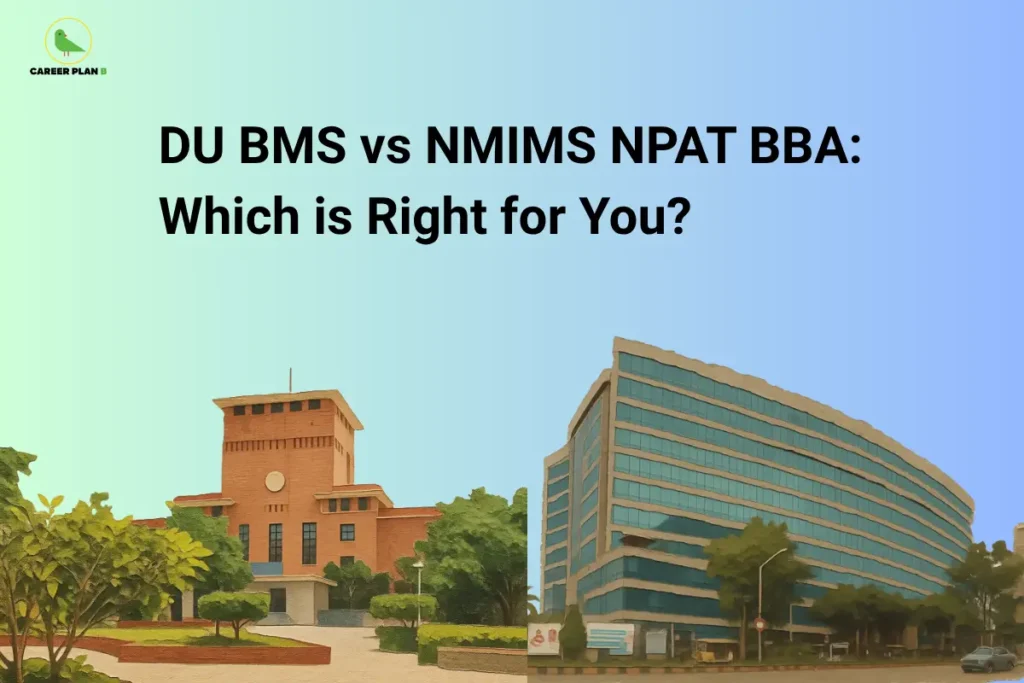
Introduction
Choosing the right business school is one of the most important decisions of your life. If you’re standing at the crossroads between DU BMS and NMIMS NPAT BBA, you’re probably asking yourself: Which program will set me up for success? Which college offers better placements? Is one significantly more expensive than the other?
You’re not alone in this dilemma. Every year, thousands of aspiring business students face this exact question. According to recent data, over 85% of top BBA graduates from reputable institutions land roles within three months of graduation, with average starting salaries ranging from ₹6-12 lakhs annually. Both Delhi University BMS and NMIMS NPAT BBA are among India’s most sought-after business programs, but they differ significantly in admission processes, costs, curriculum, and career outcomes.
In this comprehensive guide, we’ll break down both programs side by side so you can make an informed decision based on your goals, budget, and learning style. Let’s dive in.
DU BMS Overview: India’s Premier Delhi University Program
What is DU BMS?
Delhi University’s Bachelor of Management Studies (BMS) is one of India’s most prestigious BBA college programs. Offered through the Faculty of Social Sciences at Delhi University, BMS is a three-year undergraduate degree designed to prepare students for careers in business, finance, marketing, and operations.
Admission Process
DU BMS admission is merit-based, determined entirely by your Class 12 marks. There’s no entrance exam—your performance in board exams is the sole criterion. This straightforward approach makes it transparent and accessible.
- Eligibility: 50% marks in Class 12 (general category)
- Selection: Merit list based on board examination scores
- Number of Seats: Approximately 900 seats across all DU colleges offering BMS
Fee Structure
One major advantage of DU BMS is its affordability:
- Annual Fees: ₹10,000–₹15,000 (roughly)
- Total 3-Year Cost: ₹30,000–₹45,000
- Hostel Fees: ₹30,000–₹80,000 per year (optional)
This makes it accessible to students from diverse economic backgrounds.
Placements & Career Outcomes
DU BMS alumni work at leading companies like Google, Amazon, ICICI Bank, and Deloitte. Recent placement statistics show:
- Placement Rate: 90-95%
- Average Package: ₹7–₹10 lakhs
- Top Package: ₹25+ lakhs
- Recruiting Companies: 100+ corporations annually
Have Any Doubts?
NMIMS NPAT BBA Overview: Private Excellence with Entrance Exam
What is NMIMS NPAT BBA?
NMIMS (Narsee Monjee Institute of Management Studies) is a top-ranked private university offering a three-year BBA program. Admission is through the NPAT (NMIMS PG Admission Test) entrance exam, making it a competitive pathway for serious business aspirants.
Admission Process
NMIMS NPAT entrance exam is a rigorous selection process:
- Entrance Exam: NPAT (online, adaptive test)
- Exam Pattern: 120 questions (40 in each section), 2 hours duration
- Sections: Quantitative Reasoning, Logical Reasoning and Verbal Reasoning
- Merit List: Based on NPAT score and past academic performance
- Number of Seats: Approximately 180 seats per batch
Fee Structure
NMIMS is a premium private institution with higher costs:
- Annual Fees: ₹6–₹7 lakhs
- Total 3-Year Cost: ₹18–₹21 lakhs
- Hostel Fees: ₹2–₹4 lakhs per year
- Total with Hostel: ₹22–₹25 lakhs for 3 years
Placements & Career Outcomes
NMIMS graduates are highly sought after by top recruiters:
- Placement Rate: 98-99%
- Average Package: ₹10–₹14 lakhs
- Top Package: ₹35+ lakhs
- Recruiting Companies: 150+ companies annually
- Specializations: Finance, Marketing, HR, Operations, Entrepreneurship
Head-to-Head Comparison: DU BMS vs NMIMS NPAT BBA
Admission Difficulty
DU BMS: Easier admission based on merit. You need a high Class 12 percentage, but the process is straightforward—no entrance exam. Typically, you need 90%+ marks to secure a seat in a top college.
NMIMS NPAT BBA: Moderately difficult. While it has fewer seats (~180 vs 900), the entrance exam tests deeper conceptual understanding. You’ll compete with serious candidates, making it more challenging but also more selective.
Winner: DU BMS is easier to enter; NMIMS is more selective.
Fee Structure Comparison
| Parameter | DU BMS | NMIMS NPAT BBA |
| Annual Fee | ~₹10,000–₹15,000 | ~₹6–₹7 lakhs |
| 3-Year Total | ~₹30,000–₹45,000 | ~₹18–₹21 lakhs |
| With Hostel | ~₹80,000–₹2.4 lakhs | ~₹22–₹25 lakhs |
| Affordability | Highly Affordable | Premium Pricing |
DU BMS is significantly more affordable.
Curriculum & Learning Approach
DU BMS follows a traditional semester system with focus on:
- Foundational business concepts
- Indian business context
- Mix of practical projects and theoretical learning
- Less industry-immersive (compared to private universities)
NMIMS NPAT BBA offers the following:
- Industry-aligned curriculum
- Regular guest lectures from corporate leaders
- Strong emphasis on case studies and experiential learning
- Dedicated skill development programs
- International exposure and exchange programs
NMIMS edges out with more immersive learning.
Placement Opportunities
Both programs have excellent placement records, but with differences:
DU BMS Placements:
- Strong in banking, consulting, and IT sectors
- Excellent for MBA pipeline (90%+ pursue further studies)
- Average starting package: ₹7–₹10 lakhs
NMIMS NPAT BBA Placements:
- Higher average package: ₹10–₹14 lakhs
- Better international placement opportunities
- Strong in finance and premium consulting roles
- Placement rate nearly 100%
NMIMS has slightly higher packages; DU BMS has slightly lower but respectable outcomes.
Alumni Network & Reputation
DU BMS:
- One of India’s oldest and most respected business programs (established 1969)
- Extensive alumni network across India and globally
- Strong brand recognition among government and public sector employers
- Growing startup ecosystem alumni
NMIMS NPAT BBA:
- Newer but rapidly climbing rankings
- Strong corporate connections with premium companies
- Growing international recognition
- Active alumni engagement in mentorship programs
DU BMS has historical advantage; NMIMS has momentum.
Key Differences to Consider
Location & Campus Life
DU BMS: Spread across multiple Delhi University colleges (North Campus, South Campus). Students experience Delhi’s vibrant student life with cultural events, sports, and networking opportunities across the university.
NMIMS NPAT BBA: Located in Mumbai with world-class infrastructure, modern facilities, and a close-knit campus community. The Mumbai business environment provides exposure to India’s financial capital.
Specializations Offered
DU BMS: General management focus with limited specialization options compared to private universities.
NMIMS NPAT BBA: Multiple specialization options including Finance, Marketing, Human Resources, Operations, and Entrepreneurship, allowing students to build deeper expertise.
Internship Opportunities
Both universities provide excellent internship exposure, but NMIMS has a more structured internship program with dedicated industry partnerships and international internship opportunities.
How Career Plan B Helps
Choosing between these two programs is a critical career decision.
Career Plan B’s Personalized Career Counselling helps you evaluate both options based on your specific goals, learning style, and financial situation.
Our Psycheintel and Career Assessment Tests can identify which environment and curriculum align best with your strengths and interests.
Through Career Roadmapping, we guide you on the skills to develop at each institution to maximise your career outcomes post-graduation.
Whether you’re undecided or need validation, Career Plan B ensures your choice sets the foundation for long-term success.
For Latest Information
Frequently Asked Questions
Q1: Which program is easier to get into?
A: DU BMS is easier in terms of admission process (merit-based, no entrance exam), but you need 90%+ marks. NMIMS requires clearing the NPAT entrance exam, which is more selective, but fewer students compete for fewer seats.
Q2: Which offers better value for money?
A: DU BMS is dramatically more affordable at ₹30,000-45,000 total compared to NMIMS’s ₹18-21 lakh. However, NMIMS offers a premium learning experience with higher average starting packages that may offset the cost difference over time.
Q3: Can I pursue MBA after DU BMS?
A: Absolutely. In fact, 90%+ DU BMS students pursue MBA from tier-1 institutions. The program is excellent preparation for management studies. NMIMS graduates also pursue MBAs but are often directly hired into senior roles.
Q4: Is NMIMS NPAT BBA worth the higher fees?
A: It depends on your goals. If you want premium industry exposure, a higher starting salary, and international opportunities, NMIMS justifies the cost. If you’re budget-conscious and planning to pursue an MBA later, DU BMS is equally effective.
Q5: Which program has better international recognition?
A: NMIMS has stronger international rankings and better global recruitment partnerships. However, DU BMS’s historical reputation and growing international alumni network provide solid global recognition too.
Q6: Can I switch careers after BBA from either program?
A: Yes. Both programs provide foundational business knowledge applicable across sectors. However, NMIMS’s specializations offer more targeted preparation for specific career paths.
Conclusion
The choice between DU BMS and NMIMS NPAT BBA ultimately depends on your priorities. If affordability and historical prestige are paramount, DU BMS from Delhi University is an exceptional choice—you’ll receive world-class education at a fraction of the cost. If you’re willing to invest in premium education with industry immersion, cutting-edge facilities, and higher average starting packages, NMIMS NPAT BBA delivers value that justifies its investment.
Here’s the real truth: Success after your BBA depends 70% on your effort and choices and 30% on the institution. Both programs have produced successful entrepreneurs, corporate leaders, and change-makers. The “right” choice is the one that aligns with your goals, financial capacity, and learning preferences.
Ready to decide? Take the first step by exploring your strengths and career aspirations. Connect with mentors from both institutions, visit their campuses if possible, and speak with current students. Your future self will thank you for making a thoughtful, informed choice.