Team2 · June 25, 2026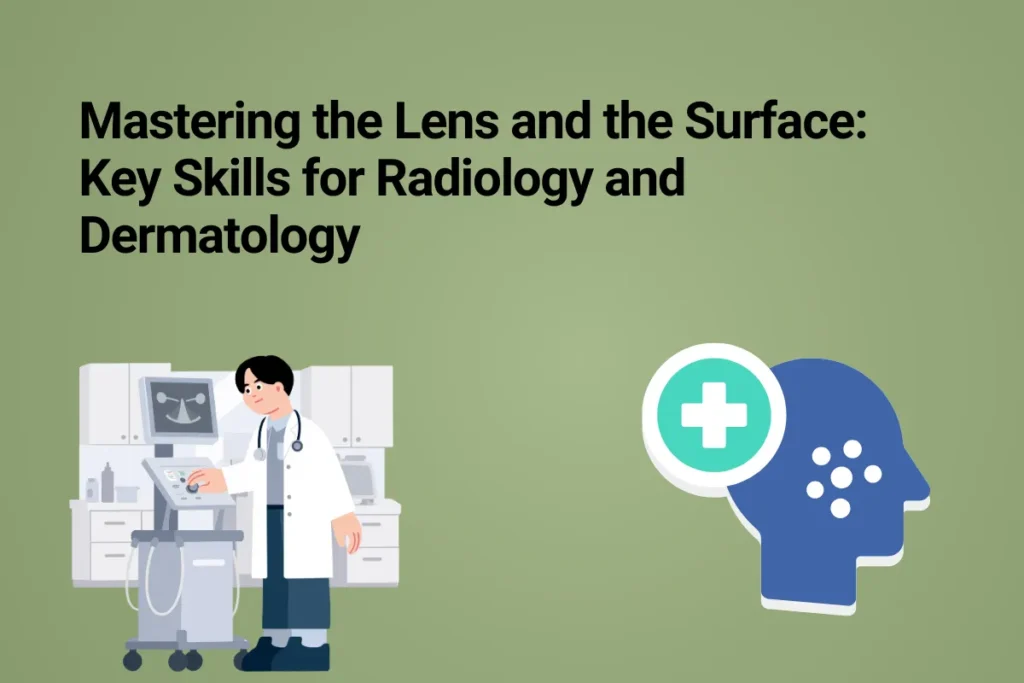
Introduction
Choosing a medical speciality is one of the most significant decisions a doctor will ever make. Among the most sought-after paths are Radiology and Dermatology. Often dubbed “lifestyle specialties” because of their manageable hours, they are frequently grouped together. However, beyond the comfortable schedules, the day-to-day reality of these two fields couldn’t be more different. One involves solving complex puzzles in a quiet, dark room, while the other requires high-energy social interaction and delicate physical procedures.
Are you someone who thrives on technology and deep analysis, or do you prefer the tactile nature of clinical procedures and long-term patient relationships? Understanding the skills for Radiology and Dermatology is the first step in ensuring your career satisfaction matches your professional ambition. In this guide, we will break down the cognitive, technical, and interpersonal abilities you need to thrive in these prestigious fields.
The Shared Foundation: Visual Mastery
Before diving into the differences, we must acknowledge the one skill that unites these two worlds: Pattern Recognition. Whether you are looking at a grayscale MRI of a brain or a pigmented lesion on a patient’s forearm, your eyes are your primary diagnostic tools.
Do you have an eye for the smallest details?
In both fields, success depends on your ability to distinguish “normal” from “abnormal”. This requires an incredible memory for visual data. A successful Radiologist or Dermatologist doesn’t just see a shape; they see a story. They can spot a subtle change in texture or a shadow that shouldn’t be there, often catching life-threatening conditions like a tiny stroke or a melanoma in its earliest, most treatable stages.
Mastering the Image: Essential Skills for Radiology
Radiology is often called the “Doctor’s Doctor.” You are the consultant other physicians turn to when they are stumped. To succeed here, you need a specific mental toolkit.
1. Analytical Thinking and Spatial Awareness
Radiologists must possess a “3D mind”. You are often looking at 2D “slices” of the body and must mentally reconstruct them into a three-dimensional image. If you enjoyed geometry or complex puzzles as a student, your brain might be wired for radiological technology and interpretation.
2. Technical Literacy and AI Adaptation
Radiology is the most tech-heavy branch of medicine. You must be comfortable with sophisticated software and evolving AI tools. Instead of fearing AI, successful Radiologists use it as a “second set of eyes” to increase their diagnostic precision.
3. Decisiveness Under Pressure
While the environment is quiet, the stakes are high. When a “stat” (emergency) CT scan comes in for a trauma patient, the surgeon is waiting for your word to operate. You must be able to make confident, accurate decisions quickly without second-guessing yourself.
Have Any Doubts?
Beyond the Surface: Essential Skills for Dermatology
Dermatology is a unique blend of medicine, surgery, and even psychology. It is much more “hands-on” than many people realize.
1. Fine Motor Skills and Dexterity
Dermatology is a procedural field. On any given day, you might perform a dozen skin biopsies, excise a cyst, or perform cosmetic injections. This requires steady hands and excellent hand-eye coordination. If you enjoy crafts, drawing, or playing a musical instrument, these procedural skills will serve you well.
2. High-Level Interpersonal Empathy
Skin conditions are highly visible and often tied to a patient’s self-esteem. A Dermatologist must be an excellent communicator. You aren’t just treating a rash; you are treating the anxiety and social stigma that comes with it. Patient communication in dermatology is just as important as the prescription you write.
3. Long-term Patient Management
Unlike Radiology, where you might never meet the patient, Dermatology is about building rapport. You might see the same patient for decades—managing their acne as a teen and their skin checks as an adult.
Quick Comparison: Radiology vs. Dermatology
| Skill / Feature | Radiology | Dermatology |
|---|---|---|
| Primary Environment | Reading Room (Dark/Quiet) | Clinic (Bright/Social) |
| Patient Interaction | Minimal to Moderate | Very High |
| Primary Tool | Computers & Imaging Software | Dermatoscope & Surgical Tools |
| Key Mental Strength | Abstract Logic & Physics | Empathy & Manual Dexterity |
How Career Plan B Helps
Choosing between these two competitive paths can be overwhelming.
How Career Plan B Helps is by providing clarity through our Psycheintel and Career Assessment Tests.
We help you identify if your personality aligns more with the analytical solitude of Radiology or the social, procedural nature of Dermatology.
Our Career Roadmapping and Personalized Career Counselling ensure you have a clear strategy for the medical career path ahead, including Admission and Academic Profile Guidance to help you secure those highly competitive residency spots.
Get In Touch With Us
Frequently Asked Questions
1. Which field is harder to get into?
Both are considered “ROAD” specialties (Radiology, Ophthalmology, Anesthesiology, Dermatology), which are notoriously competitive. However, Dermatology often has fewer residency spots, making it statistically one of the hardest medical fields to enter.
2. Do I need to be a maths genius for Radiology?
You don’t need to be a mathematician, but you should be comfortable with physics. Understanding how X-rays, magnets (MRI), and sound waves (Ultrasound) work is essential for your medical residency requirements.
3. Is Dermatology just about beauty and Botox?
Not at all. While cosmetic dermatology is popular, the core of the field involves treating complex autoimmune diseases, skin cancers, and infections. It is a serious medical discipline.
4. Can I work from home in Radiology?
Yes! Teleradiology is a growing field. Many radiologists work remotely, reading images from a home office, which is a major draw for those seeking flexibility.
Conclusion
Success in Radiology or Dermatology isn’t just about being a top student; it’s about how your natural talents align with the work. Radiology demands a quiet, focused mind capable of seeing what others miss in the shadows. Dermatology requires a social, tactile doctor who can heal both the skin and the person behind it.
Take the time to shadow doctors in both fields and reflect on where you feel most energised. Remember, your career is a marathon, not a sprint—make sure you choose the track that fits your stride.
Ready to find your perfect fit in medicine? Contact Career Plan B today for expert guidance on your professional journey!