Team Career Plan B · July 9, 2026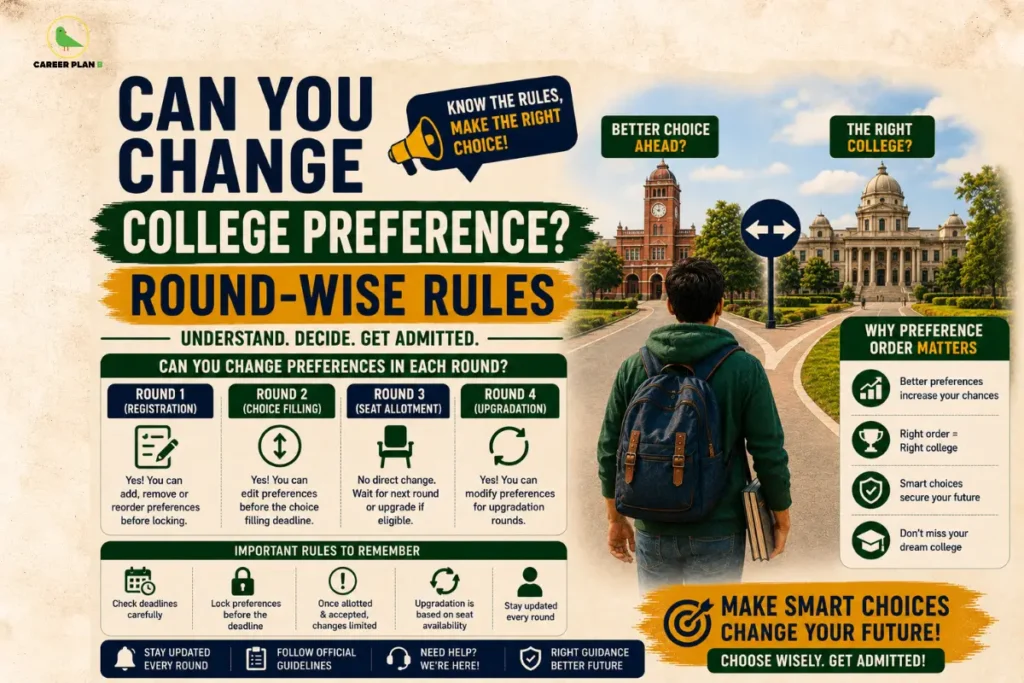
Introduction
You have been studying for months. The CUET 2026 exam is finally done, and now comes the part nobody really prepares you for the counselling. You sit in front of the screen, a long list of colleges staring back at you, and a single question starts buzzing in your head: “What if I pick the wrong one? Can I change my college preference in CUET counselling later?”
That question is more common than you think. Every year, thousands of students either miss a better seat or lose the one they had not because of their scores, but because they did not understand how the CUET counselling preference system actually works. This blog breaks it all down for you, round by round, in plain, simple language.
What Is CUET Counselling and Why Does Your College Preference Order Matter?
Before we get into the rules, let us understand what is really happening behind the scenes.
CUET counselling is not a single event. It is a multi-round process conducted individually by each participating university — universities like the University of Delhi (DU), Banaras Hindu University (BHU), University of Allahabad, and many others. The National Testing Agency (NTA) conducts the CUET exam and shares your scores with these universities, but each university runs its own counselling separately through its own portal.
Now here is the part that matters most: when you fill in your preferences — your list of college and course combinations the system allocates seats by matching your CUET score, your rank on the university’s merit list, your category, and the order in which you have listed your preferences. It is almost like a matchmaking algorithm. It starts from the top of your list and works its way down until it finds you an available seat.
This is why preference order is not just important — it is everything. A careless preference list can land you in a college that was not even your third choice when a better one was absolutely within your reach.
Can You Actually Change Your College Preference in CUET Counselling?
Short answer: it depends on when you want to change it. Most universities allow you to edit your choices during the choice-filling window the period before the first round of seat allotment begins. Once allotment starts, the rules change significantly. Let us look at both situations.
Before the First Round Allotment — Your Only Real Editing Window
This is the golden window. During the choice-filling phase, you can add, remove, and reorder your college-course preferences as many times as you want — right up until the deadline.
For Delhi University’s CSAS portal, available at https://admission.uod.ac.in/ , the University also offers a simulated rank feature before the first allocation round. This shows you a tentative idea of where you stand based on current preferences submitted across the platform. It is a brilliant tool to re-evaluate your list before everything gets locked.
One thing students often overlook is the correction window — a one-time facility offered by DU where you can edit certain details in your application. As per the official DU CSAS process, this window opens only once and closes permanently once you submit your edits. There is no second chance. So make every correction count the first time.
At BHU, preferences are entered through admission.bhu.ac.in, and the pattern is similar. There is a preference entry window before the first round of allotment, after which your submitted choices are used for seat allocation.
The takeaway: Before Round 1 results, your preferences are flexible. After results drop, the game changes.
After You Receive an Allotment — What Happens Next?
Once you receive a seat allotment in Round 1, you no longer “change” preferences in the traditional sense. Instead, you are asked to make a decision: do you want to keep this seat, try for something better, or leave entirely?
That decision comes in three forms and understanding them is crucial.
Freeze, Upgrade, and Withdrawal — The Three Decisions That Shape Your Admission
Think of these three options as your only moves on the board after allotment. Choose wisely.
Freeze: You are happy with the college and course you have been allotted. You want to confirm it and stop participating in further rounds. When you freeze, your seat is secured, your admission is confirmed (after fee payment and document verification), and you exit the system. No more upgrades, no more waiting.
As per the official DU CSAS process at admission.uod.ac.in: “Candidates who accept and take admission must submit a ‘freeze’ request to opt out of further upgrades. Once frozen, the seat cannot be changed in any subsequent counselling rounds.”
Upgrade: You have a seat, but you are not entirely happy with it. You believe a better college or course higher on your preference list might open up in the next round. When you choose to upgrade, you stay in the running for a higher preference but here is the catch: if a better seat does get allotted to you in the next round, your current seat is automatically cancelled. You cannot hold onto the old one while checking the new one. It is a one-way door.
Withdrawal: You want to exit the entire counselling process, maybe you got into another university, or you have decided to take a gap year. Withdrawal removes you from all future rounds. At DU, this can be done through your CSAS dashboard.
One more thing worth knowing: during Spot Admission rounds (the final rounds that fill up remaining vacant seats), the upgrade and withdrawal options are not available. The seat allotted in a Spot round is final and mandatory to accept.
Round-Wise Rules — What’s Allowed at Each Stage
Here is a clear breakdown of what you can and cannot do at each stage of CUET counselling:
| Stage | What You Can Do |
|---|---|
| Choice Filling Window (Pre-Round 1) | Add, remove, or reorder your college and programme preferences freely until the choice-filling deadline. |
| Correction Window (DU CSAS) | Edit eligible application details through the one-time correction facility provided by Delhi University. |
| After Round 1 Allotment | Choose one of the available options: Freeze, Upgrade, or Withdraw. |
| After Round 2 / Round 3 Allotment | You can again select Freeze, Upgrade, or Withdraw, subject to CSAS rules. |
| Final Regular Round | Only Freeze or Withdraw options are usually available. The Upgrade option may no longer be offered. |
| Spot Admission Round | Accept the allotted seat if interested. Upgrade and Withdrawal options are generally not available during this round. |
Each university follows its own round schedule. DU typically conducts three or more regular CSAS rounds followed by Spot rounds. BHU similarly runs multiple rounds depending on seat availability. Always check your specific university’s official portal for exact round dates.
Common Mistakes Students Make While Filling CUET Preferences
This section is really important. These are not hypothetical mistakes — these are things that happen every single admission season.
- Filling too few preferences: Students who add only 5 to 7 college-course combinations often find themselves with no allotment in Round 1 if cut-offs are higher than expected. Always fill as many eligible preferences as possible.
- Putting “reach” colleges at the bottom: Your top-choice college should be at the top of your list — not hidden at the bottom because you are scared of its cut-off. If you qualify, you deserve to try for it.
- Not checking programme-specific eligibility: Adding a course for which your Class 12 subject combination does not qualify leads to automatic rejection by the system. Always cross-check eligibility from the DU UG Bulletin of Information 2026–27 or the equivalent bulletin of your target university.
- Missing the preference-locking deadline: Many universities have an auto-lock mechanism. If you do not lock your preferences before the deadline, the system may auto-submit incomplete data or reject your participation altogether. Set reminders.
- Freezing too early without thinking: Some students freeze after Round 1 without even checking if Round 2 could get them something better. Take a moment to evaluate before you click Freeze.
- Not checking the dashboard regularly: For DU specifically, all communications allotments, queries, deadlines happen exclusively through the CSAS dashboard and your registered email. Missing a single notification can cost you your seat.
For Personalized Guidance
Smart Ways to Fill and Manage Your CUET College Preferences
Here are some practical things you can do right now:
- List your genuine first choice at the top: Do not let cut-off anxiety push your dream college down the list.
- Add a range of options: Include high cut-off colleges, mid-range options, and safer backups — all in genuine preference order.
- Use the simulated rank tool (DU CSAS): Before Round 1, DU releases simulated ranks to help you gauge your standing. Use it to review and reorder your list smartly.
- Keep documents ready: Class 10 and 12 mark sheets, CUET scorecard, category certificates, ID proof keep both digital and physical copies handy at all times.
- Track deadlines on official portals: Bookmark your university’s official admission. The university portal is the only source you should trust for dates and updates.
- Do not withdraw without a backup plan: If you are considering withdrawal because you got a seat somewhere else, confirm that other admission before you exit CUET counselling permanently.
How Career Plan B Helps
Career Plan B helps students navigate CUET 2026 counselling with clarity, structure, and personalized support:
- Personalized Career Counselling: Helps students build a realistic preference list based on their goals, strengths, and long-term aspirations—rather than confusion or pressure.
- Psycheintel & Career Assessment Tests: Provides data-backed insights into aptitude, personality traits, interests, and suitable academic and career pathways to guide informed choices.
- Admission & Academic Profile Guidance: Supports students in avoiding eligibility errors, tracking deadlines, and strengthening their academic profiles for better admission outcomes.
- Career Roadmapping: Helps students move beyond seat allotment by planning the next steps of their academic and professional journey with clarity and direction.
- End-to-End Guidance: Assists students throughout CUET 2026 counselling, college selection, and admissions so every decision is structured, informed, and aligned with their future goals.
For Latest Information
Frequently Asked Questions
- Can I change my college preferences after submitting them in CUET counselling?
Yes, but only during the choice-filling window before the first round of allotment. Once results are declared, you can no longer change the preference list — you can only choose to Freeze, Upgrade, or Withdraw. - What happens if I choose the Upgrade option and do not get a better seat?
If no higher-preference seat is available in the next round, you retain your previously allotted seat. Your current seat is only cancelled if a new, higher-preference allotment is actually made to you. - Is the correction window the same as the choice-filling edit window?
No. The correction window (offered by DU) is specifically for editing personal and academic details in your application form. It is a one-time facility. The choice-filling window is separate and allows you to manage your college-course preference list. - Can I participate in Spot Admission if I already have a seat?
At DU, once you are admitted, your dashboard is put in Freeze mode during Spot rounds you cannot upgrade during Spot Admission. Spot rounds are only for candidates who have not been admitted in any regular round. - If I miss the deadline to accept an allotted seat, do I lose everything?
Yes. If you do not accept the allotted seat, pay the fee, or respond to dashboard queries within the given deadline, your allotment can be cancelled and you may lose your eligibility for that university’s counselling entirely. Never ignore a deadline.
Conclusion
CUET counselling is not just a formality after the exam, it is a whole process of its own, and the decisions you make during it are just as important as the score you worked so hard to get. Understanding when you can change your preferences, what Freeze and Upgrade really mean, and how to build a smart preference list can genuinely change the college you end up in.
You have already done the hard part. Do not let a rushed click or a missed deadline undo it. Take the counselling process seriously, stay informed through official university portals, and if you need guidance, do not hesitate to reach out to someone who can help you think it through.