Team5 · July 10, 2026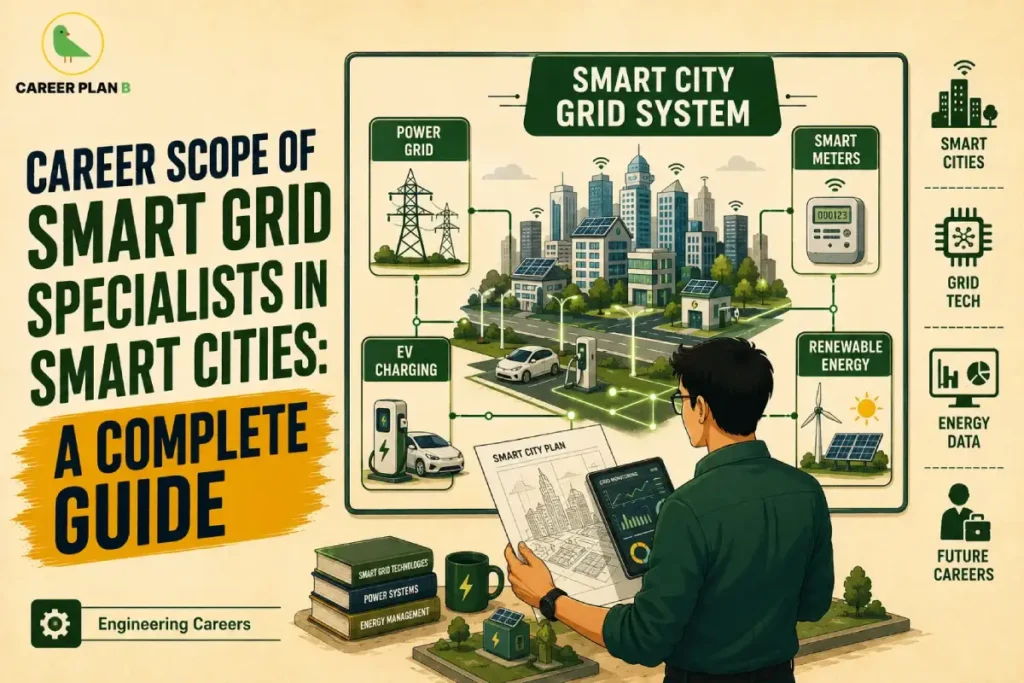
Introduction
Imagine a city where streetlights dim automatically when no one is around, where electricity theft is detected within seconds, and where power outages are predicted and prevented before they happen. This is not a distant dream; this is what smart cities powered by smart grids look like. And the professionals making it all work are Smart Grid Specialist .
India’s Smart Cities Mission, launched by the Ministry of Housing and Urban Affairs, has already selected 100 cities for transformation into intelligent, technology-driven urban centres. At the heart of every smart city is a smart grid, and the career scope of smart grid specialists in smart cities has never been broader or more promising. If you are an engineering student or professional looking for a future-ready career at the intersection of power systems, technology, and urban infrastructure, this is your guide.
What Is a Smart Grid and Why Does It Matter?
A traditional power grid moves electricity in one direction, from power plant to consumer. A smart grid is fundamentally different. It uses digital communication technology, sensors, IoT devices, and real-time data analytics to create a two-way flow of both electricity and information between utilities and consumers.
In the context of smart cities, smart grids enable:
- Real-time monitoring of electricity consumption and demand
- Automatic fault detection and self-healing capabilities
- Seamless integration of renewable energy sources like solar and wind
- Advanced metering infrastructure (AMI) for accurate billing and theft detection
- Dynamic load balancing to prevent overloads and outages
Without a smart grid, a smart city is simply a city with good intentions. The grid is the nervous system that connects everything.
What Does a Smart Grid Specialist Do?
A smart grid specialist designs, implements, manages, and optimises the digital infrastructure of modern power grids. They work at the intersection of electrical engineering, information technology, and data analytics, making them one of the most versatile professionals in the smart infrastructure engineering jobs landscape in India.
Their core responsibilities include:
- Designing and deploying Advanced Metering Infrastructure (AMI) systems
- Managing Energy Management Systems (EMS) and Distribution Management Systems (DMS)
- Configuring and monitoring SCADA systems for real-time grid control
- Integrating distributed energy resources like rooftop solar into the grid
- Analysing grid performance data to improve efficiency and reliability
- Ensuring cybersecurity of grid communication networks
They work with electricity distribution companies (DISCOMs), government bodies, smart city project developers, and private technology companies.
Career Scope of Smart Grid Specialists in Smart Cities
India’s Smart Cities Mission and What It Means for Engineers
The Smart Cities Mission is one of India’s largest urban development programmes, with over ₹1.6 lakh crore invested across 100 cities. A core component of every smart city project is the development of smart energy infrastructure, which directly creates demand for smart city jobs for engineers in India in grid technology, automation, and energy management.
National Smart Grid Mission The Official Government Push
The National Smart Grid Mission (NSGM), under the Ministry of Power, is India’s dedicated programme for modernising the country’s electricity distribution network. NSGM funds pilot projects, smart metering rollouts, and grid automation initiatives across states, all of which require smart grid specialists for design, implementation, and operation.
Growing Role of Renewable Integration in Smart Grids
As India pushes toward its 500 GW renewable energy target by 2030, integrating variable sources like solar and wind into the grid becomes increasingly complex. Smart grids are the only viable solution, and energy management engineers in India who can manage this integration are in exceptionally high demand.
Global Demand for Smart Grid Professionals
The smart grid market is not just an Indian opportunity. Countries across the Gulf, Europe, Southeast Asia, and North America are investing heavily in grid modernisation, creating significant international career prospects for Indian smart grid engineers with the right skills and certifications.
Key Job Roles in Smart Grid Engineering Career in India
The smart grid engineer career in India encompasses a wide range of specialised roles:
- Smart Grid Design Engineer Plans and designs grid automation and communication systems
- AMI Specialist Deploys and manages advanced smart metering infrastructure
- Energy Management Systems (EMS) Engineer Monitors and optimises energy flows across the grid
- Grid Automation and SCADA Engineer Programs and maintains real-time grid control systems
- Demand Response Specialist Manages consumer-side energy programmes to balance grid load
- Smart Grid Cybersecurity Engineer Protects grid communication networks from digital threats
Each of these roles contributes directly to the career scope of smart grid specialists in smart cities, and all are expected to see significant hiring growth through 2030.
What Skills Does a Smart Grid Specialist Need?
Core Technical Skills:
- Power systems analysis and distribution network design
- SCADA and DMS configuration and management
- Advanced Metering Infrastructure (AMI) deployment
- IoT protocols and communication standards IEC 61968, IEC 61970, DNP3
- Python and MATLAB for data analytics and grid modelling
- Knowledge of IS codes and BIS standards: bis.gov.in
Emerging Skills for the Future:
- AI and machine learning for predictive grid management
- Blockchain-based peer-to-peer energy trading systems
- Vehicle-to-grid (V2G) integration for EV charging management
- Edge computing for real-time grid analytics
Soft Skills:
- Analytical thinking and data interpretation
- Project management across large-scale infrastructure deployments
- Cross-sector collaboration working with IT, civil, and policy teams
How to Build a Power Grid Technology Career Path in India
Step 1: Choose PCM in Class 12
Physics, chemistry, and mathematics are the essential foundation for engineering entrance exams and all smart grid courses and certifications in India.
Step 2: Clear Engineering Entrance Exams
- JEE Main for NITs, IIITs, and centrally funded institutes: jeemain.nta.ac.in
- JEE Advanced for IITs: jeeadv.ac.in
- State-level exams like MHT-CET, WBJEE, and KCET
Step 3: Pursue the Right B.Tech Branch
Best branches for a smart grid engineer career in India:
- B.Tech in Electrical Engineering
- B.Tech in Electronics and Communication Engineering
- B.Tech in Energy Science and Engineering
- B.Tech in Information Technology (for grid cybersecurity roles)
Step 4: Gain Hands-On Experience Through Internships
Apply for internships at DISCOMs, smart city project offices, or PSUs like Power Grid Corporation of India (PGCIL) and Energy Efficiency Services Limited (EESL) to get direct exposure to smart grid systems and projects.
Step 5: Crack GATE for PSU Roles or M.Tech
A strong score in the GATE exam in Electrical Engineering (EE) opens doors to PSU recruitment at PGCIL, NTPC, and BHEL as well as M.Tech specialisations in power systems and smart grid technology at IITs and NITs.
Step 6: Earn Smart Grid Certifications
- BEE Certified Energy Manager/Auditor: beeindia.gov.in
- CPRI (Central Power Research Institute) Smart grid and power system training: cpri.in
- IIT Kanpur and IIT Bombay short-term programmes in smart grid technology
- NSGM-affiliated training programmes: nsgm.gov.in
Have Any Doubts?
Top Companies and Organisations Hiring Smart Grid Specialists
Public Sector Units and Government Bodies:
- Power Grid Corporation of India (PGCIL) National transmission and smart grid projects
- Energy Efficiency Services Limited (EESL) Smart metering and energy efficiency programmes
- BHEL Smart grid equipment manufacturing
- NTPC Limited Smart energy management across power plants
- State DISCOMs Implementing NSGM-funded smart metering projects
Private Sector:
- Siemens India Grid automation and digitalisation
- ABB India Smart grid and substation automation
- Schneider Electric India Energy management and grid solutions
- Honeywell India Smart building and grid integration
- Tata Power Smart metering and distribution automation
These organisations collectively represent the largest pool of smart city jobs for engineers in India in the grid technology space.
Smart Grid Specialist Salary in India
| Experience Level | Average Annual Salary |
|---|---|
| Entry-Level (0–2 Years) | ₹4 – ₹7.5 LPA |
| Mid-Level (3–7 Years) | ₹8 – ₹16 LPA |
| Senior-Level (8+ Years) | ₹18 – ₹32+ LPA |
| PSU (via GATE – PGCIL / EESL / BHEL) | ₹9 – ₹18 LPA + Additional Benefits & Perks |
Engineers with certifications in smart metering, SCADA, and cybersecurity for grids command a significant salary premium. The smart grid specialist salary in India also rises sharply for professionals with experience in large-scale NSGM or Smart Cities Mission projects. International postings, particularly in the Gulf and Europe, offer considerably higher packages for senior smart grid professionals.
How Career Plan B Helps
The power grid technology career path involves multiple specialisations, certifications, and evolving technologies that can be difficult to navigate alone. Career Plan B makes this journey simpler and more focused. Through personalised career counselling tailored to engineering aspirants, Career Plan B helps you understand whether smart grid engineering aligns with your strengths and long-term goals. Psycheintel-based career assessment tests identify your natural aptitudes, whether they lean toward technical design, data analytics, or systems management. And with structured career roadmapping, Career Plan B guides you through choosing the right B.Tech branch, identifying the best smart grid courses and certifications India has to offer, preparing for GATE, and planning your entry into top PSUs and private companies. Whether you are a Class 12 student or a B.Tech graduate exploring your options, Career Plan B helps you build your smart grid engineer career in India with clarity and confidence.
For Latest Information
Frequently Asked Questions (FAQs)
- Is smart grid engineering a good career in India?
Absolutely. With the National Smart Grid Mission, Smart Cities Mission, and India’s 500 GW renewable energy target all driving massive investment in grid modernisation, the career scope of smart grid specialists in smart cities is one of the strongest in the engineering sector through 2030 and beyond.
- Which B.Tech branch is best for smart grid specialisation?
Electrical engineering is the most direct path. Electronics and Communication Engineering is also highly relevant, particularly for roles involving IoT, communication protocols, and smart infrastructure engineering jobs in India in grid cybersecurity and data management.
- Is GATE required for smart grid jobs in India?
GATE is not mandatory for private sector roles but is essential for PSU recruitment at organisations like PGCIL, EESL, and BHEL. It also opens M.Tech pathways in Power Systems and Smart Grid Technology at IITs and NITs.
- What is the difference between a smart grid and a traditional power grid?
A traditional grid moves electricity in one direction with limited monitoring and manual fault management. A smart grid uses digital technology, IoT sensors, and real-time data to enable two-way energy and information flow, making it more efficient, reliable, and capable of integrating renewable energy sources.
- Can ECE students become smart grid specialists?
Yes. ECE graduates are particularly well-suited for roles in AMI deployment, grid communication protocols, SCADA programming, and cybersecurity, all of which are core components of the energy management engineer India role within smart grid projects.
Conclusion
India’s cities are getting smarter, and the grids powering them need to be smarter too. The career scope of smart grid specialists in smart cities is one of the most compelling opportunities available to engineering graduates today, combining the stability of the power sector with the dynamism of digital technology and urban innovation.
To recap: choose the right B.Tech branch, clear JEE and GATE, build skills in SCADA and AMI, earn BEE and CPRI certifications, gain project experience through internships at PGCIL or EESL, and stay ahead of emerging technologies like AI-driven grid management and V2G integration.
If you are unsure how to plan your smart grid engineer career in India or need expert help identifying the right path, visit Career Plan B today. With personalised guidance, smart career decisions start here.
India’s smartest cities are being built right now. Make sure you are one of the engineers powering them.