Team5 · July 10, 2026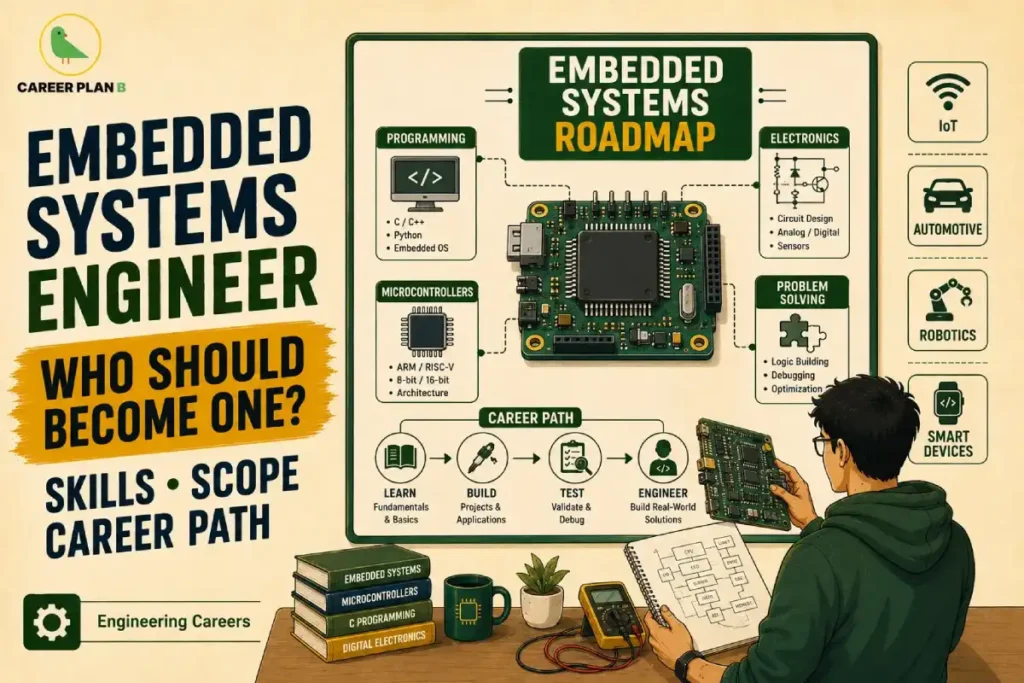
Introduction
Look around you right now. Your smartphone, your car’s anti-lock braking system, and the medical device monitoring a patient in a hospital – the satellite orbiting Earth – every single one of these is powered by embedded systems. And behind every embedded system is an engineer who programmed it, tested it, and made sure it worked perfectly under real-world conditions.
Yet despite being one of the most impactful and in-demand engineering disciplines, embedded systems engineering remains one of the least talked about career paths in India. Most students know about software development or mechanical engineering, but very few fully understand who should become an embedded systems engineer and what it takes to thrive in this field.
If you are someone who loves the idea of writing code that makes physical hardware come alive – code that controls machines, medical devices, defence systems, and consumer electronics – this blog is written for you. Here is everything you need to know about the skills, scope, and career path of an embedded systems engineer in India.
What Does an Embedded Systems Engineer Do?
An embedded systems engineer designs, develops, and tests the software and hardware that powers dedicated computing systems built to perform specific tasks within a larger device or machine.
Unlike a software developer who builds apps for general-purpose computers, an embedded systems engineer works at the intersection of hardware and software, writing firmware that runs directly on microcontrollers and processors with limited memory and processing power.
Their core responsibilities include:
- Writing and optimising firmware in C and C++ for microcontrollers
- Designing and testing hardware-software interfaces
- Working with Real-Time Operating Systems (RTOS) for time-critical applications
- Developing device drivers for sensors, actuators, and communication modules
- Debugging hardware and software issues at the system level
- Integrating communication protocols SPI, I2C, UART, CAN, and Ethernet
They work across automotive, consumer electronics, aerospace, defence, medical devices, and the rapidly expanding IoT and embedded systems jobs in India’s ecosystem.
Who Should Become an Embedded Systems Engineer?
This is the most important question, and the honest answer is that embedded systems engineering is not for everyone. It suits a very specific type of mind. Here is the profile:
You Love Both Hardware and Software
Most engineers lean one way, either toward hardware or software. Embedded systems engineers sit comfortably in both worlds. If you enjoy understanding how a circuit works AND writing the code that controls it, this career is a natural fit.
You Enjoy Solving Real-World Problems at the Device Level
Embedded engineers do not build websites or mobile apps. They build intelligence inside physical devices, from washing machines to spacecraft. If the idea of your code controlling a real machine excites you more than building a user interface, you are thinking like an embedded engineer.
You Have Strong Analytical and Logical Thinking
Debugging an embedded system requires patience and a systematic, logical approach. You might spend hours tracing a bug to a single incorrect register setting. If you enjoy that kind of deep problem-solving, the firmware engineer career India path will feel rewarding rather than frustrating.
You are detail-orientated and precise.
In embedded systems, a single incorrect line of code can cause a medical device to malfunction or a vehicle’s safety system to fail. Precision is not optional; it is the foundation of the job. Engineers who take pride in getting things exactly right are the ones who excel in this field.
You Are Curious About How Everyday Devices Work
The best embedded engineers are naturally curious. They do not just use a device; they wonder how it works, what processor it runs, and how its firmware is structured. If that sounds like you, who should become an embedded systems engineer? Has a clear answer: you should.
What Are the Right Qualifications and Eligibility?
The standard qualification for an embedded systems engineering career in India is a B.Tech or BE degree in one of the following branches:
- Electronics and Communication Engineering (ECE) most directly aligned
- Electrical Engineering (EE)
- Computer Science Engineering (CSE) particularly for firmware- and software-heavy roles
- Instrumentation Engineering
To get into a good engineering college, you need to clear:
- JEE Main for NITs, IIITs, and centrally funded institutes
- JEE Advanced for IITs
- State-level entrance exams like MHT-CET, WBJEE, KCET, and TANCET
A diploma in electronics or electrical engineering after Class 10 is also a valid alternative entry point, with a lateral entry B.Tech option available to advance further.
What Skills Does an Embedded Systems Engineer Need?
Core Technical Skills:
- C and C++ programming: the foundation of all embedded development
- Microcontroller architecture ARM Cortex, AVR, PIC, STM32
- Real-Time Operating Systems (RTOS): FreeRTOS, VxWorks, Embedded Linux
- Communication protocols: SPI, I2C, UART, CAN, Modbus, Ethernet
- PCB design basics and hardware debugging tools: oscilloscopes, logic analysers
- Knowledge of BIS and IEC standards for electronic systems
Emerging Skills for the Future:
- IoT integration MQTT, CoAP, and cloud connectivity for embedded devices
- AUTOSAR for automotive embedded systems
- AI at the edge deploying machine learning models on microcontrollers
- Cybersecurity for embedded and IoT devices
Soft Skills:
- Systematic debugging mindset
- Patience and persistence in problem-solving
- Clear technical documentation skills
- Cross-functional collaboration with hardware, mechanical, and software teams
Embedded Systems Career Path India Step-by-Step Roadmap
Step 1: Score Well in Class 12 with PCM. Physics and mathematics are critical foundations for both electronics and programming, the two pillars of embedded engineering.
Step 2: Clear JEE Main or State Entrance Exams Aim for a rank that gets you into a good NIT or state engineering college for ECE or EE.
Step 3: Pursue B.Tech in ECE, EE, or CSE. Choose a branch aligned with your interest in hardware-software integration. Focus on subjects like microprocessors, digital electronics, and embedded systems during your degree.
Step 4: Build Real Projects from Year Start experimenting with Arduino, Raspberry Pi, and STM32 development boards. Build real embedded projects: a temperature controller, a motor driver, and a Bluetooth-controlled device. Hands-on projects are what separate good candidates from great ones in embedded engineer jobs in India.
Step-5: Secure Internships at Electronics or Automotive Companies Target internships at PSUs like ISRO, DRDO, or BEL (Bharat Electronics Limited), or at private companies like Bosch India or Texas Instruments India.
Step 6: Crack GATE for PSU Jobs or M.Tech A strong GATE score in Electronics (ECE) or Electrical Engineering (EE) opens doors to top PSU recruitment and M.Tech specialisations in embedded systems, VLSI, or signal processing at IITs and NITs.
Step 7: Earn Industry-Recognised Certifications
- NPTEL courses in Embedded Systems and IoT free, IIT-delivered
- ARM-accredited engineer certification
- Texas Instruments embedded training programmes
- IIT online programmes in embedded and IoT systems
Embedded Systems Courses in India What to Pursue
Undergraduate:
- B.Tech in Electronics and Communication Engineering
- B.Tech in Electrical Engineering with embedded electives
- B.Tech in Computer Science Engineering
Postgraduate:
- M.Tech in Embedded Systems
- M.Tech in VLSI Design
- M.Tech in Signal Processing and Communications
Short-Term and Online:
- NPTEL Embedded Systems, IoT, and Microprocessors courses
- IIT Bombay and IIT Madras online certificate programmes
- ARM and Texas Instruments online training portals
Certifications from Government Bodies:
- Courses from CDAC (Centre for Development of Advanced Computing) PG Diploma in Embedded Systems Design
Have Any Doubts?
Top Companies Hiring Embedded Engineers in India
Public Sector Units:
- ISRO Satellite and spacecraft embedded systems
- DRDO Defence electronics and weapon system firmware
- BEL (Bharat Electronics Limited) Defence and civilian electronics
- HAL (Hindustan Aeronautics Limited) Avionics and aircraft embedded systems
- BHEL Industrial control systems
Private Sector and MNCs:
- Texas Instruments India Semiconductor and embedded processor design
- Qualcomm India Mobile and IoT chipset development
- Bosch India Automotive embedded systems
- Intel India Processor and platform firmware
- Honeywell India Industrial and building automation embedded systems
Startups and Product Companies:
- IoT startups, semiconductor design firms, and automotive technology companies across Bengaluru, Pune, Hyderabad, and Chennai
These organisations collectively represent the strongest pipeline of embedded engineer jobs in India, and hiring across all of them is projected to grow significantly through 2030 as IoT, automotive electronics, and defence modernisation accelerate.
Embedded Systems Engineer Salary in India
| Experience Level | Average Annual Salary |
|---|---|
| Entry-Level (0–2 Years) | ₹4 – ₹7.5 LPA |
| Mid-Level (3–7 Years) | ₹8 – ₹16 LPA |
| Senior-Level (8+ Years) | ₹18 – ₹32+ LPA |
| PSU (via GATE – PGCIL / EESL / BHEL) | ₹9 – ₹18 LPA + Additional Benefits & Perks |
Engineers with strong C programming skills, RTOS expertise, and experience in automotive or defence embedded systems command a significant salary premium. The embedded systems engineer salary in India also rises sharply for professionals working on AUTOSAR, AI at the edge, or cybersecurity for connected devices. International opportunities particularly in Germany, Japan, South Korea, and the USA offer significantly higher packages for experienced embedded engineers.
How Career Plan B Helps
Understanding who should become an embedded systems engineer is one thing; knowing how to get there is another. The embedded systems career path in India involves multiple specialisations, certifications, and technology choices that can feel overwhelming without the right guidance. Career Plan B simplifies this journey with personalised career counselling tailored specifically to engineering aspirants. Through PsycheIntel-based career assessment tests, Career Plan B identifies whether your natural aptitude leans toward hardware design, firmware development, or IoT systems, helping you choose the most aligned specialisation within the embedded systems engineering career in India. With structured career roadmapping, Career Plan B guides you through selecting the right B.Tech branch, identifying the best embedded systems courses in India, preparing for GATE, and planning your entry into top PSUs and private companies so every step forward is intentional and informed.
For Latest Information
Frequently Asked Questions (FAQs)
- Is embedded systems a good career in India?
Yes, absolutely. With India’s growing automotive electronics sector, expanding defence modernisation programmes, booming IoT industry, and semiconductor mission, the IoT and embedded systems jobs market in India is one of the fastest-growing in the engineering space. Demand for skilled embedded engineers is projected to rise significantly through 2030.
- Which B.Tech branch is best for embedded systems engineering?
Electronics and Communication Engineering (ECE) is the most directly aligned branch. Computer science engineering is also a strong option for firmware- and software-heavy embedded roles, making both ideal starting points for an embedded systems engineering career in India.
- Is GATE required for embedded engineer jobs in India?
GATE is not mandatory for private sector and MNC roles. However, it is essential for PSU recruitment at organisations like ISRO, DRDO, BEL, and HAL, which are among the most prestigious employers in the embedded systems space.
- Can CSE students become embedded systems engineers?
Yes. CSE graduates are well-suited for firmware development, RTOS programming, and embedded Linux roles. Building projects with microcontrollers and learning C programming at the hardware level gives CSE students a strong entry point into the firmware engineer career pathway in India.
- What is the difference between embedded systems and IoT engineering?
Embedded systems engineering focuses on programming and designing dedicated hardware-software systems. IoT engineering extends this by connecting embedded devices to networks and cloud platforms. In practice, the two fields overlap significantly, and most IoT and embedded systems jobs in India require expertise in both areas.
Conclusion
The world runs on embedded systems, and the engineers who build them are among the most quietly essential professionals in the technology industry. Who should become an embedded systems engineer? Someone who loves both hardware and software, enjoys solving problems at the device level, thinks logically and precisely, and is genuinely curious about how the intelligent devices around us actually work.
To recap: choose ECE or EE in B.Tech, build real projects from day one, crack GATE for PSU opportunities, earn certifications from NPTEL and CDAC, and specialise in emerging areas like automotive embedded systems or IoT.
If you are still figuring out whether embedded systems is the right path for you or how to plan your embedded systems career path in India step by step, visit Career Plan B today. With expert career counselling and personalised roadmapping, Career Plan B helps you move from uncertainty to a clear, confident direction.
The devices shaping the future are being engineered right now. Make sure you are one of the engineers programming them.