Team5 · July 10, 2026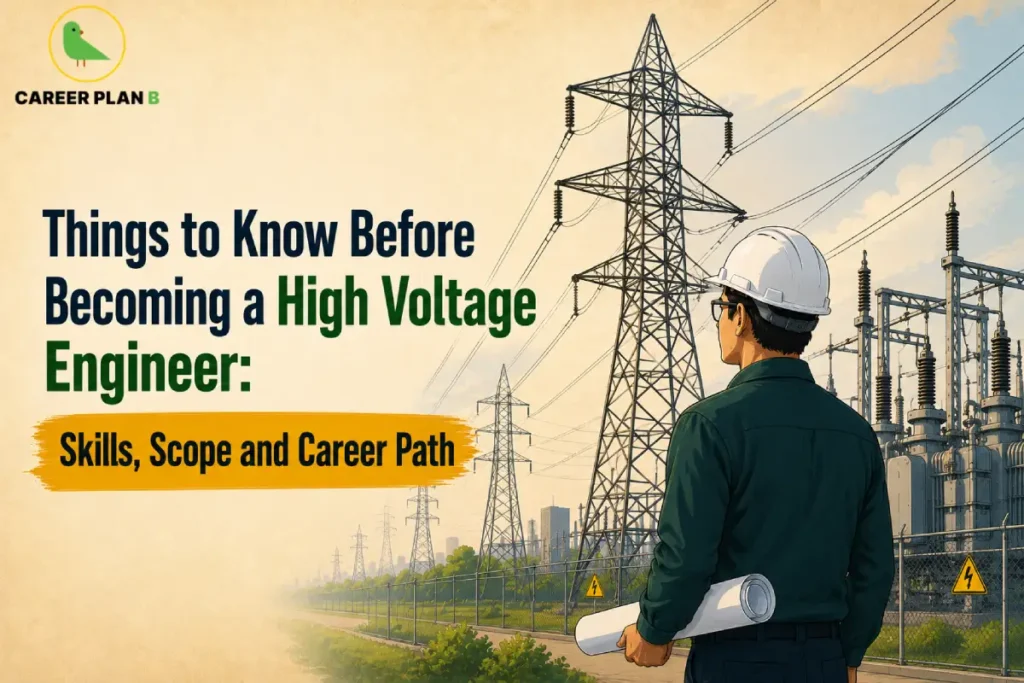
Introduction
India’s national power grid is one of the largest synchronous grids in the world. It spans over 4.5 lakh circuit kilometres of transmission lines, carries electricity at voltages ranging from 33 kilovolts to 765 kilovolts, and connects power plants to hundreds of millions of homes and industries across the country. Every single kilometre of that grid every substation, every transformer, and every switchgear assembly was designed, built, tested, and is maintained by high voltage engineers.
Yet despite being one of the most technically demanding and consequential roles in the power sector, high voltage engineering remains one of the least understood career paths among engineering students. If you are seriously considering the things to know before becoming a high voltage engineer, this blog gives you an honest, comprehensive, and practical answer covering everything from the right qualifications and skills to salary expectations and the top organisations hiring in India today.
Who Is a High Voltage Engineer?
A high voltage engineer is a specialist who designs, tests, operates, and maintains electrical systems that operate at voltages significantly above the standard low-voltage range, typically from 33 kV upward to 400 kV, 765 kV, and beyond in extra-high-voltage (EHV) and ultra-high-voltage (UHV) systems.
Unlike a general electrical engineer who may work on motors, wiring, or control panels, a high voltage engineer works specifically on:
- EHV and UHV transmission line design and project execution
- Substation engineering, both Air Insulated Switchgear (AIS) and Gas Insulated Switchgear (GIS)
- Power transformer design, testing, and diagnostics
- Insulation coordination and lightning protection systems
- High voltage cable systems for underground and subsea applications
- Relay protection and grid stability systems
They work across power utilities, transmission companies, testing laboratories, equipment manufacturers, and research institutions, making the high voltage engineering career in India one of the most specialised and stable paths in the electrical engineering sector.
Things to Know Before Becoming a High Voltage Engineer
1. It Is One of the Most Safety-Critical Roles in Engineering
The first and most important thing to understand is that high voltage engineering is not just technically demanding; it is inherently dangerous. Working with systems operating at hundreds of kilovolts requires an unwavering commitment to safety protocols, personal protective equipment (PPE), and lockout-tagout (LOTO) procedures.
The Central Electricity Authority (CEA) under the Ministry of Power publishes the Central Electricity Authority (Measures Relating to Safety and Electric Supply) Regulations that govern safety standards for high voltage installations across India. Every high voltage engineer must be deeply familiar with these regulations not as a formality but as a daily professional discipline.
If you are someone who takes safety seriously, thinks carefully before acting, and respects the power of the systems you work with, you have the right mindset for this career.
2. You Need a Strong Electrical Engineering Foundation
The standard high voltage engineer eligibility and qualifications profile begins with a B.Tech or BE in electrical engineering. This is the core academic requirement for virtually every high voltage engineering role in India, whether in PSUs, private companies, or research institutions.
To get into a good engineering college, you need to clear:
- JEE Main for NITs, IIITs, and centrally funded institutes
- JEE Advanced for IITs
- State-level exams like MHT-CET, WBJEE, and KCET
During your B.Tech, focus particularly on subjects like Power Systems, High Voltage Engineering, Electrical Machines, Power Electronics, and Electromagnetic Fields as these form the direct technical foundation of the power transmission engineer career path.
3. Specialised Knowledge of HV Systems Is Non-Negotiable
A general electrical engineering degree gives you the foundation, but a high voltage engineering career in India demands specialised knowledge that goes well beyond standard coursework. You need to develop deep expertise in:
- EHV transmission line design conductor selection, tower design, sag and tension calculations
- Substation engineering layout design, equipment specification, busbar protection
- Power transformer fundamentals: insulation systems, cooling methods, tap changers
- Gas Insulated Switchgear (GIS) technology increasingly used in urban substations
- Insulation coordination protecting equipment from overvoltages and lightning surges
- Underground and subsea high voltage cable systems
This specialised knowledge is what separates a competent electrical engineer from a true high voltage specialist, and it is the foundation of all high voltage engineer jobs in India at leading organisations.
4. Testing and Diagnostics Are Core Skills
High voltage engineering is not just about design and installation; testing is an equally critical part of the job. Before any HV equipment is energised and put into service, it must be rigorously tested to verify its insulation integrity, performance, and safety.
Key testing areas include:
- Impulse voltage testing simulating lightning and switching surges
- Partial discharge testing detecting internal insulation defects
- Dielectric strength testing verifying insulation withstand capability
- Transformer oil analysis and dissolved gas analysis (DGA)
- Power frequency withstand tests and insulation resistance measurements
The Central Power Research Institute (CPRI) is India’s premier testing and research body for high voltage equipment. CPRI certifications are mandatory for HV equipment supplied to Indian utilities, and engineers trained in CPRI testing methodologies are highly valued across the industry.
5. Standards and Regulatory Knowledge Is Essential
Every piece of high voltage equipment and every HV installation in India must comply with national and international standards. As a high-voltage engineer, you must be proficient in:
- IS codes from the Bureau of Indian Standards (BIS) covering HV equipment and installations
- IEC standards IEC 60071 (insulation coordination), IEC 60076 (power transformers), IEC 62271 (switchgear)
- CEA Regulations on safety and technical standards for HV systems
- Grid Code requirements issued by the Central Electricity Regulatory Commission (CERC)
Standards knowledge is not optional in this field; it is a daily professional requirement.
6. The Role Combines Office Design Work and Field Site Work
One of the most important practical realities of a high-voltage engineering career in India is that it is not purely a desk job. Depending on your specialisation, you may divide your time between:
- Design offices preparing technical specifications, drawings, and calculations
- Substations and transmission line sites supervising installation, testing, and commissioning
- Testing laboratories conducting HV tests on equipment before deployment
- Control rooms monitoring grid performance and responding to faults
This combination of technical depth and real-world site work makes the role genuinely engaging but also demands physical resilience, adaptability, and the ability to work in outdoor and industrial environments.
7. GATE Is Your Best Gateway to Top HV Engineering Roles
For anyone targeting high-voltage engineering jobs in India at premier organisations, cracking the GATE exam in Electrical Engineering (EE) is the single most important career step after your B.Tech. A strong GATE score opens doors to:
- PSU recruitment at PGCIL, NTPC, BHEL, and NHPC
- M.Tech in High Voltage Engineering or Power Systems at IITs and NITs
- Research positions at CPRI and ERDA
Several IITs, including IIT Kharagpur, IIT Roorkee, and IIT Madras, offer dedicated M.Tech programmes in High Voltage Engineering, which provide the specialised postgraduate training that accelerates career growth significantly.
What Skills Does a High Voltage Engineer Need?
Core Technical Skills:
- Power system analysis and fault calculation
- Substation design using AutoCAD Electrical and ETAP
- Insulation coordination and overvoltage protection design
- Relay protection and grid stability analysis
- High voltage testing methodology and equipment diagnostics
- Knowledge of CEA regulations and BIS/IEC standards
Emerging Skills:
- GIS substation technology and digital substation design
- HVDC (High Voltage Direct Current) transmission systems
- Smart grid integration with EHV transmission infrastructure
- Condition monitoring using IoT sensors and AI-driven diagnostics
Soft Skills:
- Unwavering safety discipline and risk awareness
- Analytical thinking and precision in calculations
- Strong technical documentation skills
- Cross-disciplinary project coordination with civil and mechanical teams
High Voltage Engineering Courses in India What to Pursue
Undergraduate:
- B.Tech in Electrical Engineering available at IITs, NITs, and state engineering colleges
Postgraduate:
- M.Tech in High Voltage Engineering: IIT Kharagpur, IIT Roorkee, IIT Madras
- M.Tech in Power Systems most IITs and NITs
- M.Tech in Energy Systems and Technology
Short-Term and Certification Programmes:
- CPRI training programmes in HV testing and power system protection
- NPTEL courses in High Voltage Engineering, Power Systems, and Switchgear
- PGCIL training institute for transmission engineering
- ERDA (Electrical Research and Development Association) training in HV testing
Top Companies Hiring High Voltage Engineers in India
Public Sector Units:
- Power Grid Corporation of India (PGCIL) National EHV transmission network
- NTPC Limited Power generation and transmission projects
- BHEL HV transformer and switchgear manufacturing
- NHPC Limited hydropower transmission systems
- State Transmission Utilities Every state has a dedicated transmission company
Testing and Research Institutions:
- CPRI (Central Power Research Institute) India’s premier HV testing body
- ERDA (Electrical Research and Development Association) HV equipment testing and research
Private Sector:
- Sterlite Power Private transmission line developer
- KEC International Power transmission EPC
- Kalpataru Projects International Power and urban infrastructure
- Larsen and Toubro high-voltage substation and transmission projects
These organisations collectively represent the strongest pipeline of electrical transmission line engineer India opportunities, and with India’s transmission capacity expansion continuing through 2030, hiring is expected to remain consistently strong.
Have Any Doubts?
High Voltage Engineer Salary in India
| Experience Level | Average Annual Salary |
|---|---|
| Entry-Level (0–2 Years) | ₹4.5 – ₹8 LPA |
| Mid-Level (3–7 Years) | ₹9 – ₹18 LPA |
| Senior-Level (8+ Years) | ₹20 – ₹35+ LPA |
| PSU (via GATE – PGCIL / NTPC / BHEL) | ₹9 – ₹20 LPA + Additional Benefits & Perks |
Engineers with an M.Tech in High Voltage Engineering, CPRI testing expertise, or GIS substation experience command a significant salary premium. The high-voltage engineer salary in India also rises sharply for professionals managing large EHV transmission or substation projects. International opportunities, particularly in the Gulf, Europe, and Southeast Asia, offer considerably higher packages for senior high-voltage engineers with proven project credentials.
How Career Plan B Helps
Understanding the things to know before becoming a high-voltage engineer is the first step, but knowing how to plan your journey from Class 12 to a role at PGCIL or BHEL requires structured guidance. Career Plan B provides exactly that. Through personalised career counselling tailored to engineering aspirants, Career Plan B helps you evaluate whether the power transmission engineer career path aligns with your technical strengths and career goals. Psycheintel-based career assessment tests identify your natural aptitude for precision-orientated, safety-critical, and analytically demanding work, the defining attributes of a successful high-voltage engineer. With structured career roadmapping, Career Plan B guides you through choosing the right B.Tech specialisation, identifying the best high-voltage engineering courses in India, preparing for GATE, and planning your entry into top PSUs and private transmission companies with a clear, personalised plan at every stage.
For Latest Information
Frequently Asked Questions (FAQs)
- Is high-voltage engineering a good career in India?
Absolutely. With India expanding its national transmission network, adding over 50,000 circuit kilometres of new EHV lines by 2030, and deploying GIS substations across urban centres, the high-voltage engineering career in India is one of the most stable and well-compensated paths in the power sector.
- Which B.Tech branch is best for high-voltage engineering?
A B.Tech in Electrical Engineering is the only standard entry route for meeting high-voltage engineer eligibility and qualifications requirements across all major employers in India. Specialising in power systems subjects during your undergraduate degree and pursuing an M.Tech in high voltage engineering significantly strengthens your profile.
- Is GATE required for high-voltage engineer jobs in India?
GATE is not mandatory for private sector roles but is essential for PSU recruitment at PGCIL, NTPC, BHEL, and NHPC, the top employers in the electrical transmission line engineer India space. A strong GATE score in Electrical Engineering (EE) is also your gateway to M.Tech programmes at IITs in High Voltage Engineering.
- What is the difference between high-voltage and extra-high-voltage engineering?
High voltage (HV) typically refers to systems operating between 1 kV and 33 kV. Extra high voltage (EHV) covers 220 kV to 765 kV, and ultra-high voltage (UHV) goes beyond 1,000 kV. In India, high-voltage engineer jobs at organisations like PGCIL primarily involve EHV and UHV transmission systems at 400 kV and 765 kV levels.
- Can a diploma holder become a high-voltage engineer?
A diploma in electrical engineering qualifies you for junior technical roles in HV maintenance and site supervision. However, to progress to design, testing, and project engineering roles and to qualify for PSU recruitment, a full B.Tech in Electrical Engineering is the necessary qualification for building a genuine high-voltage engineering career in India.
Conclusion
India’s power infrastructure is expanding at a pace the country has never seen before; new transmission lines, new substations, new HVDC corridors, and new GIS installations are being built across every region. And at the centre of every one of these projects is a high-voltage engineer who makes sure it is designed correctly, built safely, and tested thoroughly before it carries power to millions of people.
The things to know before becoming a high-voltage engineer come down to this: it is a career that demands academic excellence, deep technical specialisation, absolute safety discipline, and continuous learning. But it rewards those qualities with one of the most impactful, stable, and well-compensated careers available in India’s engineering sector.
To recap: choose electrical engineering for your B.Tech, clear JEE and GATE, build expertise in substation design and HV testing, earn certifications from CPRI and NPTEL, and target roles at PGCIL, NTPC, and BHEL.
If you need expert guidance on planning your power transmission engineering career path from entrance exams to your first PSU job, visit Career Plan B today. With personalised counselling and structured roadmapping, Career Plan B helps you build a career as powerful as the systems you will engineer.
India’s grid is growing. Make sure you are one of the engineers strengthening it.