Careerplanb · July 13, 2026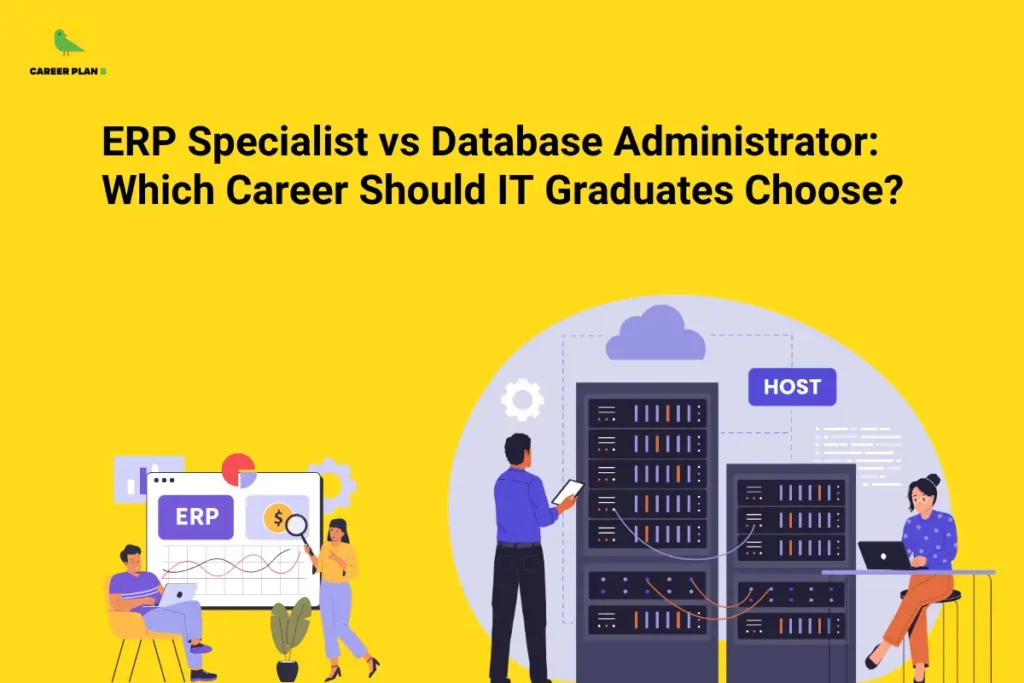
Introduction
For IT graduates, deciding between becoming an ERP Specialist vs Database Administrator can be challenging, as both roles offer strong growth potential but require different skill sets and career approaches. With organizations increasingly relying on enterprise resource planning (ERP) systems to streamline operations and manage complex databases to store and secure critical information, both career paths are in high demand. According to the U.S. Bureau of Labor Statistics, employment of database administrators and architects is projected to grow 10% from 2022 to 2032, while demand for IT professionals with ERP expertise continues to rise as more companies adopt integrated business solutions (BLS.gov – Database Administrators).
Choosing the right path requires understanding the unique responsibilities, required technical and business skills, certifications, challenges, and career progression associated with each role. This blog will explore the differences between ERP Specialists and Database Administrators, provide insights into the skills and certifications needed, showcase real-world examples, and explain how Career Plan B can help IT graduates strategically plan their careers in these fields.
Understanding the Roles
An ERP Specialist is responsible for implementing, managing, and optimizing enterprise resource planning systems, such as SAP, Oracle, or Microsoft Dynamics. They ensure that business processes across finance, supply chain, human resources, and operations are efficiently integrated within the ERP system. ERP Specialists often work closely with business stakeholders to customize and configure ERP modules according to organizational needs.
On the other hand, a Database Administrator (DBA) focuses on designing, maintaining, and securing an organization’s databases. They ensure database performance, reliability, and security while managing backup and recovery operations. DBAs work extensively with SQL, Oracle, MySQL, or Microsoft SQL Server, monitoring database health and optimizing queries to support organizational applications. While both careers require technical proficiency, ERP Specialists combine technology with business process knowledge, whereas DBAs concentrate on data integrity, security, and system performance.
Key Responsibilities and Daily Tasks
ERP Specialists spend their days configuring ERP modules, analyzing business requirements, troubleshooting system issues, and providing end-user support. They often participate in ERP implementation projects, ensuring that the system aligns with business goals and streamlines workflows across departments. Communication and collaboration are critical, as they liaise between IT teams and non-technical business users to translate operational needs into technical configurations.
Database Administrators, in contrast, are responsible for maintaining database performance, monitoring for potential security threats, performing backups, and ensuring system uptime. DBAs often write and optimize SQL queries, manage database access privileges, and collaborate with developers to implement efficient data storage solutions. Their role is more technically focused, but it is equally critical for the smooth operation of IT systems that organizations depend on.
For Personalized Guidance
Skills Required for Each Role
To succeed as an ERP Specialist, IT graduates need both technical and business skills. Technical skills include familiarity with ERP software, system integration, and workflow automation. Additionally, a strong understanding of business processes and analytical skills are essential to identify inefficiencies and optimize ERP configurations. Communication and problem-solving abilities are also key to managing user expectations and collaborating with stakeholders.
For Database Administrators, technical expertise in SQL, database management systems, performance tuning, and security protocols is vital. Analytical thinking is necessary for monitoring data trends and diagnosing performance issues, while problem-solving skills help prevent downtime and data loss. Both roles require continuous learning, adaptability, and the ability to integrate technology with organizational objectives.
Career Growth and Opportunities
Career growth in ERP and database administration varies based on specialization and experience. ERP Specialists typically start as Junior ERP Analysts, advancing to ERP Consultant, ERP Manager, and eventually ERP Architect. This trajectory allows IT graduates to gain expertise in business processes, project management, and strategic planning.
Database Administrators often start as Junior DBAs, progressing to Senior DBA, Database Architect, or Database Manager. These roles emphasize technical mastery, leadership in database management, and strategic involvement in IT infrastructure planning.
| Career Path | Entry-Level Role | Mid-Level Role | Senior-Level Role |
|---|---|---|---|
| ERP Specialist | Junior ERP Analyst | ERP Consultant | ERP Architect / ERP Manager |
| Database Administrator | Junior DBA | Senior DBA | Database Architect / Database Manager |
Both paths offer competitive salaries, strong job security, and opportunities across industries such as finance, healthcare, manufacturing, and IT services. Choosing the path that aligns with your strengths and interests is essential for long-term success.
Certifications That Boost Careers
Certifications validate skills and enhance employability in both ERP and database careers. For ERP Specialists, relevant certifications include SAP Certified Application Associate, Oracle ERP Cloud Certification, and Microsoft Dynamics 365 Certifications. For Database Administrators, certifications such as Oracle Certified Professional, Microsoft SQL Server Certification, and MySQL Database Administrator are highly valued.
These certifications not only demonstrate technical expertise but also show a commitment to professional development, making IT graduates more competitive in the job market. Combining certifications with hands-on experience ensures readiness for complex projects and leadership roles in either field.
Challenges in Each Career Path
ERP Specialists face challenges like managing multiple ERP modules, addressing user issues, and integrating ERP systems with legacy platforms. The need to balance technical knowledge with business understanding can be demanding, especially when working on large-scale ERP implementations.
Database Administrators encounter challenges such as ensuring database security, maintaining high availability, and keeping up with rapidly evolving database technologies. Downtime or data breaches can have significant consequences, so DBAs must work proactively and accurately under pressure.
Despite these challenges, both career paths offer highly rewarding opportunities for IT graduates who are prepared to learn continuously and adapt to evolving technologies.
Real-World Examples
Consider an IT graduate who begins as a Junior ERP Analyst in a manufacturing company. By gaining expertise in SAP modules and assisting in ERP implementations, they advance to ERP Consultant, leading projects and advising management on process improvements.
Similarly, an IT graduate starting as a Junior DBA in a finance organization can advance to Senior DBA, optimizing databases, ensuring security compliance, and designing database architectures that support enterprise applications. These examples show that IT graduates can leverage technical skills to excel in either ERP specialization or database administration, depending on their interests and career goals.
How Career Plan B Helps
Career Plan B assists IT graduates in navigating the choice between ERP Specialist vs Database Administrator by providing personalized career counselling to identify strengths and interests. Through Psycheintel and assessment tests, graduates can evaluate their technical and analytical skills. Certification and academic guidance helps plan the right credentials, while career roadmapping ensures a structured approach to achieving career goals. Learn more at Career Plan B.
Get In Touch With Us
Frequently Asked Questions
1. Can IT graduates without ERP experience become ERP Specialists?
Yes, with technical skills, certifications, and business process understanding, IT graduates can enter ERP roles and gain experience on the job.
2. Which certifications are most valuable for ERP Specialists and DBAs?
ERP certifications: SAP, Oracle ERP Cloud, Microsoft Dynamics; DBA certifications: Oracle Certified Professional, SQL Server, MySQL.
3. How long does it take to advance in these careers?
Typically 2–3 years to mid-level roles, and 5–8 years to senior-level roles, depending on experience and certifications.
4. Are these roles high-pressure or stressful?
Both require problem-solving and attention to detail; DBAs may face pressure during downtime, and ERP Specialists may face challenges during implementations.
5. Can IT graduates switch between ERP and database administration later?
Yes, with additional training and experience, IT graduates can transition between these roles.
Conclusion
Choosing between an ERP Specialist vs Database Administrator career is a pivotal decision for IT graduates. ERP roles combine technology with business process optimization, while database administration focuses on technical mastery and data integrity. Both offer excellent career growth, competitive salaries, and high demand across industries.
Career Plan B helps IT graduates evaluate strengths, select certifications, and create a structured roadmap for a successful career in either field. Whether you pursue ERP specialization or database administration, both paths offer opportunities to advance your IT career and make a strategic impact in organizations. Start planning your career today with Career Plan B.