Team Career Plan B · November 2, 2026
Introduction
Right now, somewhere in India, a seventeen-year-old is staring at their CUET 2026 admit card, wondering what happens if the score doesn’t match the dream. That quiet panic is more common than anyone admits out loud. Unconventional college admissions are quickly becoming the conversation students are having with themselves, long before results day even arrives.
Here’s the part nobody tells you in school. Choosing a backup isn’t about lowering your standards. It’s about widening your map. While everyone fights over the same fifty seats in the same five colleges, unconventional college admissions are quietly opening doors to courses that didn’t even exist when your parents were applying. This blog walks you through what those options look like, how CUET 2026 connects to them, and why “Plan B” might actually be your better story.
Why “Backup Plan” Doesn’t Mean “Settling”
Picture this. A student named Aanya spends two years preparing for CUET, eyes set on a single university, a single course, a single idea of what success looks like. Results come. The score is decent, just not decent enough for that one seat. For a few days, it feels like the floor has dropped.
Then her cousin mentions something she’d never even considered. A design program at a private university, built around AI and product innovation, with industry projects from semester one. Aanya rolls her eyes at first. Then she looks closer.
This is the moment so many students miss. A backup option isn’t a smaller version of your dream. Sometimes it’s a completely different door that happens to lead somewhere better. The trouble is, most students don’t even know these doors exist until they’re standing right in front of them, resulting in hand clocks ticking.
That’s exactly why exploring unconventional college admissions early, even before your CUET 2026 results, makes such a difference. You’re not scrambling. You’re choosing.
What Exactly Are New-Age Degrees?
Let’s get something straight. New-age degrees aren’t a gimmick or a watered-down version of “real” courses. They’re built around the kind of work that didn’t have a job title a decade ago.
From BA to AI: How Courses Have Changed
Think about it this way. Twenty years ago, if you were interested in technology, your options were basically computer science or electronics. Today, that single interest can branch into dozens of specialised paths.
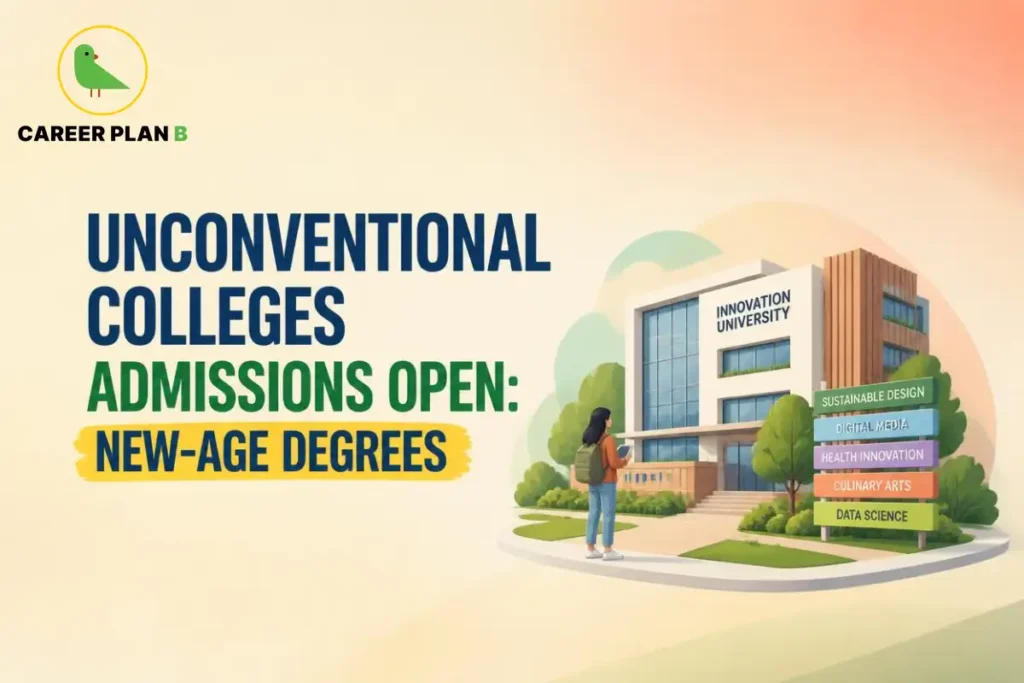
Popular New-Age Specialisations Students Are Choosing
Here’s a quick look at how traditional courses compare with their new-age counterparts:
| Traditional Course | New-Age Equivalent | What It Actually Covers |
|---|---|---|
| B.Tech (General) | B.Tech in AI & Machine Learning | Agentic AI, deep learning, autonomous systems |
| BBA (General) | BBA with Business Analytics or Fintech | Data-driven decision making, financial technology |
| B.Des (General) | M.Des in Product Design Innovation | UX, AI-assisted design, immersive tech |
| Physical Education | Sports Science | Biomechanics, sports psychology, wearable tech, analytics |
| B.Sc. Computer Science | Cybersecurity & Blockchain | Ethical hacking, data protection, decentralised systems |
Why Are These Courses Suddenly Everywhere?
Simple. Industries changed faster than old syllabi could keep up. Universities that adapted quickly are now the ones offering programmes that feel less like textbooks and more like real-world rehearsals. Some institutions have built dedicated labs for robotics, AI, and behavioural analytics, giving students hands-on exposure most degree programmes only talk about in theory , with cutting-edge fields like AI, AR/VR, genomics, wearables, and blockchain woven directly into programmes such as Sports Science.
CUET 2026 and the Private University Connection
Here’s where things get genuinely useful. A lot of students assume CUET only matters for central universities. That’s not the full picture.
The CUET 2026 exam dates and application form were released on the official website, along with the official notification on January 3, 2026, with exams scheduled for May 11 to 31, 2026. What matters for you, especially if you’re thinking about unconventional college admissions, is that this single exam now opens doors well beyond government institutions.
Do Private Universities Accept CUET Scores?
Yes, and this is where most students get pleasantly surprised. CUET-UG is an all-India test organised by the National Testing Agency for admission to undergraduate, integrated, postgraduate, diploma, certification, and research programmes, and several private universities now plug directly into this system for select courses.
For example, Amity University Kolkata allows students to use their CUET scores for admission to BBA, BCA, and BBA LLB courses through CUET-UG. So that exam you spent months preparing for? It might already be your ticket into a course you hadn’t even researched yet.
It’s worth checking each university’s official CUET information page directly, since eligibility criteria can vary by course and by year. As one official admission notice puts it, applicants are advised to visit the respective university’s website and confirm eligibility criteria themselves, since NTA will not be responsible for selection of subjects or programmes.
Where Should You Even Look? Spotlight on a Few Names
You don’t need to scroll through fifty tabs to find these options. A few names keep coming up for good reason, and they’re worth a closer look on their official pages.
Amity University
Amity offers a wide spread of new-age and traditional courses side by side. According to their official admissions FAQ page, CUET is recognised as one of the entrance routes for several undergraduate programmes, alongside merit-based and direct admission tracks.
Woxsen University
If design, AI, or business innovation interests you, Woxsen’s official website (woxsen.edu.in ) is worth bookmarking. Their School of Technology page outlines specialisations in artificial intelligence, product design innovation, and sports science, areas that simply weren’t part of mainstream UG conversations even five years ago.
A small tip here. When you visit these official pages, don’t just read the course name and move on. Look at the curriculum breakdown, the labs mentioned, and the kind of industry exposure promised. That’s where the real difference between courses shows up.
For Personalized Guidance
Is a Backup Admission Actually a Bad Word?
Honestly? It shouldn’t be. The word “backup” carries this heaviness, like it’s the consolation prize at the end of a long race. But think about how many people you know who ended up loving a course they “settled” for, more than the one they originally wanted.
Why does this happen so often? Probably because the course you originally wanted was chosen at sixteen, based on what sounded impressive at dinner parties. The course you discover later, while exploring unconventional college admissions, is often chosen with a little more self-awareness. You know yourself better by then, even if it’s just by a few months.
So here’s a genuinely fair question. What if your backup plan isn’t smaller than your original dream? What if it’s just less explained to you, simply because nobody talked about it as much?
How Career Plan B Helps
Career Plan B helps students choose the right new-age degree with clarity, confidence, and a focus on long-term fit rather than short-term trends:
- Personalized Career Counselling: Helps students explore emerging degree options based on their strengths, interests, academic profile, and future aspirations—not just what’s currently popular.
- Psycheintel & Career Assessment Tests: Provides data-backed insights into aptitude, personality traits, learning styles, and academic/career alignment, helping students identify pathways that genuinely suit them.
- Admission & Academic Profile Guidance: Supports students in evaluating degree programs, understanding admission requirements, and building a strong profile for their chosen path.
- Career Roadmapping: Helps students create a structured plan that connects their degree choice with future academic opportunities, skill development, and career goals.
- End-to-End Guidance: Assists students throughout the decision-making process so they can move forward with confidence, whether CUET 2026 unfolds exactly as expected or leads them toward alternative opportunities.
For Latest Information
Frequently Asked Questions
- Is choosing an unconventional college admission a sign that I didn’t perform well?
Not at all. Many students choose new-age degree programmes by preference, not by compulsion. Performance and choice are two separate conversations, even though they often get mixed up under exam pressure.
- Can I use my CUET 2026 score for private universities too?
Several private universities accept CUET scores for specific undergraduate courses, particularly in management and computer applications streams. However, this varies by university and programme, so always confirm directly on the official admission page of the university you’re considering.
- Are new-age degrees recognised the same way as traditional degrees?
Yes, as long as the university and programme are approved by relevant regulatory bodies such as UGC or AICTE. It’s a good habit to check this approval status on the university’s official website before applying.
- What if I don’t get a college through CUET at all?
Many private universities also offer direct or merit-based admission routes that don’t depend solely on CUET. Researching these options early, rather than after results, gives you far more breathing room.
- How early should I start researching backup options?
Ideally, before your CUET 2026 results are out. Waiting until after results often means rushed decisions under pressure, while researching early lets you compare programmes calmly and thoroughly.
Conclusion
If there’s one thing worth taking away from all this, it’s that your education doesn’t have to follow a single predictable script. CUET 2026 is one important chapter, but it’s not the only chapter, and unconventional college admissions are proof that there’s more than one good way to write your story.
The students who feel calmest after results day are usually the ones who looked around a little earlier than everyone else. So take that look now. Visit the official pages, compare a few new-age degrees, and give yourself options before you actually need them. Sometimes the path you didn’t plan for turns out to be the one you needed all along.