Team Career Plan B · November 2, 2026
Introduction
Picture this. You got into a private college last year because your CUET score didn’t quite hit the cutoff for that government college you really wanted. You settled in, made friends, started attending classes. But somewhere in the back of your mind, that dream of studying at a public university never really left. Now it’s CUET 2026 season again, and you’re wondering: can you actually switch from a private college to a public one this time around?
This question comes up more often than you’d think, and the honest answer isn’t a simple yes or no. CUET 2026 college transfer doesn’t work the way most students imagine it does, and understanding the real process can save you a lot of confusion, wasted time, and disappointment. In this blog, we’ll walk through how CUET 2026 college transfer actually works, why so many students consider moving from private to public institutions, and how a smart backup plan can keep your options open no matter what happens.
What Does “Transferring” Really Mean Under CUET 2026?
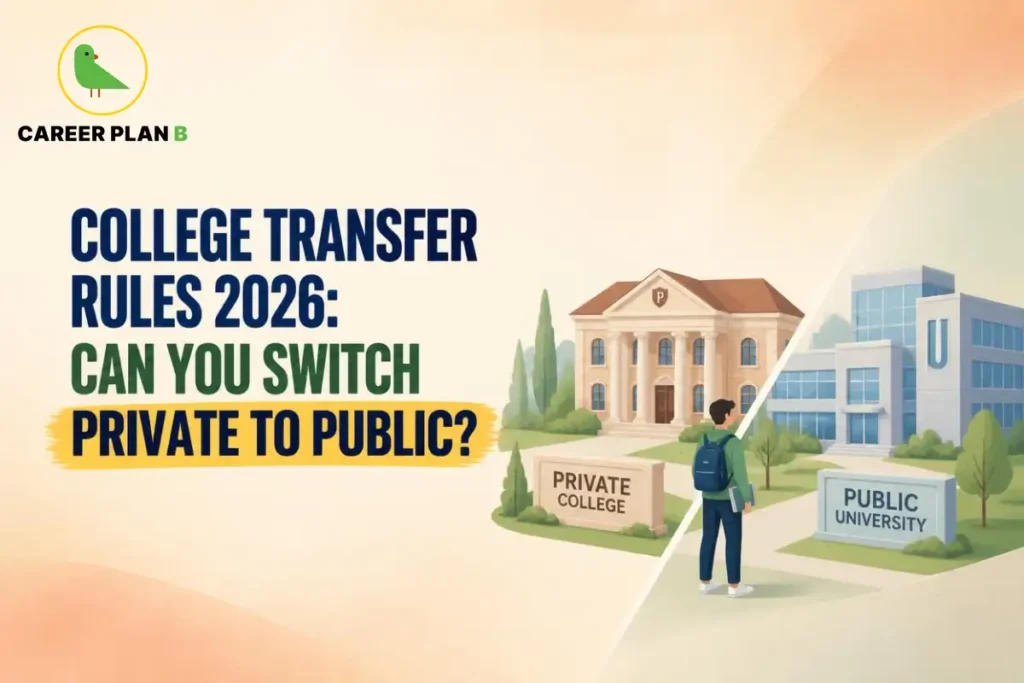
Here’s the first thing to understand, and it might surprise you. There is no formal “transfer” system where you simply move your existing degree from a private college to a public one mid-course. What CUET 2026 actually offers is a fresh shot at admission. Every year, you appear for the exam again, get a new score, and apply to whichever participating universities you want, whether that’s the one you’re currently studying in or a completely different one.
So if you’re currently enrolled in a private college and CUET 2026 results open the door to a government university, what you’re really doing is starting a new admission cycle, not transferring your old one. This usually means starting the course afresh unless the new university has a specific lateral entry or credit transfer policy, which is rare and varies a lot from institution to institution.
Think of it less like switching trains on the same track, and more like getting off one train and boarding a completely different one at the next station. The journey changes, but the ticket (your CUET score) is what gets you on board.
Why This Distinction Matters So Much
A lot of students assume their first year of college “counts” no matter where they go next. That assumption can cost you a year, sometimes more. Before you get excited about a public university seat, it’s worth checking that institution’s policy on credit recognition from private colleges. Some universities are flexible, others aren’t, and CUET alone doesn’t guarantee continuity of your academic progress.
Why Do So Many Students Want to Move From Private to Public Colleges?
Ever wondered why this question pops up every single admission season? It’s not random. There are real, practical reasons students chase a seat in a public university even after settling into a private one.
Cost is usually the biggest one. Government colleges, especially central universities, charge a fraction of what private institutions ask for. A single year’s tuition difference can sometimes run into lakhs of rupees. Then there’s the brand value. A degree from a recognised central university often opens doors faster, whether that’s for higher studies, government exams, or certain corporate roles where the college name still matters during shortlisting.
There’s also the alumni network, the campus culture, and for many families, simply a sense of pride attached to certain institutions. None of these reasons are wrong. But chasing them without understanding the process can leave students stuck halfway between two systems.
How CUET 2026 Counselling Actually Works for Multiple Universities
One Score, Many Doors
Here’s the part that actually works in your favour. CUET 2026 is not tied to one university. After the CUET UG 2026 results are declared, candidates must apply separately for counselling or admission on the official websites of participating universities, with each university conducting its own admission process based on CUET scores. This means the same exam score becomes your key to multiple doors, central universities, state universities, deemed universities, and private institutions that accept CUET scores.
So if you’re hoping to move from a private college to a government one, your CUET 2026 score is exactly what you’d use to apply. The catch is that counselling isn’t centralised under one portal for everyone. CUET counselling is not conducted in a centralised manner by NTA, and each participating university releases its own CUET counselling form on its official website. That means you can’t just sit back after the result. You need to actively track each university’s counselling timeline separately.
A Quick Look at the DU Example
Delhi University is a good example of how this plays out for one of the most sought-after central universities. DU admission is finalised through the Common Seat Allocation System, known as CSAS, based on CUET scores. After CUET results are out, candidates register on the DU CSAS portal, submit their scores along with personal details and documents, and then fill in their preferred program-college combinations in order of priority, with more preferences generally improving the chances of allotment.
This is the kind of system you’d be navigating if you’re aiming to move from a private college into DU or a similar public university. It rewards students who plan ahead, list their preferences carefully, and stay updated rather than those who wait and hope.
Can You Really Switch Your Private College for a Government One? Here’s the Truth
Let’s address this directly, because it’s the question most students actually want answered.
Yes, you can apply to a government university through CUET 2026 even if you’re currently in a private college. No, your private college will not automatically transfer your record, credits, or year of study to the new institution. Whether you join the public university as a fresh first-year student or get any credit consideration depends entirely on that university’s own academic policy, not on CUET.
Here’s a simple comparison to make this clearer.
| Aspect | Staying in Private College | Moving to Public University via CUET 2026 |
|---|---|---|
| Admission Process | Already completed | Fresh application and counselling required |
| Academic Year | Continues from where you are | Usually restarts unless lateral entry is approved |
| Tuition Cost | Generally higher | Generally lower, often significantly |
| Credit Transfer | Not applicable | Rare, depends on university policy |
| Application Route | Already enrolled | Through CUET score and the university’s own counselling portal |
This table isn’t meant to discourage the move. It’s meant to help you walk in with realistic expectations, so you’re not blindsided halfway through the process.
The Power of a Backup Plan — Why Private Admissions Still Matter
Here’s something students often overlook in the rush to land a government seat. Your private college admission isn’t a failure or a fallback to be embarrassed about. It’s your safety net, and a well-chosen one can be just as valuable as the public seat you’re chasing.
Think about it like this. Applying only to government colleges through CUET 2026 and hoping for the best is like walking a tightrope without a net below. A private admission, especially in a recognised, UGC-approved institution, gives you something to land on if the public seat doesn’t come through.
A few things worth keeping in mind while building this backup plan:
- Don’t burn bridges with your current college too early: Wait until your new admission is fully confirmed, including document verification, before withdrawing from your current institution.
- Check the academic calendar overlap: Government counselling rounds can stretch across weeks, and you don’t want to miss classes at your private college while waiting on a seat that may or may not come.
- Keep your documents ready for both processes: Marksheets, CUET scorecards, category certificates, and identity proofs should be sorted in advance so you’re not scrambling during a tight counselling window.
- Research the specific course, not just the university name: Sometimes a private college’s specialised program can be a better fit than a general degree at a public university, even with the cost difference.
Isn’t It Risky to Keep Both Options Open?
Not really, if you manage it well. The actual risk lies in putting all your hope into one outcome and having no plan if it doesn’t work out. Keeping a private admission as your backup while you attempt the public university route through CUET 2026 isn’t indecisive. It’s smart planning.
For Personalized Guidance
Common Mistakes Students Make While Juggling Private and Public Options
Even well-meaning students trip up here, often because the system feels more confusing than it needs to be. A few patterns show up again and again.
Some students withdraw from their private college the moment they get a CUET 2026 score they’re excited about, only to find that the public university’s counselling takes weeks and the seat isn’t guaranteed until the final round. Others assume that because both colleges accept CUET, the admission process must be similar, when in reality each university’s portal, documentation, and deadlines can be completely different.
Another common slip-up is ignoring the fine print on category-based reservations, domicile requirements, and programme-specific eligibility criteria. These rules often vary significantly between private institutions and central universities. Many students also skip the official notification and rely on forwarded messages or social media posts. Those sources often contain outdated or incorrect information.
How Career Plan B Helps
Career Plan B helps students navigate CUET 2026 transfer decisions with clarity, structure, and personalized guidance:
- Personalized Career Counselling: Helps students evaluate private vs public university options based on their academic profile, CUET performance, interests, and long-term goals.
- Psycheintel & Career Assessment Tests: Provides data-backed insights into aptitude, personality traits, learning styles, and academic/career alignment, helping students identify the path that genuinely fits them.
- Admission & Academic Profile Guidance: Supports students in comparing transfer possibilities, understanding eligibility, and making informed decisions across different institutions.
- Career Roadmapping: Helps students build a structured long-term plan that connects their transfer decision with future academic progression and career outcomes.
- End-to-End Guidance: Assists students throughout the decision-making process so choices are not driven by confusion or pressure, but by clarity and direction.
For Latest Information
Frequently Asked Questions
- Can I transfer my degree from a private college to a public university mid-course using CUET 2026?
No. CUET 2026 is an admission exam, not a transfer mechanism. Moving to a public university typically means a fresh admission, and your previous academic year may not automatically carry over unless the new institution has a specific credit transfer policy.
- Do I need to apply separately to each university even with one CUET score?
Yes. Your CUET score is accepted by multiple universities, but each one runs its own counselling process on its own official website. You’ll need to track deadlines and apply separately to every institution you’re interested in.
- Will I lose my private college seat if I apply for a public university through CUET 2026?
Not immediately. You retain your current seat until you formally withdraw or your admission elsewhere is fully confirmed. This is exactly why keeping your private admission active as a backup is a wise move. - Is it cheaper overall to switch to a public university even if I lose a year?
It depends. While public university fees are usually much lower, repeating a year has its own costs, including time, delayed entry into the job market, and sometimes additional living expenses. It’s worth calculating the full picture before deciding.
- What if I don’t get a seat in any public university through CUET 2026?
This is exactly where a backup plan matters. If you’ve kept your private college admission active and in good standing, you can simply continue there without losing an academic year.
Conclusion
Switching from a private college to a public one through CUET 2026 is absolutely possible, but it’s rarely as simple as flipping a switch. What it really comes down to is fresh admission, separate counselling processes, and realistic expectations about credit transfers and academic continuity. The more informed you are going in, the fewer surprises you’ll face along the way.
So if you’re standing at this crossroads right now, take a breath. You don’t have to choose between panic and giving up on your dream college. With the right information, a solid backup plan, and a little patience through the counselling process, you can make a decision that actually works for your future, not just one that feels urgent in the moment. And if you ever feel stuck, remember that guidance is always within reach.