Careerplanb · July 14, 2026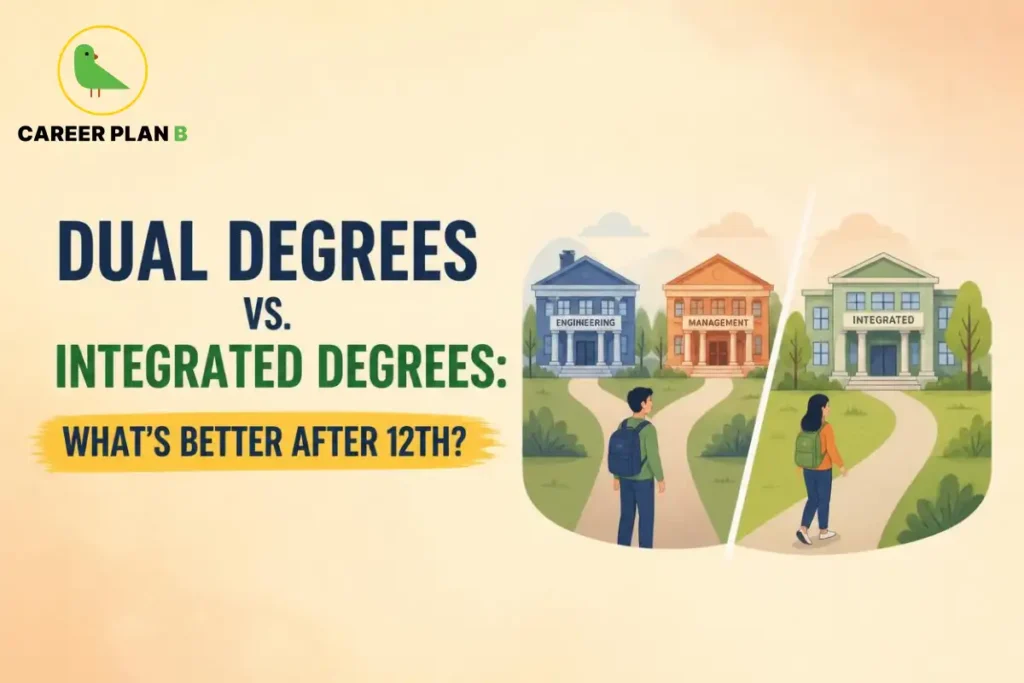
Introduction
If you’ve been researching undergraduate options after class 12, you’ve likely come across two terms that sound similar but mean very different things: dual degree and integrated degree. Both let you walk away with more than one qualification, but they work in fundamentally different ways — and choosing the wrong one for your goals can cost you years. Here’s the official distinction, straight from UGC’s own regulatory framework.
What Is an Integrated Degree?
An integrated degree is a single, continuous academic programme that combines two levels of study — typically undergraduate and postgraduate — into one unbroken course structure. The most recognisable example is the 5-year Integrated Programme in Management (IPM) offered by IIMs, where students complete a BA (Foundations of Management) and MBA within a single 5-year enrolment at one institution. (Source: IIM Indore — IPM Programme)
Other common integrated degree formats in India include:
- 5-year Integrated BA LLB / BBA LLB (law)
- Integrated MSc (5-year science programmes at IITs and central universities)
- Integrated BTech-MTech (dual-level engineering programmes)
In an integrated degree, you are enrolled in one continuous programme from day one. There is no separate application or admission process between the undergraduate and postgraduate stages — you progress through predefined years within the same institution and curriculum.
Have Any Doubts?
What Is a Dual Degree?
A dual degree (sometimes called a “two degree programme”) allows a student to pursue two separate, distinct degree programmes simultaneously — often from two different institutions, or even two different countries — and emerge with two independent degree certificates.
The University Grants Commission (UGC) formally enabled this through the UGC (Academic Bank of Credits) Regulations and the broader push under the National Education Policy (NEP) 2020, which permits students to pursue two academic programmes simultaneously, either through two full-time programmes (if the academic schedules allow) or by combining a full-time and a part-time/online/distance programme. (Source: UGC — University Grants Commission, ugc.gov.in)
Under this framework, a student can, for example, pursue a regular BA at one university while simultaneously completing a BCom through a distance/online mode at another UGC-recognised university — resulting in two independent degree certificates upon completion.
Key Differences at a Glance
| Factor | Integrated Degree | Dual Degree |
|---|---|---|
| Structure | One continuous programme with two levels | Two separate and independent programmes |
| Institutions Involved | Usually one institution | One or two different institutions |
| Admission Process | Single admission at the start (for example, UCEED or IPMAT) | Separate admission or enrolment for each programme |
| Flexibility to Exit Early | Limited, as the programme follows a fixed academic pathway | Each programme can be completed or exited independently |
| Common Examples | 5-year IPM, Integrated BA LLB, Integrated MSc | BA + BCom (Distance), BTech + Part-time Diploma |
| Governing Framework | Institution-specific regulations (such as the IIM Act or university statutes) | UGC Academic Bank of Credits (ABC) and NEP 2020 framework |
(Source: UGC — ugc.gov.in; IIM Indore — IPM Programme)
Why This Distinction Matters for Your Career Planning
Choose an Integrated Degree If:
- You are confident about your career direction (e.g., management, law, a specific science field) and want a structured, time-efficient pathway without reapplying at the postgraduate stage
- You value the brand strength and continuity of staying within a single, well-regarded institution for 5 years
- You want to avoid the uncertainty of competing again for postgraduate admission
Choose a Dual Degree If:
- You want two distinct qualifications that serve different purposes (e.g., a core subject degree plus a vocational or technical add-on)
- You want flexibility — the ability to complete, pause, or adjust one programme independently of the other
- You’re comfortable managing the academic workload of two simultaneous programmes
NEP 2020’s Role in Enabling Multiple Pathways
The National Education Policy (NEP) 2020, released by the Ministry of Education, Government of India, introduced the concept of multiple entry and exit points and the Academic Bank of Credits (ABC) — a digital mechanism for storing and transferring academic credits across institutions. This framework is what legally enables the dual degree model, since credits earned in one programme can now be recognised and banked even while a student pursues another. (Source: Ministry of Education — National Education Policy 2020)
This is a significant shift from the earlier rigid model, where pursuing two regular full-time degrees simultaneously was not permitted at most Indian universities.
A Note of Caution
Not every “dual degree” advertised by an institution is UGC-compliant. Always verify:
- Whether both programmes/institutions are UGC-recognised
- Whether the combination of two full-time programmes is permitted (UGC restricts students from pursuing two full-time on-campus programmes simultaneously at the same time slots; one of the two must typically be open/distance/online mode)
- The AISHE code of both institutions, to confirm legitimate accreditation
(Source: UGC — ugc.gov.in)
How Career Plan B Helps
Deciding between an integrated and a dual degree pathway is as much about your risk tolerance and career clarity as it is about the academic structure itself. Career Plan B offers personalised career counselling, Psycheintel and career assessment tests to determine whether a structured integrated pathway or a flexible dual-degree approach suits your goals, admission and academic profile guidance for entrance exams linked to integrated programmes, and career roadmapping to help you choose the route that best matches your long-term ambitions.
Get In Touch With Us
Frequently Asked Questions
01. Can I pursue two full-time degrees simultaneously in India?
Generally, no — UGC regulations under NEP 2020 typically require that if you pursue two programmes simultaneously, at least one must be in open/distance/online mode, unless the timing of both full-time programmes doesn’t clash. (Source: UGC — ugc.gov.in)
02. Is an integrated degree faster than doing a UG and PG separately?
Often yes. Since integrated degrees combine UG and PG into one continuous structure, students typically save 1-2 years compared to completing a separate UG followed by a separate PG application and admission process.
03. What is the Academic Bank of Credits (ABC)?
A digital framework introduced under NEP 2020 that allows students to accumulate and transfer academic credits across institutions, enabling flexible, multi-programme academic pathways. (Source: Ministry of Education — NEP 2020)
04. Are integrated degrees recognised for higher studies abroad?
Generally, yes, provided the issuing institution is recognised (e.g., IIMs, IITs, central universities). Always verify specific recognition requirements with your target country/university.
05. Which is more competitive to get into — dual or integrated degree programmes?
Integrated degree programmes at top institutes (IIMs, IITs) are typically more competitive since admission is through a single, high-stakes entrance exam (like IPM AT or UCEED). Dual degree combinations vary widely in competitiveness depending on the institutions involved.
Have Any Doubts?
Conclusion
Integrated degrees offer a structured, time-efficient route through a single institution, ideal if you already know your direction. Dual degrees, enabled by NEP 2020’s flexible credit framework, offer the freedom to combine two distinct qualifications — but require careful verification of UGC compliance. Your choice should be guided by how confident you are in your career direction and how much flexibility you want to retain.
For personalised guidance on which structure fits your specific goals, [get a career assessment and admission roadmap from Career Plan B] before you commit to either path.
Sources:
- University Grants Commission (UGC) — ugc.gov.in
- Ministry of Education, Government of India — National Education Policy 2020 (education.gov.in)
- IIM Indore — Five-Year Integrated Programme in Management (iimidr.ac.in)