Team Career Plan B · July 15, 2026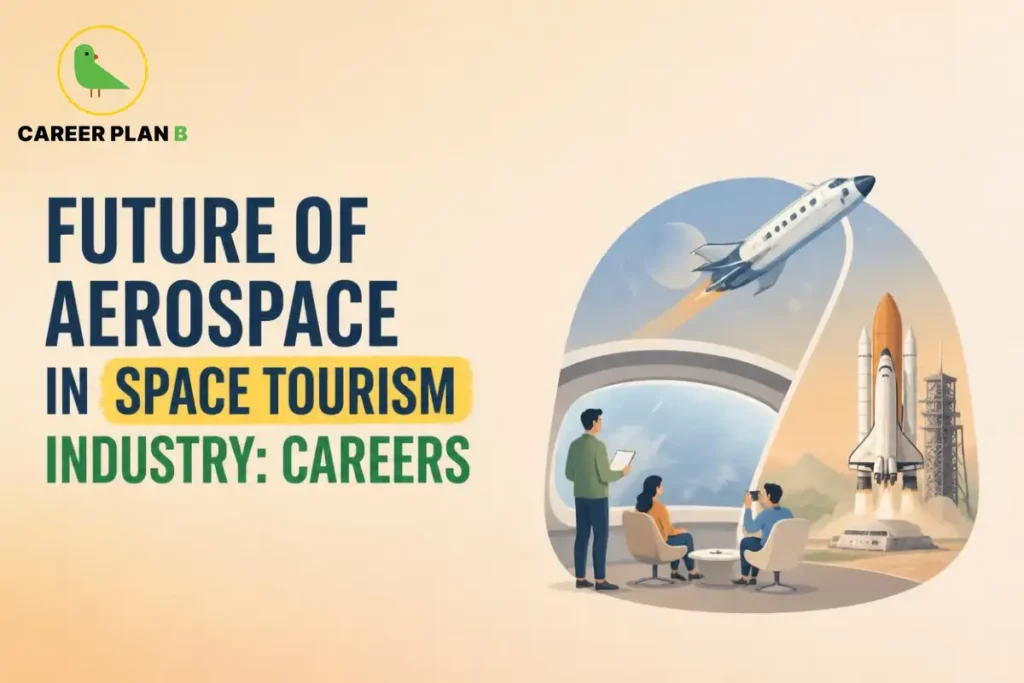
Introduction
For decades, going to space was reserved for trained astronauts. That’s beginning to change. As commercial spaceflight companies work toward making space travel accessible to private citizens, the future of aerospace in the space tourism industry is shaping up to be one of the most exciting frontiers within aerospace engineering.
How close is this really to becoming mainstream, and what does it mean for aspiring aerospace engineers in India? This blog breaks down where the technology currently stands, India’s growing role in this space, and the career opportunities emerging around it.
What Is Space Tourism, and How Close Are We?
Space tourism involves commercial spaceflights that take private citizens beyond Earth’s atmosphere. These missions may offer brief suborbital experiences or, in the future, longer orbital stays. Globally, companies have already conducted crewed suborbital flights. Orbital tourism has also begun through commercial partnerships with space stations.
Suborbital vs Orbital Tourism: Key Differences
Suborbital space travel involves a shorter flight that reaches the edge of space before returning to Earth, typically lasting minutes. Orbital tourism, by contrast, involves circling the Earth or docking with a space station, requiring significantly more complex engineering, life support systems, and safety certification.
Commercial Spaceflight Technology: What’s Driving This Shift?
Commercial spaceflight technology has advanced considerably as private companies have entered a space traditionally dominated by government agencies. Falling launch costs, reusable rocket technology, and growing private investment have made commercial human spaceflight a more realistic near-term goal than it was a decade ago.
India’s Private Space Sector: Where Does India Fit In?
India’s space sector reforms since 2020 have opened the door for private companies to participate in launch vehicle development, satellite technology, and space infrastructure. The India private space sector now includes several startups working on launch vehicles and space technology, alongside ISRO‘s own human spaceflight programme, Gaganyaan, which is working toward India’s first indigenous crewed spaceflight.
India’s first space traveller flew on a commercial international mission in 2025. The mission provided valuable spaceflight experience and supported preparations for India’s future crewed missions. This reflects India’s current stage of development. Space tourism remains a long-term commercial opportunity rather than an immediate, large-scale industry.
Aerospace Engineering in Space Tourism: What’s Actually Involved?
Aerospace engineering in space tourism spans several critical areas: spacecraft design for repeated, safe crewed flights, life support systems for passenger safety and comfort, launch vehicle reliability engineering, and rigorous safety certification processes specific to carrying non-professional astronauts.
Key Engineering Challenges
Unlike traditional government space missions, space tourism serves a much broader range of passengers. Engineers must prioritise comfort, medical safety protocols, and simplified emergency procedures. At the same time, they must maintain the extreme reliability standards required for human spaceflight.
Emerging Career Opportunities: Space Tourism Engineering Jobs
This emerging field is creating genuinely new roles within aerospace. Space tourism engineering jobs include:
- Spacecraft systems engineer – designing crewed vehicle systems for repeated commercial use
- Life support systems engineer – developing systems that maintain passenger safety and comfort
- Launch vehicle reliability engineer – focused on the safety and reusability of launch systems
- Astronaut training and simulation specialist – developing training programs for non-professional space travellers
Skills Needed for Space Tourism Careers
| Traditional Aerospace Skills | Space Tourism Skills |
|---|---|
| Spacecraft structural design | Passenger safety systems and human factors engineering |
| Propulsion and launch systems | Reusable launch vehicle design |
| Systems testing and certification | Commercial human spaceflight safety standards |
| Materials science | Life support and cabin environment systems |
Building a career in space-tourism careers India-wide will likely mean combining strong aerospace fundamentals with a growing focus on human factors engineering and commercial safety certification, an area still maturing globally.
For Personalized Guidance
Aerospace Engineer Future Scope in Tourism
Looking ahead, the aerospace engineer’s future scope in tourism appears genuinely promising, but it’s realistic to expect this to develop gradually. Suborbital tourism is likely to mature commercially before orbital tourism becomes widely accessible, and India’s own path will likely follow the progress of its human spaceflight programme before any dedicated commercial tourism ventures take shape domestically.
How Career Plan B Helps
Space tourism is one of the most futuristic and rapidly evolving niches within aerospace, and understanding whether it’s genuinely the right fit takes more than fascination with the idea of space travel. Career Plan B offers personalised career counselling and the Psycheintel assessment to help students evaluate their aptitude for this emerging, high-precision field. With academic profile guidance and structured career roadmapping, Career Plan B helps students build a realistic path toward careers in commercial spaceflight and space tourism engineering.
For Latest Information
Frequently Asked Questions
- Is space tourism already happening today?
Yes, in a limited way. Suborbital commercial flights have already taken private citizens to the edge of space, and orbital tourism has taken early steps through commercial missions to space stations, though it remains expensive and limited in scale.
- What should I study to work in space tourism engineering?
A strong foundation in aerospace engineering, combined with knowledge of systems safety, human factors engineering, and spacecraft life support systems, is valuable for this niche.
- Is space tourism a realistic career path in India right now?
It’s an emerging, longer-term opportunity. India’s human spaceflight programme is currently the primary stepping stone, with dedicated commercial space tourism likely to develop further as that programme matures.
- Which companies are working on space tourism technology?
Globally, several private spaceflight companies are actively developing suborbital and orbital tourism capabilities. In India, ISRO’s Gaganyaan programme and a growing ecosystem of private space startups are building the underlying technology and expertise.
- Is this a good specialization for aerospace engineering students?
Yes, as a long-term, high-potential niche. It’s still an early-stage field globally, so building relevant skills now, particularly in human spaceflight safety and systems engineering, can be a genuine long-term advantage.
Conclusion
The future of aerospace in the space tourism industry works, pointing toward a genuinely exciting, if gradually developing, frontier. As India builds toward its own crewed spaceflight capability and the global commercial space industry matures, the career opportunities in this niche are likely to expand meaningfully over the coming decade.
If this emerging field excites you, don’t navigate it alone. Connect with Career Plan B and take the Psycheintel assessment to understand how your strengths align with this evolving space. Being early to a frontier industry can shape the entire trajectory of your career.