Team Career Plan B · July 15, 2026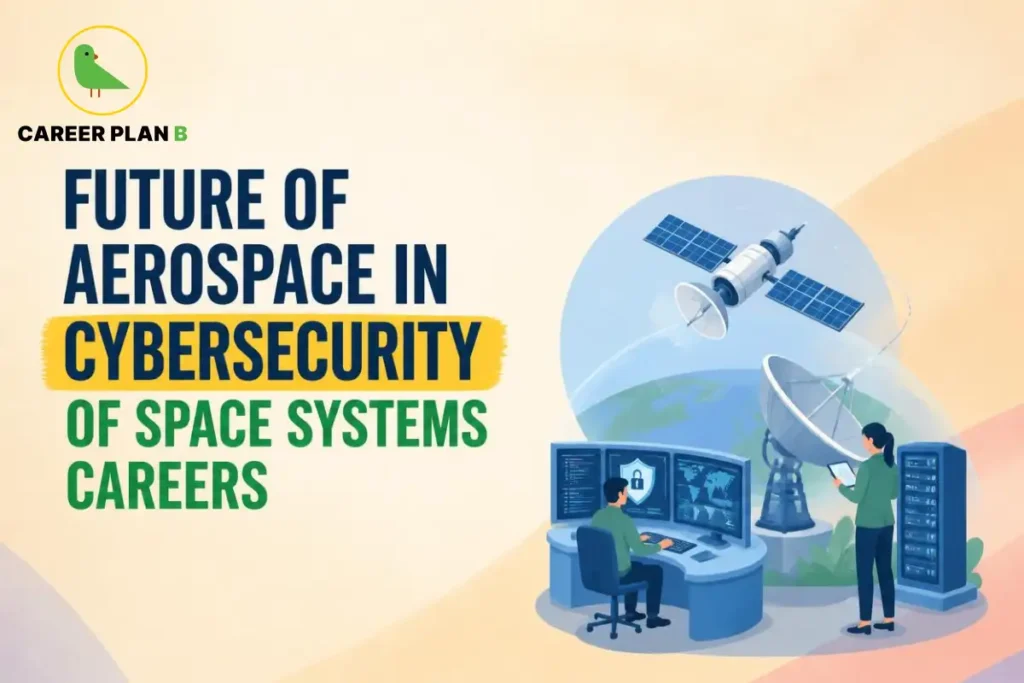
Introduction
A satellite hack isn’t just about stolen data; it can disrupt communication, navigation, and national security in an instant. As India’s space sector expands rapidly, protecting satellites and ground infrastructure from cyber threats has moved from an afterthought to a genuine engineering priority. This is exactly what the future of aerospace in cybersecurity of space systems looks like: a fast-emerging niche combining traditional aerospace engineering with cybersecurity expertise.
This blog breaks down why this field is growing, what recent Indian policy developments mean for the industry, and the career opportunities opening up at the intersection of aerospace and cybersecurity.
Why Space Systems Cybersecurity Matters Now
Satellites are unlike typical IT systems in important ways: they operate in orbit for years, can’t be physically repaired after launch, and rely on radio signals that can potentially be jammed or spoofed. As space systems cybersecurity India-wide becomes a growing concern, it’s clear that protecting these assets requires engineering-level thinking, not just conventional IT security practices.
A Real Policy Shift in India
In February 2026, India took a significant step in this direction. The Indian Computer Emergency Response Team (CERT-In), working with the Satcom Industry Association of India (SIA-India), released the country’s first comprehensive CERT-In space guidelines, a dedicated cybersecurity framework covering satellite operators, ground station controllers, equipment manufacturers, and private space firms. This reflects a broader shift: cybersecurity is now being treated as a core part of mission assurance for space systems, not an afterthought bolted on later.
How Aerospace Engineering Connects to Cybersecurity
Aerospace engineering in cybersecurity is a genuinely interdisciplinary space. The framework groups satellite systems into distinct segments: the satellite itself, the ground stations that control it, and the communication links connecting them, and each segment requires engineers who understand both the underlying aerospace systems and how to secure them against digital threats.
Key Vulnerabilities in Space Systems
Some of the specific risks this field addresses include attacks on the communication link between satellites and ground stations, attempts to jam or intercept signals, and vulnerabilities in onboard software that controls satellite operations. Since many satellites remain in orbit for a decade or more, security measures need to be built to last, including forward-looking approaches like quantum-resistant encryption.
Ground Station Security: A Critical Layer
Ground station security is a major focus area within this field, since ground infrastructure is often more accessible to attackers than the satellite itself. This involves securing command and control systems, protecting against unauthorised access, and ensuring that the systems sending commands to satellites can’t be spoofed or manipulated a genuinely serious risk, since fake commands could cause real operational damage.
Emerging Career Opportunities in This Niche
This shift is creating genuinely new roles that didn’t widely exist a few years ago.
Satellite Cybersecurity Careers
Satellite cybersecurity careers now include roles such as the following:
- Space systems security engineer – securing satellite hardware and onboard software
- Ground station security specialist – protecting control and command infrastructure
- Satellite communications security analyst – monitoring and securing the links between satellites and ground systems
- Chief Space Security Officer (or equivalent) – a newly emerging leadership role focused specifically on cybersecurity governance for space operations
These roles are appearing across government space agencies, private satellite operators, and defence-adjacent organisations, reflecting a talent pipeline that India’s space sector is still actively building.
Skills Needed for This Niche
| Traditional Aerospace Skills | Space Cybersecurity Skills |
|---|---|
| Satellite systems design | Secure-by-design engineering principles |
| Communication payload engineering | Encryption and signal security (including quantum-resistant approaches) |
| Ground station operations | Zero Trust security architecture |
| Systems testing | Incident response and threat monitoring |
Building expertise in this field means combining core aerospace and satellite communication knowledge with genuine cybersecurity fundamentals, a distinctly interdisciplinary skill set that’s still relatively rare.
Have Any Doubts?
Aerospace Engineer Future Scope in Cybersecurity
The aerospace engineer’s future scope in cybersecurity looks strong, driven by a straightforward reality: India’s space sector is growing faster than its cybersecurity talent pipeline. As more private satellite operators and space-tech startups enter the market, the need for engineers who understand both satellite systems and security fundamentals will only increase. This is a genuinely early-stage niche in India, which means meaningful opportunity for those who build the right skills now.
How Career Plan B Helps
Understanding whether this interdisciplinary niche blending aerospace engineering with cybersecurity is the right fit takes more than following headlines about India’s new space policies. Career Plan B offers personalised career counselling and the Psycheintel assessment to help students evaluate their aptitude for this emerging, technically demanding field. With academic profile guidance and structured career roadmapping, Career Plan B helps students build a realistic path into space systems security.
For Latest Information
Frequently Asked Questions
- Is cybersecurity really a concern for satellites?
Yes. Satellites and ground stations face genuine risks like signal jamming, interception, and command spoofing, which is why India introduced a dedicated cybersecurity framework for its space sector in 2026.
- What should I study to work in space systems cybersecurity?
A strong foundation in aerospace or communication systems engineering, combined with cybersecurity fundamentals like encryption, network security, and secure systems design, is ideal for this niche.
- Is this a government-only career path?
No. While government space agencies are involved, private satellite operators, ground station providers, and space-tech startups are increasingly building out cybersecurity roles as well.
- Are India’s new space cybersecurity guidelines mandatory?
As of their release in early 2026, the CERT-In and SIA-India guidelines are advisory rather than mandatory, though they represent a significant step toward formal, government-backed standards for the sector.
- Is this a good long-term specialization for aerospace students?
Yes, particularly given how early-stage this niche currently is in India. Building interdisciplinary skills in both aerospace systems and cybersecurity now could be a genuine long-term advantage as the talent pipeline develops.
Conclusion
The future of aerospace in cybersecurity of space systems reflects a genuinely important shift in how India’s growing space sector thinks about resilience, treating cybersecurity as mission-critical, not an afterthought. For aerospace engineers, this represents a real, early-stage opportunity to build expertise in a field that’s only going to grow more essential.
If this interdisciplinary niche interests you, don’t navigate it alone. Connect with Career Plan B and take the Psycheintel assessment to understand how your strengths align with this evolving space. Being early to a genuinely emerging field can shape the rest of your career.