Team8 · July 27, 2026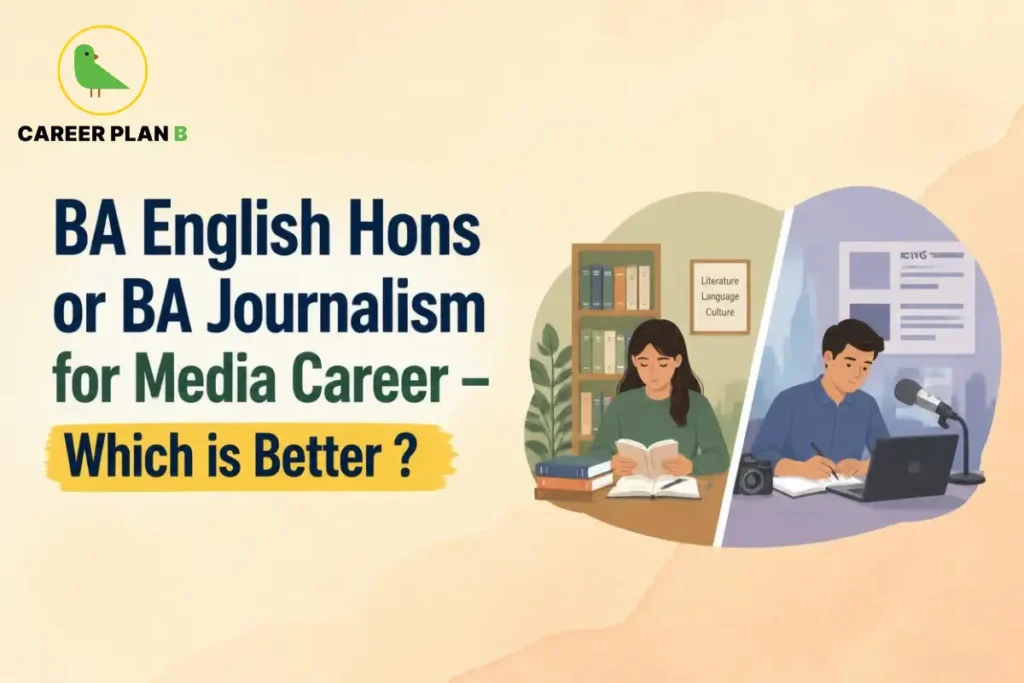
Introduction
If a media career is your goal, you have probably wondered whether BA English Hons or BA Journalism for media career is the better choice. Although both degrees can lead to rewarding opportunities in journalism, content writing, publishing, digital media, and broadcasting, they prepare students in different ways. While BA English Hons focuses on language, literature, and critical thinking, BA Journalism emphasises reporting, media production, and practical newsroom skills. Therefore, the right option depends on the career path you want to pursue. In this guide, we compare BA English Hons or BA Journalism for media career to help you understand what each programme offers, the skills you will develop, and the roles you can pursue after graduation.
What BA English Honours Actually Builds
A BA English Honours degree focuses heavily on literature, critical analysis, and long-form writing. You’ll spend three years reading closely, arguing ideas on paper, and developing a genuinely strong command over language and structure.
This foundation translates well into roles requiring polished, thoughtful writing — think editorial work, scriptwriting, or content strategy. However, it doesn’t specifically train you in news writing, deadlines, or media production, which Journalism programmes do directly.
What BA Journalism Actually Builds
BA Journalism and Mass Communication, meanwhile, is built specifically around the media industry itself. You’ll learn news writing, reporting techniques, media law and ethics, and often get hands-on exposure to print, broadcast, or digital production.
Consequently, this degree prepares you more directly for newsroom environments, where speed, accuracy, and format-specific writing matter as much as language skill.
Which One Actually Suits Your Media Ambitions?
If you’re drawn to reporting, breaking news, or broadcast journalism specifically, BA Journalism gives you a genuinely faster, more direct runway. Its curriculum is built around exactly those skills from day one.
However, if your interest leans toward long-form writing, editorial roles, or even scriptwriting for OTT and film, BA English Honours often builds a stronger core writing foundation, even though it requires you to pick up media-specific skills separately later.
What About Combining Both Paths?
Many successful media professionals actually studied English and picked up journalism skills through internships, certifications, or a postgraduate diploma afterward. Institutes like the Indian Institute of Mass Communication (IIMC), an autonomous body under the Ministry of Information and Broadcasting, offer postgraduate diplomas that work well after either undergraduate degree.
Therefore, choosing English Honours doesn’t lock you out of journalism — it just means adding a targeted diploma later, rather than getting that training built in from year one.
Have Any Doubts?
Eligibility for Both Degrees
Both BA English Honours and BA Journalism typically require only a Class 12 pass from a recognised board, in any stream. Some universities do request a basic English proficiency check or a short writing sample for Journalism specifically.
Comparison Table: BA English Hons vs BA Journalism for Media Careers:
| Institute | Programme | Best Suited For |
|---|---|---|
| Delhi University (Various Colleges) | BA English (Honours) | Editorial, content writing, publishing, and scriptwriting careers |
| School of Open Learning, University of Delhi | BA (Programme) with Journalism | Flexible learning with no CUET requirement for media-related education |
| Sharda University | BA Journalism and Mass Communication | Practical media training with a strong focus on visual storytelling and communication skills |
| Indian Institute of Mass Communication (IIMC), New Delhi | PG Diploma in Journalism (After Any UG Degree) | Newsroom, reporting, broadcasting, and digital journalism careers |
Note: Admission criteria and specialisation availability change periodically. Verify current details directly on each official website. (Source: Indian Institute of Mass Communication, autonomous body under Ministry of Information and Broadcasting)
How Career Plan B Helps
Choosing between English Honours and Journalism genuinely depends on which corner of media you’re drawn to. Career Plan B offers Personalised Career Counselling to help you match your specific media interest to the right undergraduate path.
It also provides Psycheintel and Career Assessment Tests to check whether reporting-style urgency or reflective, editorial writing suits you better. Admission and Academic Profile Guidance and Career Roadmapping then help you sequence your degree and any postgraduate diploma sensibly.
Get In Touch With Us
Frequently Asked Questions
01. Can I become a journalist with just a BA English Honours degree?
Yes, many do, often by adding a postgraduate diploma in journalism or gaining hands-on experience through internships afterward.
02. Is BA Journalism only useful for news reporting?
Not at all. It also opens doors to broadcast production, digital media, public relations, and corporate communications roles.
03. Which degree is more respected by media employers?
Neither is universally “more respected” — employers generally value demonstrated writing skill and practical experience over the specific degree title.
04. Should I do BA English Honours if I want to write for films or OTT eventually?
Yes, this path often suits scriptwriting ambitions better, since it builds deep narrative and language skills that journalism programmes don’t emphasise as heavily.
05. Do I need to choose right now, or can I explore both?
You can absolutely explore both through internships or electives during your degree before committing fully to one media direction.
Have Any Doubts?
Conclusion
Neither BA English Honours nor BA Journalism is objectively “better” for a media career — they simply build different skills for different corners of the industry. Journalism trains you directly for newsroom speed and format, while English Honours builds deeper writing craft you can later direct toward media work.
That said, your specific interest — reporting versus reflective writing — should guide this choice more than reputation alone. If you’re still torn between the two, Career Plan B can help you match your genuine strengths to the right starting point.
Media careers rarely follow one single path — pick the degree that builds the skills you’ll actually use first.