Careerplanb · November 2, 2026
Introduction
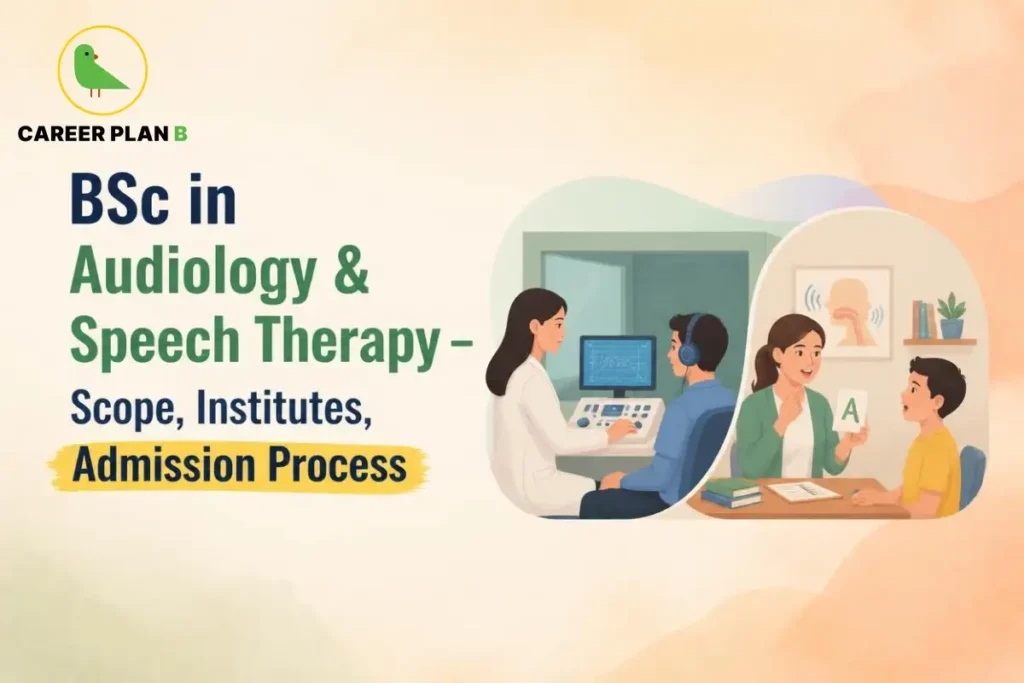
Imagine helping a child speak their first clear words, or helping someone regain their hearing function after an accident. That’s the everyday reality for professionals in audiology and speech-language pathology — a healthcare field that’s often overlooked but deeply impactful.
If you’re a science student wondering what comes after 12th beyond the usual MBBS/Engineering choices, BSc Audiology & Speech-Language Pathology, commonly known as BASLP, is worth a serious look. It’s a specialized, regulated healthcare degree with strong scope across hospitals, schools, and rehabilitation centers.
This blog covers what BASLP actually is, why it’s a regulated profession, the admission process, and your career scope after graduating.
What is BASLP and Why It’s a Regulated Course?
BASLP trains students to assess, diagnose, and treat hearing, speech, and language disorders. Unlike tattoo artistry, this field is tightly regulated — and for good reason, since it directly involves patient health and clinical care.
The Rehabilitation Council of India (RCI) is the apex government body, set up under an Act of Parliament, to regulate training programmes and courses targeted at disabled, disadvantaged, and special education communities. RCI was set up as a registered society in 1986, became a Statutory Body on 22 June 1993 after the RCI Act was enacted by Parliament in 1992, and was further amended by Parliament in 2000 to make it more broad-based. The Council’s mandate includes regulating and monitoring services given to persons with disabilities, standardising syllabi, and maintaining a Central Rehabilitation Register of all qualified professionals working in Rehabilitation and Special Education — with punitive action prescribed against unqualified persons delivering these services.
This means BASLP isn’t just an academic qualification — under Sections 19 and 23 of the RCI Act, 1992, professionals must be enrolled in the Central Rehabilitation Register to legally practice as a rehabilitation professional anywhere in India.
Have Any Doubts?
Why Choosing an RCI-Recognised Institute is Non-Negotiable
Candidates wishing to pursue any rehabilitation training course are strongly advised to seek admission only in institutions recognised by RCI, because any rehabilitation qualification obtained from a non-recognised institution is not valid for employment or practice. This is one of the most important things to verify before you apply anywhere.
Eligibility and Admission Process
While exact entrance requirements vary slightly by institute, the general eligibility pattern for BASLP includes:
- Educational qualification: 10+2 (or equivalent) with Physics, Chemistry, and Biology/Mathematics/Computer Science
- Minimum marks: Typically around 50% aggregate, though this varies by institution
- Age: Some institutes set an age range, generally between 17–25 years
- Medical fitness: Candidates are usually required to be medically fit, given the clinical nature of the course
How Admissions Typically Work
- Check that your shortlisted institute is RCI-recognised
- Apply through the institute’s or affiliated university’s admission portal
- Some institutes conduct entrance exams or interviews; others offer direct merit-based admission
- Submit required documents (marksheets, medical fitness certificate)
- Complete admission formalities and fee payment
It’s worth noting that admission processes differ significantly between institutes — some use centralized entrance exams, while others rely on direct merit-based selection, so checking with your specific shortlisted institute is essential.
Course Structure and Duration
BASLP is a four-year undergraduate course combining theoretical knowledge with clinical training, regulated by the Rehabilitation Council of India to ensure a standardized curriculum and clinical training across recognized colleges. The program consists of 3 years of full-time academic coursework followed by a mandatory 1-year clinical internship.
During the academic years, students study anatomy and physiology of speech and hearing mechanisms, audiology, speech-language pathology, psychology, and allied clinical subjects. The internship year gives students hands-on supervised experience working with individuals who have speech, language, hearing, and swallowing disorders, alongside training in counselling clients and their families.
Career Scope After BASLP
BASLP opens doors across both clinical and educational settings:
| Career Role | Typical Work Setting |
|---|---|
| Clinical Audiologist | Hospitals, ENT clinics, hearing care centres, and audiology departments |
| Speech-Language Pathologist | Hospitals, rehabilitation centres, multidisciplinary healthcare facilities, and private clinics |
| Speech Therapist (Schools) | Special schools, inclusive education institutions, and child development centres |
| Hearing Aid Specialist | Hearing aid manufacturers, hearing care companies, and audiology clinics |
| Independent Practitioner | Private practice or independent clinic after obtaining RCI registration |
Source: Rehabilitation Council of India (RCI) — recognised course structure and registration requirements (rehabcouncil.nic.in )
Many BASLP graduates also choose to pursue MASLP (Master of Audiology and Speech-Language Pathology) for deeper specialization, research opportunities, or academic/teaching roles.
How to Choose the Right BASLP Institute?
Before shortlisting any college, verify:
- Is it RCI-recognised? This is the single most important check — an unrecognised qualification won’t let you register or practice.
- What university is it affiliated with? Several BASLP programs are affiliated with state universities, which matters for degree validity.
- What clinical exposure do they offer? Look for institutes with strong hospital tie-ups or in-house clinical facilities for your internship year.
How Career Plan B Helps
Choosing a regulated healthcare course like BASLP requires careful institute verification and planning. Career Plan B offers personalized career counselling, Psycheintel and career assessment tests to confirm your fit for clinical healthcare work, admission and academic profile guidance to help you identify genuinely RCI-recognised institutes, and structured career roadmapping for your audiology and speech therapy career.
Get In Touch With Us
Frequently Asked Questions
01. Is BASLP a recognized degree in India?
Yes, when pursued at an institute recognised by the Rehabilitation Council of India (RCI), which is the statutory body governing rehabilitation training and education in India.
02. Can I practice as an audiologist without RCI registration?
No. Under the RCI Act, only professionals enrolled in the Central Rehabilitation Register are legally entitled to practice as rehabilitation professionals in India.
03. What is the duration of the BASLP course?
It’s a four-year program: three years of academic coursework followed by a mandatory one-year clinical internship.
04. What subjects do I need in 12th grade for BASLP?
Most institutes require Physics, Chemistry, and Biology/Mathematics/Computer Science, along with a minimum aggregate percentage that varies by institute.
05. What can I do after BASLP — is further study necessary?
You can start working immediately as an audiologist or speech-language pathologist after RCI registration, or pursue MASLP for specialization, research, or academic roles.
06. How do I check if an institute is RCI-recognised?
The Rehabilitation Council of India publishes a list of approved institutions; verify directly through the institute or RCI before applying, since a qualification from a non-recognised institute is not valid for practice.
Have Any Doubts?
Conclusion
BASLP offers a meaningful, clinically grounded career path for science students who want to make a tangible difference in people’s lives — whether that’s helping a child develop speech or restoring someone’s hearing function. Because it’s a regulated profession under the Rehabilitation Council of India, the most important decision you’ll make isn’t just choosing the course — it’s choosing an RCI-recognised institute.
Take the time to verify recognition status before you apply anywhere. Not sure how to evaluate your options? [Connect with Career Plan B] for personalized guidance on your audiology and speech therapy career journey.
Every conversation restored, every sound heard again — that’s the impact you could have. Your journey starts with the right institute.