Careerplanb · November 2, 2026
Introduction
When someone asks “what do you want to be?”, the standard answers roll out — engineer, doctor, lawyer, MBA. But India in 2026 is a vastly different world than the one those answers were designed for. New industries, new consumer behaviours, digital platforms, and a growing awareness of personal fulfilment have created genuine, income-generating careers in fields that did not exist — or were not taken seriously — just a decade ago.
The Government of India’s Skill India Mission, implemented through the National Skill Development Corporation (NSDC), recognises over 30 Sector Skill Councils covering industries from agriculture and beauty & wellness to media and entertainment. Each of these councils defines job roles, develops curriculum standards, and certifies professionals — including in fields most students would never consider as “careers.”
Source: National Skill Development Corporation
This blog is your guide to careers that are real, growing, and wide open for the right kind of person.
1. Pet Grooming and Animal Care
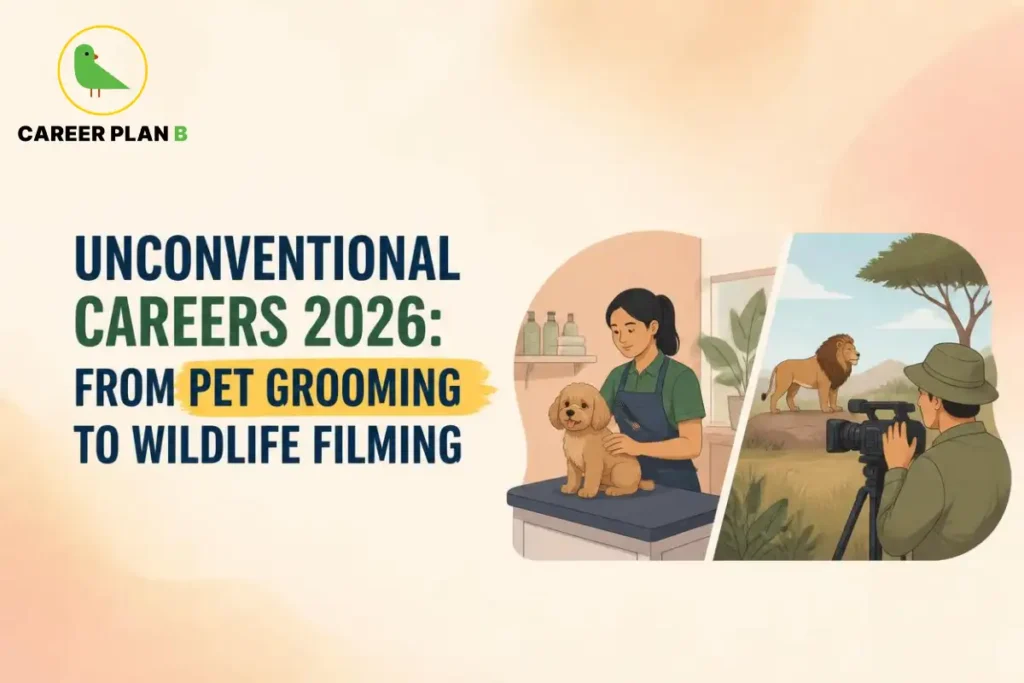
India’s pet care industry is one of the fastest-growing consumer sectors in the country, driven by rising urban pet ownership, nuclear families, and a growing culture of pet humanisation. Pet groomers provide professional hygiene, grooming, styling, and basic health care for pets — and the demand has gone from niche to mainstream in metros and tier-2 cities alike.
What you need:
- A passion for animals and patience with them
- Certificate or diploma in pet grooming and animal care
- Knowledge of animal anatomy, breed characteristics, and grooming techniques
How to start:
The Tourism and Hospitality Skill Council (THSC) and the Agriculture Skill Council of India (ASCI), both under NSDC, recognise animal care and grooming-related job roles under the National Qualifications Framework. You can pursue short-term certification programmes through NSDC-affiliated training centres listed on the Skill India Portal (skillindia.gov.in).
Source: NSDC Skill India Portal
Career paths: Pet grooming salon owner, mobile pet groomer, animal care technician at veterinary clinics, pet boarding facility manager.
Have Any Doubts?
2. Wildlife Filming and Nature Documentation
A career in wildlife filming is both visually demanding and intellectually rewarding. India’s extraordinary biodiversity makes it one of the world’s best locations for nature documentaries and wildlife filmmaking.
The Wildlife Institute of India (WII), an autonomous institution under the Ministry of Environment, Forest and Climate Change (MoEFCC), offers a range of training programmes in wildlife science and conservation that form the academic backbone for careers in wildlife documentation.
As per WII’s official training page, WII conducts:
- Short-term courses (1–3 weeks) on wildlife conservation, natural history, species identification, and field techniques for forest officers, NGOs, educators, and enthusiasts
- A Wildlife Conservation Course for Enthusiasts — a 10-day programme covering Indian biogeography, wildlife conservation strategy, citizen science, and field visits to protected areas
As per a Press Information Bureau (PIB) release dated March 2026, WII conducted its 10th Wildlife Conservation Course for Enthusiasts from 2–11 March 2026, with 148 participants trained since the programme’s inception in 2012.
Source: Wildlife Institute of India ; PIB (pib.gov.in)
Additionally, the Media and Entertainment Skills Council (MESC), set up under NSDC with NCVET recognition, defines job roles and qualifications in wildlife and nature cinematography, camera operation, and documentary production — providing a formal skills pathway for aspiring wildlife filmmakers.
Source: MESC — mescindia.org
Combine: A BSc in Wildlife Sciences or Zoology (UG level) + WII short courses + cinematography skills = a rare, powerful profile for wildlife documentary work.
3. Food Styling and Culinary Content Creation
With Instagram, YouTube, and OTT food shows dominating digital consumption, food styling has emerged as a genuine creative profession. Food stylists make dishes look extraordinary for photographs, advertisements, cookbooks, and video content.
This career sits at the intersection of culinary training, visual art, and commercial creativity. The National Council for Hotel Management and Catering Technology (NCHMCT), an autonomous body under the Ministry of Tourism, Government of India, offers B.Sc. in Hospitality and Hotel Administration — the foundational culinary qualification from which food stylists often build their careers.
Source: National Council for Hotel Management and Catering Technology
4. Ethical Hacking and Cybersecurity
The Ministry of Electronics and Information Technology (MeitY) has made cybersecurity a national priority under the National Cyber Security Policy. Ethical hackers — or penetration testers — are professionals hired to legally test systems for vulnerabilities before malicious actors can exploit them.
This is one of the highest-demand unconventional tech careers in India. Starting pathways include B.Tech in Cybersecurity at the National Forensic Sciences University (NFSU), which is a declared Institution of National Importance.
5. Laughter Yoga and Wellness Facilitation
India’s wellness sector — yoga, mindfulness, and therapeutic practices — is growing rapidly. Laughter yoga, a practice combining laughter exercises with yogic breathing, is now formally recognised as a wellness intervention in corporate health programmes and hospitals.
The Ministry of Ayush promotes traditional and alternative wellness practices, and the Yoga Certification Board (YCB) under the Ministry of Ayush certifies yoga professionals at different levels — including wellness facilitators.
Source: Ministry of Ayush ; Yoga Certification Board
6. Sustainable Farming and Agri-Entrepreneurship
The Government of India is working to double farmers’ income while promoting organic and natural farming. These initiatives are creating new opportunities in sustainable agriculture, agri-tech entrepreneurship, and farm consulting.
The Indian Council of Agricultural Research (ICAR) runs the Farmer First Programme and multiple Krishi Vigyan Kendras (KVKs) across India, providing skill development and entrepreneurship training in agriculture-related fields for students and rural youth.
Source: Indian Council of Agricultural Research
How Career Plan B Helps
Unconventional careers require courage, clarity, and a roadmap that most traditional guidance counsellors cannot provide. Career Plan B’s Psycheintel and Career Assessment Tests identify your unique strengths, interests, and temperament — helping you match them to careers that are genuinely right for you, not just familiar. Personalised Career Counsellinghelps you understand how to build a sustainable income in non-traditional fields. Career Roadmapping creates a step-by-step plan — from skill certifications to freelance work to full-time careers — so you never have to figure it out alone.
Get In Touch With Us
Frequently asked questions
Q1. Are unconventional careers financially stable?
Yes — when pursued with the right skills and certifications. Careers in pet grooming, culinary arts, wildlife conservation, and wellness facilitation all have formal skill certification frameworks under NSDC’s Sector Skill Councils and government ministries.
Q2. Does the government support skill development in unconventional careers?
Yes. The Pradhan Mantri Kaushal Vikas Yojana (PMKVY), implemented through NSDC, offers free or subsidised skill training across dozens of non-traditional job roles. Visit skillindia.gov.in for the list of training centres and eligible roles. (Source: NSDC — nsdcindia.org)
Q3. How can I become a wildlife filmmaker in India?
>>>>>>>>>>>>>>>>>>>>>>>>>>>>>>>>>>>>>>>>>>>>>>>>>Start with a BSc in Zoology or Wildlife Sciences, pursue short-term courses at the Wildlife Institute of India (WII), develop cinematography skills, and build a portfolio through field documentation. WII’s short-term courses are open to enthusiasts and professionals. (Source: wii.gov.in)
Q4. Is pet grooming a recognised career in India?
Yes. The Agriculture Skill Council of India (ASCI) under NSDC recognises animal care and grooming as formal job roles with National Qualifications Framework (NQF) aligned certification.
Q5. What is the role of MoEFCC in wildlife careers?
>>>>>>>>>>>>>>>>>>>>>>>>>>>>>>>>>>>>>>>>>>>>>>>The Ministry of Environment, Forest and Climate Change (MoEFCC) oversees the Wildlife Institute of India, Project Tiger, Project Elephant, and the network of protected areas — all of which offer research, documentation, and conservation career opportunities. (Source: moef.gov.in)
Have Any Doubts?
Conclusion
The Future Belongs to Those Who Colour Outside the Lines
In 2026, some of India’s most fulfilling and future-proof careers are in fields that do not appear in standard textbooks. The government is investing in skill development, wildlife conservation, wellness, and digital content — all of which create real professional opportunities. The question is not whether these careers are valid. The question is whether you are willing to pursue them with as much seriousness as any conventional path.
Discover your unconventional strengths. Take Career Plan B’s Psycheintel Assessment today.