Deepti · August 11, 2026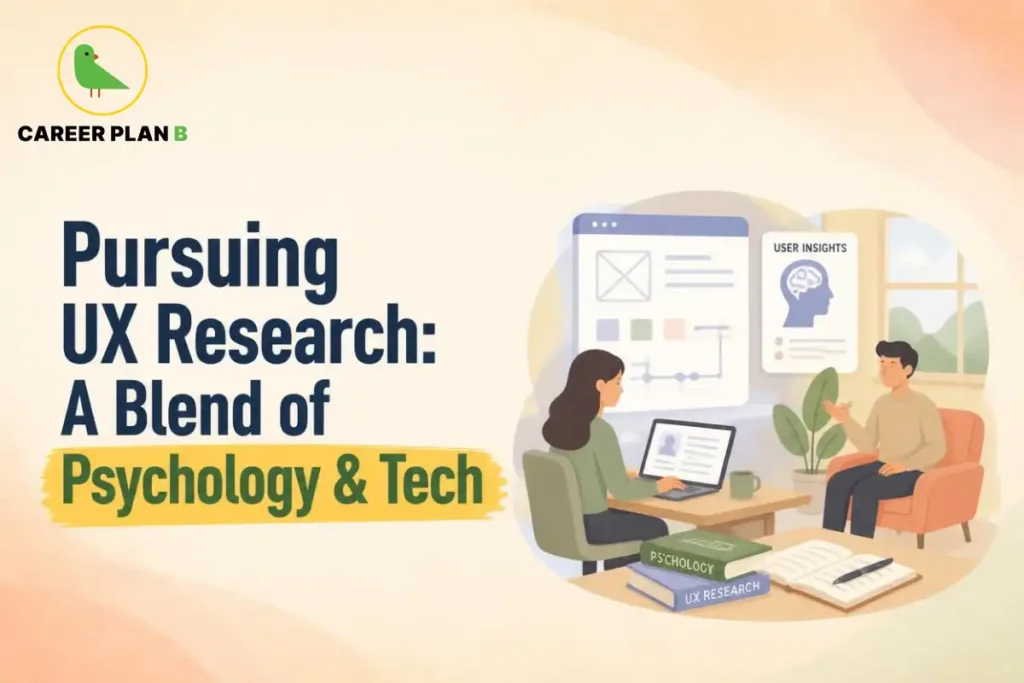
Introduction
For students who find themselves equally drawn to psychology and technology, UX research offers a career path that genuinely combines both — studying how real people think, feel, and struggle while using digital products, then translating those insights into better design decisions. Pursuing UX research as a career has grown rapidly in India alongside the broader tech and product design industry, but it’s still poorly understood by many students and parents who assume “UX” simply means graphic design. This guide breaks down what UX research actually is, the academic routes into it, and what a genuine career here looks like.
What Is UX Research, Exactly?
UX (User Experience) Research is the systematic study of how users interact with products — apps, websites, software, physical devices — to understand their needs, pain points, and behaviour patterns. It sits at the intersection of psychology (understanding human cognition and behaviour), design (translating insights into usable interfaces), and technology (understanding what’s feasible to build). A UX researcher isn’t the person drawing wireframes — that’s typically a UX/UI designer’s role — but the person who conducts interviews, usability tests, surveys, and behavioural analysis that inform what gets designed in the first place.
Academic Pathways After Class 12
BA/BSc in Psychology — A strong foundation, since UX research draws heavily on cognitive psychology, behavioural science, and research methodology; many Indian universities, including Delhi University, offer well-regarded psychology programs with admission through CUET UG.
Human-Computer Interaction (HCI) or Design programs — A smaller number of Indian institutes offer dedicated design or HCI-focused undergraduate and postgraduate programs that combine technology and user-centred design directly.
Computer Science or Information Technology, paired with UX specialisation later — Some students enter through a technical undergraduate degree and then specialise in UX research through postgraduate study or targeted certifications.
Postgraduate specialisation — An MSc in Human-Computer Interaction, Cognitive Science, or a specialised UX/Design postgraduate diploma is common for those aiming for research-heavy roles at larger technology companies.
Academic Pathways Into UX Research: Quick Comparison
| Pathway | Core Strength | Typical Duration | Best Suited For |
|---|---|---|---|
| BA/BSc Psychology | Cognitive science, research methodology | 3–4 years | Students drawn to human behaviour first, tech second |
| HCI/Design programmes | Direct blend of design and technology | 3–4 years (fewer institutes offer this) | Students wanting a dedicated, focused UX track early |
| Computer Science/IT + later specialisation | Strong technical grounding, UX added later | 3–4 years + postgraduate/certification | Students entering through a technical route |
| Postgraduate specialisation (MSc HCI/Cognitive Science) | Deep research focus, senior-role readiness | 2 years, after a bachelor’s degree | Those aiming for research-heavy roles at larger companies |
Skills That Actually Matter in UX Research
- Qualitative and quantitative research methods — conducting user interviews, running usability tests, and analysing survey data are core, everyday tasks, not occasional add-ons
- Cognitive psychology fundamentals — understanding attention, memory, decision-making, and cognitive load directly shapes how you interpret user behaviour
- Data analysis and basic statistics — quantitative UX research increasingly involves working with behavioural data and analytics, requiring reasonable comfort with numbers
- Communication and storytelling — translating research findings into insights that designers, engineers, and business stakeholders can actually act on is arguably the most underrated UX research skill
- Familiarity with design and research tools — common industry tools for prototyping, usability testing, and survey analysis are typically expected, and most professionals build this familiarity on the job or through short coursesFor Personalized Guidance
Career Scope and Where UX Researchers Work
Technology and product companies — Software companies, e-commerce platforms, and fintech firms are major employers, given how directly user experience affects business outcomes in digital products.
Design and consulting agencies — Specialised UX/design consultancies serve multiple clients across industries, offering researchers exposure to varied problem types rather than a single product.
Government digital services — India’s expanding digital governance initiatives increasingly need user research to ensure public digital services are actually usable by citizens across literacy and digital-familiarity levels — a genuinely growing and socially meaningful application of the field.
Startups — Early-stage companies often need UX researchers to validate product decisions quickly, offering broader, less specialised exposure than large corporate teams.
Academia and research institutions — For those drawn more to the psychology side, cognitive science and HCI research roles within universities and research labs are a smaller but legitimate path, usually requiring postgraduate qualification.
Skilling and Certification Ecosystem
Beyond formal degrees, India’s tech skilling ecosystem — including government-industry partnership platforms like NASSCOM’s FutureSkills Prime, supported by the Ministry of Electronics and Information Technology — offers structured upskilling programs relevant to UX and related digital design roles, useful for students who want to supplement a psychology or design degree with practical, industry-aligned training.
Realistic Salary and Growth Expectations
UX research as a specialised tech-adjacent role typically offers competitive entry-level compensation compared to many traditional career paths, particularly at established technology companies, though this varies significantly based on company size, city, and whether the role is research-focused or blended with design responsibilities. Growth in this field tends to reward specialisation — researchers who develop strong expertise in specific research methods, a particular industry vertical, or quantitative/data-heavy research tend to see the strongest long-term career progression.
Who Should Consider This Path
UX research suits students who are genuinely curious about why people behave the way they do, comfortable with structured research methodology, and interested in technology without necessarily wanting to code or design visually themselves. It’s a strong option for psychology-inclined students who want a technology-industry career without abandoning their interest in human behaviour — a combination that traditional career advice in India often overlooks.
How Career Plan B Helps
UX research sits at a genuine crossroads between psychology and technology, and figuring out the right entry point — psychology degree, HCI program, or technical degree with later specialisation — depends heavily on your specific strengths and interests. Career Plan B uses Psycheintel and Career Assessment Tests to assess whether your aptitude leans toward the research-methodology and human-behaviour side or the more technical, data-driven side of UX work, helping clarify the right starting degree. Our Personalised Career Counselling helps you evaluate specific psychology, HCI, or design programs realistically, and Admission and Academic Profile Guidance supports your applications to the right undergraduate or postgraduate courses. Career Roadmapping lays out a clear path from your Class 12 decision through to a genuine UX research role, including where certifications and postgraduate specialisation fit in along the way.
Get In Touch With Us
FAQs
Q1. Is UX research the same as UI/UX design?
No — UX research focuses on studying user behaviour and needs through structured methods, while UI/UX design focuses on creating the actual interface and visual experience based on those research insights.
Q2. Do I need a psychology degree to become a UX researcher?
Not strictly, but it’s a strong and increasingly common foundation; students from HCI, design, or even computer science backgrounds also enter this field, often with additional targeted training.
Q3. What’s the difference between UX research and market research?
UX research specifically focuses on how users interact with a product or interface, while market research is broader, covering consumer preferences, pricing, and brand perception beyond just product usability.
Q4. Is coding knowledge necessary for a UX research career?
Not essential for most UX research roles, though basic technical literacy helps you communicate effectively with designers and engineers and understand product constraints.
Q5. Which Indian companies hire UX researchers?
A broad range of technology, e-commerce, fintech, and design consultancy firms hire for this role, alongside a growing number of government digital service initiatives focused on citizen-facing platforms.
Q6. Is a master’s degree necessary for a strong UX research career?
Not always required for entry-level roles, but a postgraduate qualification (in HCI, cognitive science, or a related field) meaningfully strengthens prospects for senior or research-heavy positions.
Conclusion
Pursuing UX research offers a genuinely distinctive career path for students who want to combine psychology and technology rather than choosing one over the other, with strong and growing demand across India’s technology, design, and digital governance sectors. Whether you start from psychology, design, or a technical degree, the field rewards curiosity about human behaviour paired with structured research skill. If you’re drawn to understanding why people do what they do — and want that curiosity to shape real products — this is a career worth taking seriously.