Team6 · July 22, 2026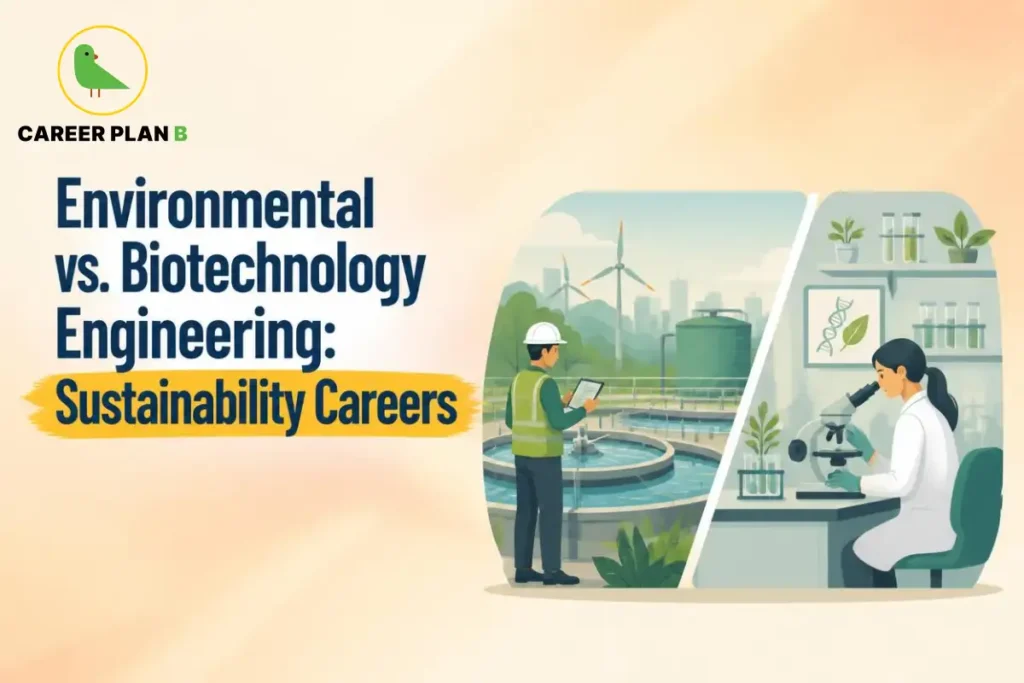
Introduction
Both of these fields get grouped under the broad label of “sustainability careers”, and it’s easy to see why. Both involve solving environmental problems, both require serious technical training, and both show up in conversations about the future of clean industry. But the environmental vs biotechnology engineering comparison actually reveals two fairly different career paths, with different training, tools, and day-to-day work, even though they sometimes overlap in surprising ways.
Understanding these differences matters if you’re trying to choose between them, or even just trying to figure out which field lines up better with how you like to work. Let’s break down what each one actually involves.
What Does Environmental Engineering Actually Involve?
Environmental engineering tends to focus on large-scale systems: water treatment, air quality, waste management, and pollution control. This kind of work often connects to sustainable materials management, where engineers apply a hierarchy of preferred strategies, from source reduction to recycling to responsible disposal, when tackling waste-related challenges (EPA Sustainable Materials Management Hierarchy). Most environmental engineering careers involve working on infrastructure projects, regulatory compliance, or large industrial systems, and environmental engineering jobs typically require a strong foundation in civil engineering principles alongside environmental science.
What Does Biotechnology Engineering Actually Involve?
Biotechnology engineering, particularly the branch closely related to bioengineering and biomedical engineering, takes a very different approach. Instead of managing large physical systems, this field applies engineering principles directly to biological systems, organisms, and processes. According to the U.S. Bureau of Labour Statistics, bioengineers and biomedical engineers held about 22,200 jobs in 2024, with a median annual wage of $106,950 (BLS Bioengineers and Biomedical Engineers). Many biotechnology engineering careers involve laboratory work, designing biological processes, or developing organisms and enzymes that can perform specific functions, which is a meaningfully different day-to-day experience from environmental engineering’s more infrastructure-heavy work.
Where Sustainability Fits Into Both Fields
Sustainability shows up in both fields, just through different mechanisms. Environmental engineering’s connection to sustainability is fairly direct: managing pollution, treating water, and reducing waste at scale. Biotechnology’s contribution often comes through what’s known as green biotechnology, using engineered organisms or biological processes to solve environmental problems. Bioremediation is a clear example here, where microorganisms are used to help break down contaminants in soil, sediment, or groundwater rather than relying purely on physical or chemical cleanup methods (EPA Biological Agents and Bioremediation). Similarly, the U.S. Department of Energy’s Bioenergy Technologies Office supports research into converting biomass and waste into biofuels and bioproducts, another example of biological processes being engineered toward sustainability goals (DOE Bioenergy Technologies Office).
Have Any Doubts?
Key Differences in Education, Skills, and Tools
Despite both contributing meaningfully to sustainability, the actual training and daily tools involved look quite different.
| Aspect | Environmental Engineering | Biotechnology Engineering |
|---|---|---|
| Core Focus | Large-scale systems: water, air, waste | Biological systems, organisms, and processes |
| Typical Background | Civil/environmental engineering, environmental science | Bioengineering, biomedical engineering, molecular biology |
| Common Work Settings | Infrastructure sites, government agencies, consulting firms | Laboratories, research facilities, biotech companies |
| Sustainability Angle | Direct pollution control and resource management | Green biotechnology: bioremediation, biofuels, engineered organisms |
This kind of split helps explain why someone drawn to hands-on infrastructure work might lean environmental, while someone who enjoys lab-based biological problem-solving might lean toward biotech.
Which Sustainability Career Path Is Right for You?
Both are genuinely sustainable engineering fields, just suited to different kinds of interests. If you enjoy working with large systems, infrastructure, and regulatory frameworks, environmental engineering is likely the better fit. If you’re drawn to biology, lab work, and engineering at the molecular or organism level, biotechnology engineering probably makes more sense. Neither path is objectively more valuable to sustainability efforts; they simply approach the same broad goal from very different technical angles.
How Career Plan B Helps
Career Plan B helps students choose the right sustainability career path through personalized guidance, assessments, and career planning.
Personalized Career Counselling: Helps identify whether environmental engineering or biotechnology engineering aligns with your interests and career goals.
Psychometric & Career Assessment Tests: Evaluate skills, strengths, and preferences to suggest suitable career opportunities.
Career Roadmapping: Provides a clear plan for education, skill development, and future career growth.
Admission & Academic Profile Guidance: Supports students in selecting the right courses, colleges, and specialization options.
Get In Touch With Us
Frequently Asked Questions
1. Is biotechnology engineering the same as biomedical engineering?
They overlap significantly, though biomedical engineering often focuses more specifically on healthcare applications, while biotechnology engineering can extend into environmental and industrial uses as well.
2. Which field has better job growth, environmental or biotech engineering?
Both show steady, positive growth, with bioengineers and biomedical engineers projected to grow slightly faster than environmental engineers according to BLS data.
3. Do both careers require lab work?
Biotechnology engineering typically involves more consistent lab work, while environmental engineering often involves a mix of field, office, and site-based work.
4. Can environmental engineers work in green biotechnology?
It’s possible with additional training, though the two fields generally require somewhat different technical foundations.
5. Which degree is harder to pursue?
Both are demanding, technical degrees; the difficulty often comes down to personal strengths in large-systems thinking versus biological and molecular science.
Conclusion
The environmental vs biotechnology engineering comparison ultimately comes down to scale and approach. Environmental engineering tackles sustainability through large systems and infrastructure, while biotechnology engineering approaches it through biological processes and organisms. Both are legitimate, meaningful paths into sustainability work, and both offer solid long-term career prospects for the right person.
If you’re still weighing which direction fits your strengths and interests, Career Plan B can help you explore both paths and build a realistic plan to get there. Whichever you choose, you’ll be stepping into work that genuinely contributes to a more sustainable future.