Team6 · July 22, 2026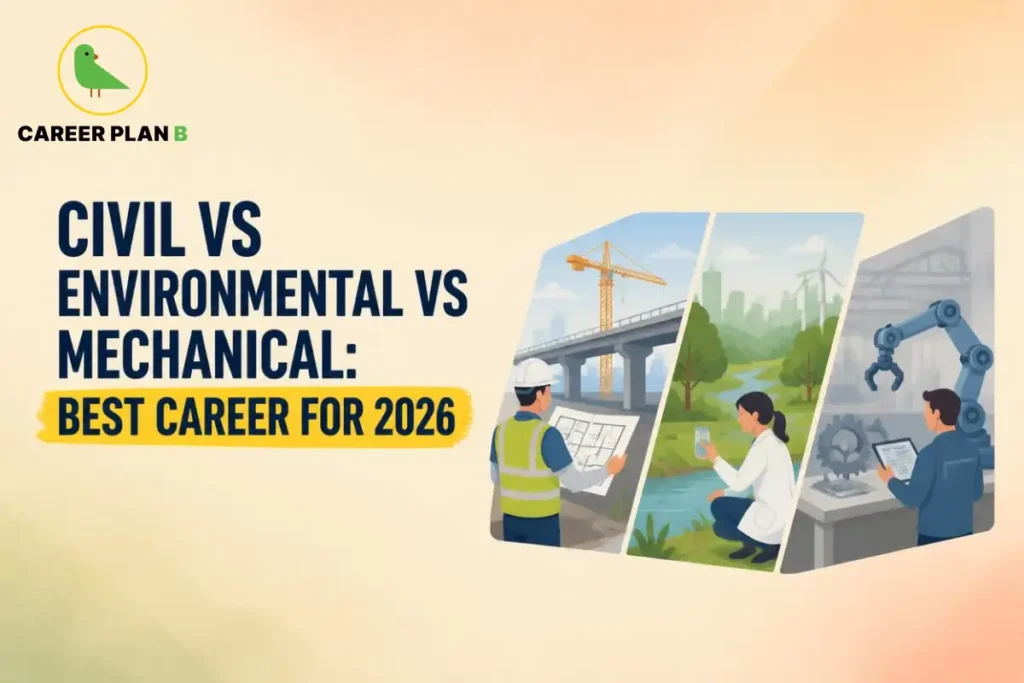
Introduction
Every year, thousands of students weigh the same three options after Class 12, and the debate around civil vs environmental vs mechanical: the best career for 2026 keeps getting more relevant as each field evolves at a different pace. These remain the most commonly chosen engineering branches in India, yet they lead to genuinely different job markets, growth trajectories, and day-to-day work. Too often, students pick one of these based on popularity or a family member’s suggestion, without actually comparing scope, salary, and government job routes side by side. This blog breaks down all three honestly, so you can make a more informed choice for 2026 and beyond.
What Each Field Actually Focuses On
Civil engineering centres on designing, constructing, and maintaining infrastructure, buildings, roads, bridges, and urban development projects. A mechanical engineering career, by contrast, focuses on manufacturing, machinery, thermal systems, and increasingly, electric vehicle components and automation. Environmental engineering career paths centre on pollution control, sustainability compliance, and protecting ecosystems from industrial impact. There’s meaningful overlap at the edges: mechanical engineers now work on EV battery thermal management, civil engineers increasingly handle environmental impact assessments, and environmental engineers collaborate with both on sustainable infrastructure and clean manufacturing processes.
Which Field Is Growing Fastest Right Now?
Is one of these three genuinely outpacing the others in 2026? Mechanical engineering is seeing a strong push from India’s electric vehicle production, industrial automation, and defence manufacturing sectors, with national policy priorities like Atmanirbhar Bharat and PLI schemes directly shaping this engineering specialization 2026 growth. Environmental engineering scope is expanding steadily too, driven by climate policy, renewable energy targets, and stricter pollution regulations, though its overall job volume remains smaller than the other two. Civil engineering continues to benefit from India’s ongoing infrastructure pipeline, though its growth tends to track construction and government spending cycles rather than a single dramatic policy push like EVs or green hydrogen.
Salary Comparison: Civil vs Environmental vs Mechanical
| Career Stage | Civil Engineering | Environmental Engineering | Mechanical Engineering |
|---|---|---|---|
| Entry-Level | INR 3 – 5 lakh | INR 4.5 – 7 lakh | INR 3 – 5 lakh (tier 2/3), 7–12 lakh (IIT/NIT) |
| Mid-Level | INR 8 – 14 lakh | INR 8 – 18 lakh | INR 7 – 18 lakh |
| Senior-Level | INR 15 – 35+ lakh | INR 15 – 30+ lakh | INR 20 – 60+ lakh (PSU/MNC) |
Interestingly, mechanical engineering shows the widest senior-level spread, largely because top PSUs and multinational R&D roles pay considerably more than smaller manufacturing units, while environmental engineering salaries tend to be more consistent across the mid-career range due to steady demand in compliance-focused roles.
Government (PSU) Routes Through GATE
All three fields offer strong government job pathways through the Graduate Aptitude Test in Engineering, commonly known as GATE. Civil engineers can pursue GATE PSU recruitment routes into organizations like NHAI and CPWD, mechanical engineers into BHEL, ONGC, ISRO, and SAIL, and environmental engineers into pollution control boards and PSUs needing dedicated compliance expertise. You can check official exam dates, eligibility, and participating organizations through the GATE official website, maintained by the IIT hosting the exam that year. Notably, mechanical and civil engineering typically see higher GATE cut-offs due to larger applicant pools and more PSU vacancies, while environmental engineering, being a smaller branch, often has comparatively less competition for available government seats.
Have Any Doubts?
Skills and Certifications That Matter for Each
For a civil engineering career, certifications in Building Information Modeling (BIM) and project management (PMP) boost pay significantly. For mechanical engineers, skills in Finite Element Analysis (FEA), CAD/CAM software, and increasingly robotics or EV systems design are highly valued, particularly as companies like Ola Electric and Tata Motors expand their EV manufacturing hiring. For environmental engineering career paths, credentials like LEED green building certification and GIS mapping proficiency continue to open doors in consulting and compliance roles. Across all three fields, professionals who combine core engineering fundamentals with in-demand digital or specialized skills consistently out-earn peers who rely purely on their degree.
Career Roles and Growth Path
| Career Stage | Civil | Mechanical | Environmental |
|---|---|---|---|
| Entry-Level | Site Engineer / Junior Civil Engineer | Design/Production Engineer Trainee | Junior Environmental Engineer |
| Mid-Level | Project Engineer / Manager | Senior Design Engineer / Project Lead | Environmental Consultant / PSU Officer |
| Senior-Level | Senior Project Manager | Engineering Manager / R&D Lead | Senior Consultant / Compliance Manager |
How Career Plan B Helps
Career Plan B helps students choose the right engineering specialization through personalized guidance, assessments, and career planning.
Personalized Career Counselling: Helps compare civil, environmental, and mechanical engineering paths based on interests, skills, and career goals.
Psychometric & Career Assessment Tests: Evaluates aptitude, strengths, and preferences to identify the most suitable engineering field.
Career Roadmapping: Provides a structured plan for education, skill development, certifications, and career growth.
Admission & Academic Profile Guidance: Supports students in selecting the right courses, colleges, and specialization options.
Get In Touch With Us
Frequently Asked Questions
1. Which of these three fields pays the most in 2026?
Mechanical engineering shows the highest senior-level pay ceiling, particularly through PSU and MNC roles, though environmental and civil engineering both offer strong mid-career growth.
2. Which field has the most government job opportunities?
Civil and mechanical engineering generally have more PSU vacancies due to larger applicant pools, though environmental engineering roles face less competition per seat.
3. Which field is growing fastest right now?
Mechanical engineering is currently seeing rapid growth through EV manufacturing and defence production, while environmental engineering is expanding steadily through climate policy.
4. Is environmental engineering a smaller field than the other two?
Yes, numerically it’s a smaller branch, but demand is growing steadily and competition for government roles tends to be comparatively lower.
5. Which one should I choose if I’m unsure of my interests?
Reflect on whether you’re drawn to building infrastructure, designing machinery and systems, or protecting the environment through compliance work, since each field rewards a different kind of problem-solving.
Conclusion
Weighing civil vs environmental vs mechanical: the best career for 2026 ultimately depends on the type of problem-solving you enjoy most. All three branches offer strong government and private-sector opportunities. They also provide competitive salary growth and clear GATE-based pathways to stable PSU roles. Mechanical engineering currently leads in rapid industry growth and senior-level earning potential. Civil engineering offers the broadest infrastructure-driven job opportunities. Environmental engineering provides steady, policy-backed demand with comparatively less competition for specialized roles. Instead of choosing based on popularity or peer influence, consider the day-to-day work each field involves. Choosing a branch that matches your interests and strengths will support long-term career satisfaction.
If you’re still torn between these three paths, a conversation with a Career Plan B counsellor can help you weigh your genuine interests and aptitude before you finalize your entrance exam choices.