Team Career Plan B · July 22, 2026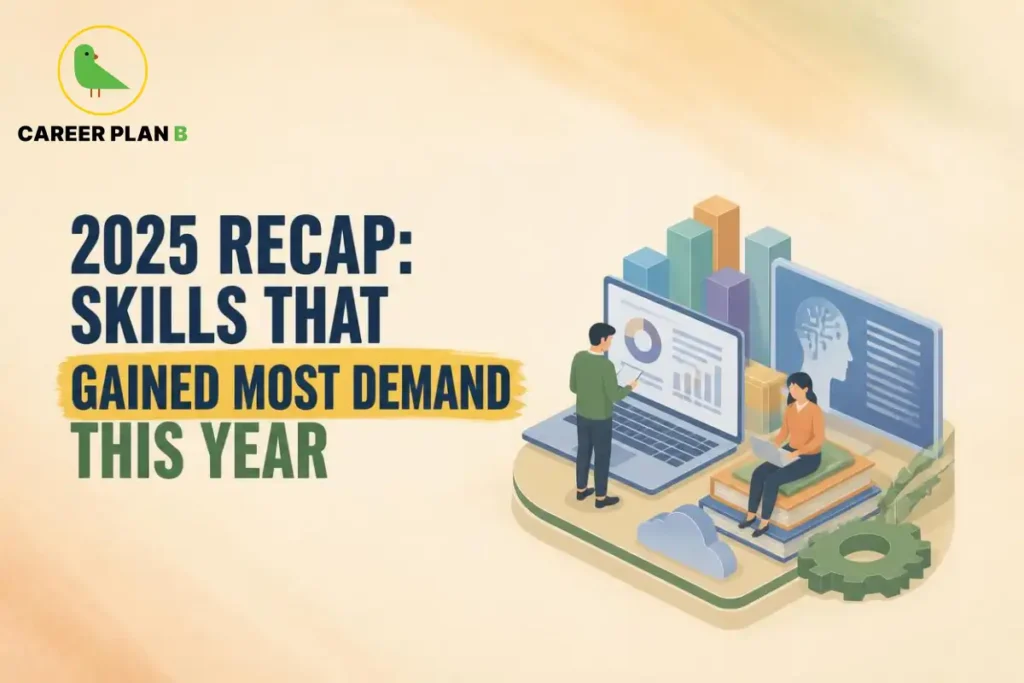
Introduction
India’s skilling landscape shifted noticeably in 2025. The Ministry of Skill Development and Entrepreneurship trained candidates under PMKVY 4.0. By December, 27.08 lakh people had completed this training (Source: PIB, Government of India). This training spanned 38 sectors and 732 districts nationwide. Consequently, that scale reflects a broader shift in which Skills That Gained Most Demand in India is prioritising.
This guide covers which specific skills that gained most demand through 2025. It explains why this shift happened, and who should pay attention to it. In addition, it looks at the government programmes driving this change. Finally, it explains what this recap means for students planning their path in 2026.
Why 2025 Was a Turning Point for skills that gained most demand?
Why did skill demand shift so visibly this year? Government policy played a direct role.
PMKVY 4.0 introduced 102 future-skill job roles and 77 customised courses during 2025 (Source: PIB, Government of India). This marked a clear move from generic training toward targeted, high-demand skill areas. Moreover, the scheme converged with major national missions. These included the National Green Hydrogen Mission and PM Surya Ghar: Muft Bijli Yojana.
Additionally, over 400 new courses were introduced covering AI, 5G technology, cybersecurity, and drone technology (Source: Prime Minister of India). This signals a decisive policy push toward emerging technology skills. Therefore, 2025 was not a random shift. It was a deliberate, government-backed realignment of India’s skilling priorities.
Who Should Pay Attention to This Recap?
Is this recap only relevant to job seekers already in the workforce? Not exactly.
Students in Class 11 and 12 benefit from understanding which skills are gaining traction early. This helps inform subject and stream choices before board exams. College students and recent graduates can use this recap to identify certification gaps. Filling these gaps can strengthen their employability significantly. Working professionals considering upskilling can also use this information. It helps them choose relevant, future-focused training instead of outdated options.
Therefore, this recap serves as a planning tool. It is not just a historical summary of the past year.
Skills that gained most demand in 2025
Several specific skill areas stood out clearly through government skilling data this year.
1. Artificial Intelligence and Emerging Technology Skills
AI-related courses were among the newly introduced skill areas under PMKVY 4.0 in 2025. The Ministry also launched SOAR, a foundational AI literacy initiative for Classes 6 to 12 (PIB, Government of India). As a result, AI literacy is being built earlier in the education pipeline.
2. Cybersecurity Skills
Cybersecurity training was explicitly added among the new PMKVY 4.0 course offerings this year. Consequently, this reflects growing demand as more sectors digitise their operations.
3. Green and Renewable Energy Skills
Green jobs training expanded significantly through PMKVY’s convergence with national missions. This includes the National Green Hydrogen Mission and PM Surya Ghar: Muft Bijli Yojana. Skilling here directly supports India’s renewable energy expansion.
4. Semiconductor and Advanced Manufacturing Skills
The government developed a dedicated Semiconductor Workforce Strategy during 2025. This built industry-led, stackable qualifications for a future-ready talent pipeline. In turn, this reflects India’s growing focus on advanced manufacturing capability.
5. Digital Design and 3D Modelling Skills
The Directorate General of Training signed an agreement with Autodesk in November 2025. This aims to enhance digital design skills across 14,682 ITIs and 33 NSTIs nationwide (PIB, Government of India). This covers over 23 lakh trainees in AI, 3D design, and manufacturing tools.
6. Soft Skills and Workplace Readiness
The Ministry launched a national Employability and Life Skills Framework in 2025. This strengthens soft skills and 21st-century workplace competencies. Therefore, technical skills alone are no longer considered sufficient.
The Government Programmes Driving This Shift
What is actually powering these changes? Several restructured schemes sit behind this shift.
The Skill India Programme was approved with an outlay of Rs. 8,800 crore. It now combines PMKVY 4.0, PM-NAPS, and the JSS Scheme (Prime Minister of India). Moreover, this restructuring emphasises demand-driven, industry-aligned training. It replaces the earlier target-driven enrollment approach.
The Skill India Digital Hub now provides end-to-end digitisation of the training lifecycle. This includes registration through post-certification tracking. Meanwhile, KaushalVerse has digitised governance, monitoring, and grievance redressal. As a result, the entire skilling ecosystem has become considerably more transparent.
For Personalized Guidance
What This Means for Students Planning Ahead
How should students actually use this recap? Focus on aligning your choices with clearly emerging demand.
Firstly, consider building foundational AI literacy early, even at the school level. This is now formally supported through NSQF-aligned micro-credentials for Classes 6 to 12. Secondly, evaluate whether your current stream includes exposure to green skills or emerging technologies. If not, look for relevant certification options alongside your core curriculum.
Finally, remember that soft skills now carry official recognition alongside technical training. Ultimately, building genuine workplace readiness matters just as much as technical certification.
How Career Plan B Helps
Understanding which skills to prioritise can feel overwhelming without clear direction. Career Plan B simplifies this through:
- Personalised Career Counselling: matching your interests to emerging skill areas like AI, green energy, or advanced manufacturing
- Psycheintel Career Assessment Tests: identifying whether your strengths align with technical, analytical, or workplace-readiness skill areas
- Admission and Academic Profile Guidance: helping you identify certifications aligned with 2026’s most in-demand skill categories
- Structured Career Roadmapping: building a clear plan that connects your current academic stage to future-focused skill development
For Latest Information
Frequently Asked Questions
Q1. Which skill area saw the biggest government push in 2025?
Artificial intelligence and emerging technology skills saw significant investment. This included school-level AI literacy programmes and hundreds of new specialised courses.
Q2. Do I need to leave my current stream to build these skills?
However, most in-demand skills can be built alongside your existing academic stream. Many are available through certification programmes rather than full course changes.
Q3. Are green skills only relevant for engineering students?
No, green skills span technical, policy, and support roles across sectors. This makes them relevant to a wide range of academic backgrounds.
Q4. How can school students access AI literacy training?
The SOAR initiative provides NSQF-aligned AI literacy for Classes 6 to 12. This is integrated directly into the national skilling framework.
Q5. Is soft skills training officially recognised in India’s skilling system?
Yes, the Employability and Life Skills Framework formally recognises soft skills in 2025. It sits alongside technical training as a national priority.
Q6. Will this trend toward emerging skills continue into 2026?
Government investment and restructured schemes suggest continued focus in this direction. Additionally, skilling priorities are expected to keep evolving alongside industry demand.
Conclusion
Skills that gained most demand in 2025 reflect a clear, government-backed shift in India’s workforce priorities. From AI literacy in schools to green skills and semiconductor training, this was a deliberate realignment, not a passing trend. Therefore, students who understand these shifts can plan their academic and certification choices accordingly.
That said, success still depends on matching your interests and strengths to these emerging areas. Do not simply follow every trend blindly. If you are unsure which skills fit your profile, Career Plan B can help you plan ahead.