Team6 · July 23, 2026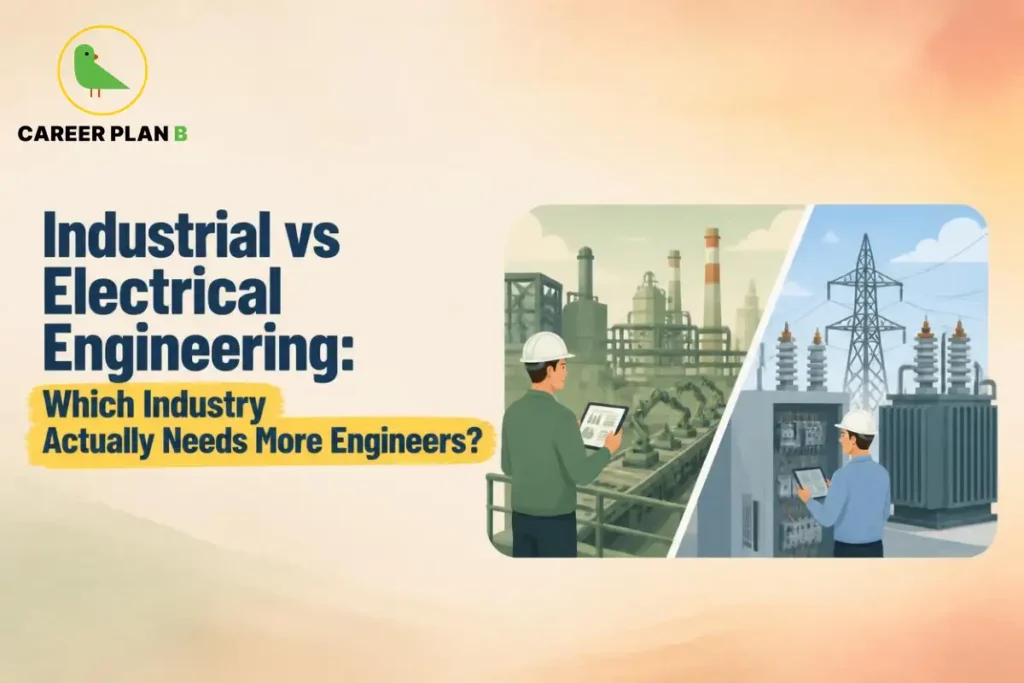
Introduction
India’s power sector is expanding rapidly through smart grids, EV charging infrastructure, and renewable energy integration, while manufacturing simultaneously scales under the National Manufacturing Mission’s push toward a 25 per cent GDP share by 2035. Both stories sit right at the heart of Industrial vs Electrical Engineering: Which Industry Needs More?, a question genuinely worth exploring since these two branches serve such different, fast-growing sectors of the economy. Students rarely compare these two branches head-to-head, largely because electrical engineering feels tied to power and electronics, while industrial engineering feels tied to factories and manufacturing systems, seemingly unrelated worlds. However, once you look closely at real demand drivers, GATE-PSU access, and actual salary data, the comparison reveals genuinely useful insights for choosing between them. This blog breaks down both branches honestly and in depth, so you can decide with real clarity.
What Each Branch Actually Focuses On in Practice
Electrical Engineering: Power, Grids, and Electrification
Electrical engineering centres on generating, transmitting, and distributing electrical power, alongside designing the systems that make modern electrification possible, from power grids to electric motors and control systems. This branch has evolved considerably from its traditional roots, now extending deeply into smart grids, electric vehicle infrastructure, and renewable energy integration. Consequently, an electrical engineering career India-wide today looks considerably more dynamic than it did even a decade ago, since the field increasingly overlaps with digital technology and clean energy transitions rather than remaining confined to traditional power distribution work.
Industrial Engineering: Systems, Efficiency, and Process Optimization
Industrial engineering, by contrast, focuses on optimizing how people, machines, and materials work together within a system, whether that’s a factory, a supply chain, or an entire manufacturing operation. Rather than specializing in one specific technology like power systems, industrial engineers apply systems thinking across nearly any operational context, making this branch genuinely interdisciplinary by design. Therefore, industrial engineering scope tends to span multiple industries simultaneously, from automotive to pharmaceuticals, rather than anchoring itself to one specific sector the way electrical engineering anchors itself to power and electrification.
Which Industry Genuinely Needs More Engineers Right Now?
So which of these two industries actually needs more engineers today? Both sectors are expanding, but for meaningfully different reasons. India’s power sector needs electrical engineers specifically because the country is racing to electrify transportation, modernize aging grid infrastructure, and integrate rapidly growing renewable energy capacity, all of which require specialized power systems expertise that doesn’t exist in abundant supply yet. Manufacturing, meanwhile, needs industrial engineers because the National Manufacturing Mission’s ambitious 2035 targets depend on genuine efficiency gains within existing and new factories, work that requires systems-level optimization skills rather than power-specific technical knowledge. Consequently, neither industry is objectively winning this demand race outright; they’re both scaling simultaneously, just for structurally different reasons tied to India’s broader economic transformation.
Government Job Scope: Electrical vs Industrial Engineering Through GATE
Electrical’s Strong Maharatna PSU Access
Electrical engineering holds a particularly strong position in government recruitment, being described as the most demanding branch in the PSU sector by several placement analyses. Maharatna and Navratna PSUs like GRID-INDIA, BHEL, NTPC, and Power Grid Corporation actively recruit electrical engineers through GATE, with salaries at these top-tier PSUs ranging between ₹14 and ₹25 lakh per annum. This strong PSU pull reflects just how central electrical infrastructure remains to nearly every major government initiative, from power generation to defence and railways.
Where Industrial Engineering Fits Into PSU Recruitment
Industrial engineering, being a comparatively niche specialization, sees fewer dedicated PSU recruitment channels than electrical engineering’s broader access across power, oil and gas, and infrastructure sectors. That said, industrial engineers still find opportunities within manufacturing-focused PSUs and increasingly within private sector companies scaling under GATE PSU recruitment-linked government incentive schemes. Programmes across both branches require approval from the All India Council for Technical Education (AICTE), the Government of India’s apex technical education regulator, and official GATE exam details can be verified through the GATE official website, maintained by the IIT hosting the exam that year.
Have Any Doubts?
Which Sectors Are Actually Driving Demand for Each Branch?
Electrical engineering’s growing demand traces directly back to India’s electrification push. The FAME India Scheme, run by the Department of Heavy Industry under the Ministry of Heavy Industries, has sanctioned over 9,300 EV charging stations nationwide as of mid-2025, alongside the National Programme on Advanced Chemistry Cell Battery Storage, carrying an outlay of ₹18,100 crore to build domestic battery manufacturing capacity. This electrification push, combined with smart grid modernization and renewable energy integration, is creating consistent, structural demand for smart grid careers India-wide. Industrial engineering’s demand, meanwhile, ties closely to the broader manufacturing growth story, with the National Manufacturing Mission targeting 143 million jobs by 2035, a goal that fundamentally depends on the process optimization expertise industrial engineers specifically provide across expanding factories nationwide.
Salary Comparison: Electrical vs Industrial Engineering
| Career Stage | Electrical Engineering | Industrial Engineering |
|---|---|---|
| Entry-Level (Private) | INR 3.5 – 6 lakh | INR 2 – 6 lakh |
| Entry-Level (PSU/GATE) | INR 7–9 lakh (broad) and 14–25 lakh (Maharatna) | INR 5 – 14 lakh |
| Mid-Level | INR 8 – 15 lakh | INR 6 – 12 lakh |
| Senior-Level | INR 15 – 25+ lakh (PSU), higher in MNC EV roles | INR 12 – 20+ lakh |
Interestingly, electrical engineering shows a noticeably stronger PSU pay ceiling at top-tier Maharatna companies, largely because power sector infrastructure commands considerably higher government investment and priority than manufacturing-specific process roles typically receive.
Career Roles and Growth Path
| Career Stage | Electrical Engineering | Industrial Engineering |
|---|---|---|
| Entry-Level (Private) | INR 3.5 – 6L Basic electrical & EV work |
INR 2 – 6L Basic factory & process work |
| Entry-Level (PSU/GATE) | INR 7 – 25L Government & PSU power jobs |
INR 5 – 14L Government & PSU industrial jobs |
| Mid-Level | INR 8 – 15L Grid control & troubleshooting |
INR 6 – 12L Process optimization & logistics |
| Senior-Level | INR 15 – 25L+ Managing power projects & teams |
INR 12 – 20L+ Plant head & operations management |
How Career Plan B Helps
Career Plan B helps students and professionals make informed career decisions by providing personalized guidance, assessments, and structured career planning for choosing the right engineering specialization.
Personalized Career Counselling: Provides expert guidance based on individual interests, skills, career goals, and understanding of different engineering domains such as electrical, industrial, manufacturing, and technology-driven careers. It helps students identify the career path that best matches their strengths and future aspirations.
Psychometric & Career Assessment Tests: Identify personality traits, technical interests, aptitude, problem-solving abilities, and career preferences to help students evaluate whether electrical engineering, industrial engineering, smart manufacturing, power systems, or related fields align with their capabilities.
Career Roadmapping: Creates a step-by-step career plan covering academic decisions, skill development, certifications, entrance exam preparation, and industry readiness required for careers in GATE PSU recruitment, smart grids, EV technology, automation, manufacturing systems, and industrial operations.
Admission & Academic Profile Guidance: Helps students select the right engineering branch, courses, and colleges while improving their academic profile to prepare for long-term opportunities in electrical engineering, industrial engineering, renewable energy, manufacturing, and India’s evolving industrial sectors.
Get In Touch With Us
Frequently Asked Questions
1. Which industry genuinely needs more engineers right now, power or manufacturing? Both are expanding rapidly for different reasons power needs electrical engineers for electrification and grid modernization, while manufacturing needs industrial engineers for process efficiency under the National Manufacturing Mission.
2. Which branch pays more through GATE-PSU recruitment? Electrical engineering generally offers a stronger PSU pay ceiling, particularly at Maharatna companies like GRID-INDIA and BHEL, compared to industrial engineering’s narrower PSU access.
3. Which branch has stronger private-sector demand? Electrical engineering currently sees strong private demand through EV and renewable energy companies, while industrial engineering demand grows steadily alongside broader manufacturing expansion.
4. Can an industrial engineer work in the power sector, or vice versa?
Yes, to some extent industrial engineers can apply systems optimization skills within power plant operations, though core electrical design work typically requires electrical engineering expertise specifically.
5. Which branch should I choose if I want the most government job security?
Electrical engineering generally offers stronger, more consistent PSU access across a wider range of Maharatna and Navratna companies compared to industrial engineering’s narrower government recruitment channels.
Conclusion
Answering Industrial vs Electrical Engineering: Which Industry Needs More? ultimately reveals that both sectors are genuinely expanding, just driven by different structural forces within India’s broader economic transformation. Electrical engineering benefits from the country’s aggressive electrification push through EV infrastructure and smart grid modernization, while industrial engineering benefits from the systems-level efficiency work that manufacturing growth under the National Manufacturing Mission fundamentally requires. Rather than choosing based on which industry sounds more urgent in the news, it’s worth reflecting honestly on whether power systems and electrification genuinely interest you more than process optimization and manufacturing efficiency.
If you’re still unsure which path fits you best, a conversation with a Career Plan B counsellor can help you weigh your genuine interests and aptitude clearly before you finalize your entrance exam choices.