Team6 · July 23, 2026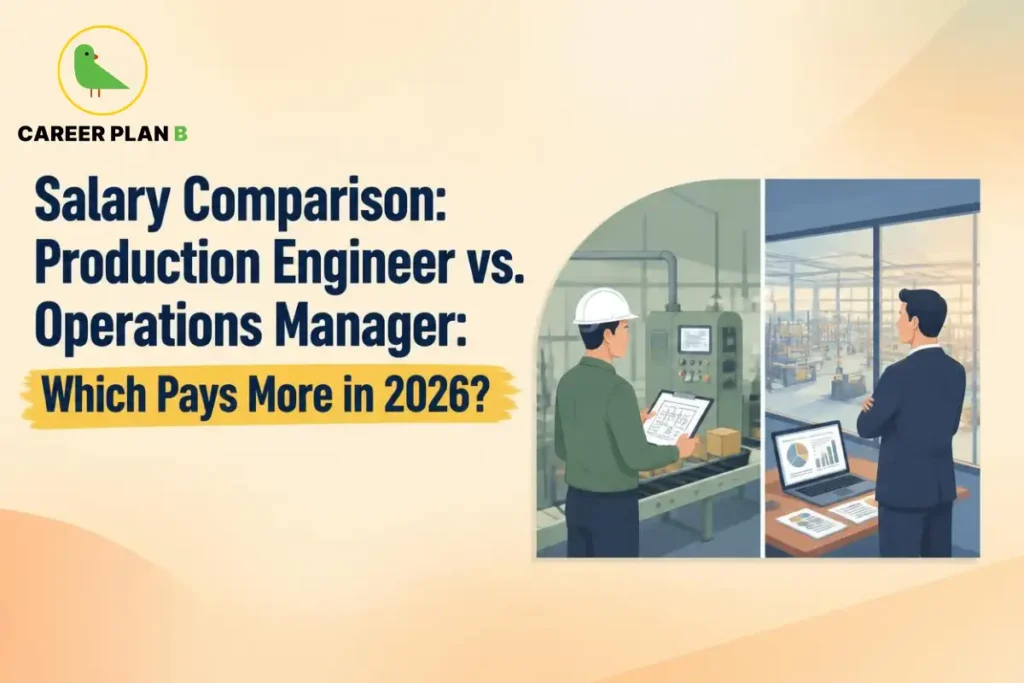
Introduction
Many production engineers eventually become operations managers, which makes this Salary Comparison: Production Engineer vs Operations Manager slightly trickier than it first appears, since these two roles often sit on the same career ladder rather than existing as entirely separate paths. Students frequently don’t realize this connection, assuming they’re choosing between two unrelated careers when they’re actually looking at different stages of the same professional journey. Understanding how this transition works, and what genuinely drives the pay difference between these two roles, matters considerably more than simply comparing two isolated salary figures. This blog breaks down the real data honestly, explains how the progression actually happens, and clarifies what drives the pay jump between them.
What’s the Real Difference Between These Two Roles?
Production Engineer: Hands-On Technical Execution
A production engineer focuses on the technical execution side of manufacturing, optimizing production processes, managing quality control, and ensuring products get manufactured efficiently and cost-effectively. This role demands deep, hands-on technical knowledge, since production engineers directly troubleshoot machinery issues, refine manufacturing workflows, and solve problems tied to specific production lines. Consequently, a production engineering career India-wide typically starts with this kind of specialized, execution-focused work close to the factory floor itself.
Operations Manager: Broader Business and People Leadership
An operations manager, by contrast, oversees the broader business side of manufacturing operations, managing budgets, coordinating cross-functional teams, and ensuring production goals align with overall business strategy. This role requires skills in supply chain management, project management, and data-driven decision-making, extending well beyond the technical execution focus that defines production engineering. Therefore, an operations management career genuinely broadens your scope of responsibility, shifting emphasis from solving specific technical problems toward leading people and aligning operations with business objectives.
Why Comparing These Two Salaries Isn’t Quite Apples-to-Apples
Is this really a fair, side-by-side comparison, or are we comparing two different career stages entirely? The honest answer leans toward the latter. Career resources consistently describe operations managers as beginning their careers in entry-level positions like production coordinator or operations analyst, then advancing into operations supervisor, project manager, or eventually operations manager roles as their experience grows. This progression pattern confirms that operations management often represents a natural evolution from technical roles like production engineering, rather than a completely separate entry point students choose independently right after graduation.
Production Engineer Salary India: What the Data Actually Shows
Why Third-Party Salary Figures Vary So Widely
Anyone researching this specific role quickly notices the same frustrating inconsistency seen across most engineering titles. One source reports fresher pay around ₹2.5 to ₹4.5 lakh annually; another shows entry-level figures between ₹4 and ₹5 lakh, while a third claims the average gross salary sits considerably higher at ₹16.3 lakh, blending junior and senior professionals together without clear labelling. This wide variance happens because most platforms pull from small, self-reported samples that rarely distinguish between fresher and experienced professionals clearly.
The More Reliable GATE-PSU Benchmark
Given this inconsistency, the most trustworthy anchor for production engineer salary in India comes from documented public sector pay structures accessible through GATE PSU recruitment. PSU pay scales for production and manufacturing-focused engineering roles typically offer more transparent, verifiable starting compensation than scattered private job-site estimates, since these figures follow a documented, government-linked structure rather than shifting based on which website you happen to check.
Operations Manager Salary India: A More Consistent Picture
Interestingly, operations manager salary India figures show noticeably more consistency across sources compared to production engineering data. Multiple sources converge around similar bands: associate operations managers with zero to two years of experience typically earn between ₹5 and ₹8 lakh annually, mid-level operations managers with three to five years of experience earn between ₹9 and ₹12 lakh, and senior operations managers with six to eight years of experience earn between ₹15 and ₹28 lakh. This relative consistency likely reflects that operations management, as a more standardized corporate title across industries, gets tracked more uniformly than manufacturing-specific engineering roles that vary considerably by sector and company size.
Have Any Doubts?
What Actually Drives the Pay Jump From Production Engineer to Operations Manager?
So why does pay typically increase meaningfully when someone transitions from production engineering into operations management? The answer largely comes down to expanded scope and accountability. Production engineers are responsible for specific technical outcomes within their domain, while operations managers hold broader responsibility for budgets, cross-functional coordination, and overall business performance, a considerably higher-stakes role that companies compensate accordingly. Additionally, many professionals strengthen this transition with an MBA or professional certifications in project management or supply chain, credentials that further justify the pay increase employers typically offer for this expanded responsibility.
Salary Comparison Table: Production Engineer vs Operations Manager
| Career Stage | Production Engineer | Operations Manager |
|---|---|---|
| Entry-Level | INR 2.5 – 5L Shop floor manufacturing and assembly monitoring. |
INR 5 – 8L Junior supervisory and workflow coordination. |
| Mid-Level | INR 5 – 10L Process line scaling and output quality control. |
INR 9 – 12L Resource planning and team leadership. |
| Senior-Level | INR 9 – 20L+ Plant production oversight and strategic scaling. |
INR 15 – 28L+ Enterprise operational strategy and budget control. |
This table makes the progression pattern clear: rather than being two competing entry-level choices, operations manager compensation genuinely builds on top of the experience and technical foundation a production engineering background typically provides.
Career Roles and Growth Path
| Career Stage | Typical Role | Natural Progression |
|---|---|---|
| Entry-Level | Junior Production Engineer | Builds technical foundation in manufacturing processes |
| Mid-Level | Senior Production Engineer / Operations Analyst | Takes on broader process and coordination responsibility |
| Senior-Level | Operations Manager / Plant Head | Leads teams, budgets, and overall operational strategy |
How Career Plan B Helps
Career Plan B helps students and professionals make informed career decisions through personalized guidance, career assessments, and structured planning for long-term growth.
Personalized Career Counselling: Provides expert guidance based on individual interests, skills, career goals, and preferred career direction. It helps students understand whether they should focus on technical production roles or plan a transition toward operations leadership.
Psychometric & Career Assessment Tests: Identify strengths, personality traits, leadership abilities, and career preferences to determine suitable opportunities in production engineering, operations management, manufacturing, and related fields.
Career Roadmapping: Creates a clear step-by-step career plan covering skill development, certifications, experience milestones, and career transitions required to move from production engineering roles toward higher-level operational leadership positions.
Admission & Academic Profile Guidance: Helps students choose the right courses, colleges, certifications, and specialization paths while improving their academic profile for better opportunities in manufacturing engineering jobs, production engineering careers, and operations management roles.
Get In Touch With Us
Frequently Asked Questions
1. Can a production engineer become an operations manager?
Yes, this is actually one of the most common career progressions, since production engineers already possess the technical foundation operations managers build broader leadership skills upon.
2. Which role pays more at the senior level?
Operations managers generally show a higher senior-level pay ceiling, reflecting their broader business responsibility and cross-functional leadership scope.
3. Do I need an MBA to become an operations manager?
Not always mandatory, but many professionals pursue an MBA or project management certifications to strengthen this transition and justify the expanded responsibility.
4. Why do salary websites show such different numbers for production engineers?
Different platforms pull from small, often unlabelled samples that blend junior and senior professionals together, creating inconsistent figures across sources.
5. Which role offers more stability, production engineering or operations management?
Production engineering offers strong technical stability tied to manufacturing demand, while operations management offers stability through its broader, more universally applicable business skill set.
Conclusion
Understanding this salary comparison: Production Engineer vs Operations Manager makes it clear that these aren’t really two competing career choices, but rather two connected stages of the same manufacturing career journey. Production engineering builds the essential technical foundation, while operations management genuinely expands that foundation into broader business leadership, a transition that consistently results in stronger senior-level pay. Rather than treating this as an either-or decision at the start of your career, it’s worth thinking about production engineering as the technical groundwork that could eventually support a move into operations leadership down the line.
If you’d like help mapping out this exact progression for your own career, a conversation with a Career Plan B counsellor can help you plan the right path forward.