Deepti · August 7, 2026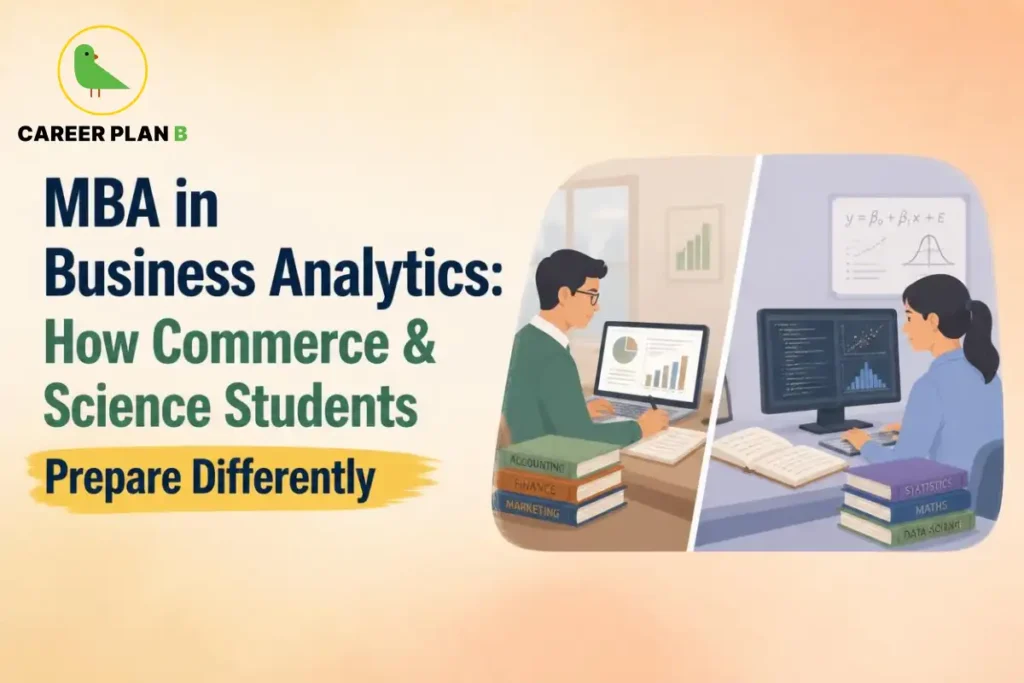
Introduction
Can a commerce graduate compete with a science graduate in an MBA in Business Analytics program? It’s one of the most common questions students ask before applying. Analytics-driven roles are growing fast across industries, and B-schools have responded by expanding their Business Analytics MBA India offerings. But your undergraduate background does shape how you prepare, what you’ll find easy, and where you might need extra effort.
In this blog, we’ll break down how commerce and science students typically experience this program differently, and what each group should focus on to succeed.
Is an Analytics MBA Open to Any Stream?
The short answer is yes. As per AICTE, the official regulatory body for technical and management education in India, MBA programs including specializations like analytics do not require a specific undergraduate stream.
A bachelor’s degree in any discipline with the minimum required aggregate marks meets the basic Data Analytics MBA eligibility criteria. So whether you come from a B.Com or a B.Sc background, you’re eligible to apply.
How Commerce Students Typically Approach Analytics MBA
Strengths Commerce Students Bring
Commerce graduates often walk in with a strong grip on finance, accounting, and business fundamentals. This helps when analytics is applied to real business problems like budgeting, market forecasting, or financial modeling.
Where Commerce Students May Need to Catch Up
The steeper learning curve for Analytics MBA for commerce students is usually technical. Concepts like statistics, probability, and coding (Python, R, SQL) can feel unfamiliar at first. The good news is that most programs start with foundational modules, so students who are willing to put in extra practice early on tend to catch up quickly.
How Science Students Typically Approach Analytics MBA
Strengths Science Students Bring
Science graduates, especially those with a background in mathematics, statistics, or computer science, often find the technical and quantitative side of analytics more intuitive. Logical reasoning and analytical thinking, which are core to most science curriculums, translate well here.
Where Science Students May Need to Catch Up
The challenge for Analytics MBA for science students is usually on the business side. Concepts like marketing strategy, organizational behavior, and financial statements may require more attention, since these aren’t typically part of a science degree.
For Personalized Guidance
Commerce vs Science: A Quick Comparison
| Area | Commerce Background | Science Background |
|---|---|---|
| Business Concepts | Generally comfortable | May need extra reading |
| Statistics & Coding | Needs foundational work | Often more comfortable |
| Financial Analysis | Strong starting point | Needs practical exposure |
| Data Interpretation | Learnable with practice | Usually a natural fit |
| Overall Adjustment | Business-first, tech catch-up | Tech-first, business catch-up |
Does Your Background Affect Career Outcomes?
Not significantly, once you complete the program. Recruiters hiring for analytics roles care more about your applied skills, project work, and internship experience than your undergraduate stream.
In fact, a mixed cohort of commerce and science students learning together often produces well-rounded professionals who understand both the numbers and the business context behind them. The MBA Analytics career scope spans roles like business analyst, data analyst, marketing analytics associate, and consulting, regardless of your original degree.
Tips for Both Streams to Succeed
- Commerce students: Start basic statistics and Excel/SQL practice before the course begins
- Science students: Read up on core business concepts like marketing, HR, and finance basics
- Both: Take advantage of peer learning pair up with classmates from the other stream
- Both: Prioritize hands-on projects and case studies over just theory
How Career Plan B Helps
Not sure whether your commerce or science background is a good fit for an MBA in Business Analytics? Figuring this out takes more than checking eligibility criteria; it means honestly assessing where your natural strengths lie and where you’ll need to put in extra effort.
Career Plan B helps you work through this. Our Personalized Career Counselling assesses your readiness for an MBA in Business Analytics, whatever your undergraduate stream.
PsycheIntel and Career Assessment Tests identify whether you’re naturally stronger on the technical or business side, so you know where to focus your prep.
Our Admission and Academic Profile Guidance is tailored to your specific background, and Career Roadmapping helps you plan a smooth transition from commerce or science into a strong analytics career.
Get In Touch With Us
Frequently Asked Questions
Q1. Do I need coding knowledge before joining an Analytics MBA?
No, most programs teach coding basics from scratch during the course.
Q2. Is a science background necessary for this specialization?
No, commerce, arts, and science graduates are equally eligible.
Q3. Will commerce students struggle with statistics?
Some initial effort is needed, but foundational modules help bridge the gap.
Q4. Do recruiters prefer one stream over another?
No, recruiters focus more on skills and project experience than your original degree.
Q5. Is prior work experience required for this program?
Not usually for full-time MBA programs; it’s more relevant for executive tracks.
Q6. Can science students handle the business-focused subjects?
Yes, with consistent effort most science students adapt well over the first semester.
Conclusion
A Study abroad MBA India experience doesn’t require a full year overseas or a steep budget commitment. Whether it’s a semester-long exchange, a two-week immersion module, a credit-based elective, or a summer program, Indian B-schools now offer genuinely flexible ways to build global exposure while staying on track with your core MBA. The right choice depends on your specialization, budget, credit-transfer needs, and how the timing fits around placements. Before committing, verify your college’s AICTE-approved status and confirm program specifics directly with your institute, since format and cost details can shift between cohorts.
With the right guidance, a short-term international experience can meaningfully strengthen both your resume and your long-term career trajectory without derailing your degree timeline.