Team5 · August 7, 2026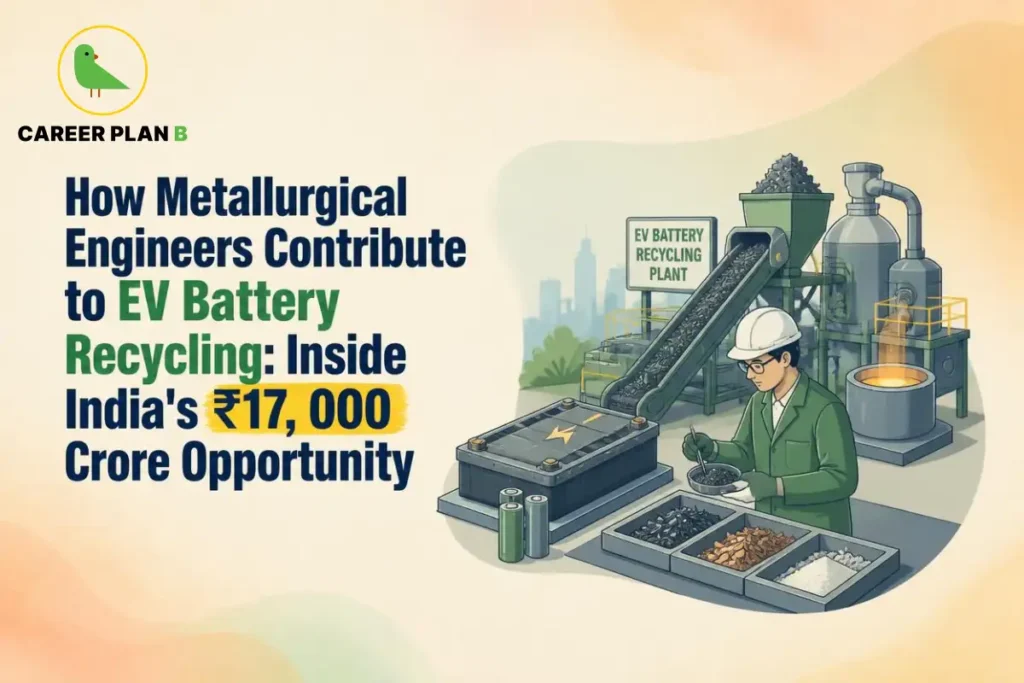
Introduction
India imports nearly 100 per cent of its lithium-ion battery cells, primarily from China, yet the country will generate roughly 128 GWh of recyclable batteries by 2030, a genuine strategic gap that metallurgists are uniquely positioned to close through urban mining. Understanding how metallurgical engineers contribute to EV battery recycling requires recognizing that this isn’t primarily a chemical or environmental engineering challenge; it’s fundamentally a metallurgical one, centred on recovering pure, battery-grade metals from complex waste streams. Many students assume battery recycling belongs to environmental engineers managing waste disposal, completely missing how deeply metallurgical the actual metal recovery process genuinely is. This blog explains the real recovery process, why it depends on metallurgical expertise specifically, and what it means for your career.
Why India’s Battery Recycling Push Is Really an Urban Mining Story
The Import Dependence Problem Recycling Solves
Government Backing Through the Critical Mineral Recycling Scheme
This urgency is reflected directly in policy. The Ministry of Mines has committed ₹1,500 crore under the Critical Mineral Recycling Incentive Scheme, part of the broader National Critical Mineral Mission, specifically to accelerate domestic recovery capacity from e-waste and spent lithium-ion batteries. This sits alongside the Battery Waste Management Rules 2022, which established Extended Producer Responsibility as the primary regulatory mechanism, legally obligating producers and importers to meet defined annual collection and channelling targets. Together, these frameworks confirm critical mineral recycling India funding isn’t a side initiative; it’s a core strategic priority requiring genuine metallurgical expertise to execute.
The Real Recovery Process, Step by Step
From Dismantling to Black Mass
The recovery process moves through distinct stages, starting with collecting, safely discharging, and dismantling end-of-life battery packs into individual modules and cells. These cells are then shredded in controlled-atmosphere chambers to produce what the industry calls black mass, a mixed powder containing lithium, cobalt, nickel, manganese, and graphite, which is then mechanically separated from the surrounding casing materials.
Hydrometallurgical Leaching: Where Metallurgical Skill Matters Most
This is precisely where metallurgical expertise becomes indispensable. Hydrometallurgical processing dissolves this black mass in acid solutions, bringing the target metals into a liquid phase for selective separation, followed by solvent extraction and controlled precipitation that isolates lithium, cobalt, nickel, and manganese at battery-grade purity. Recovery efficiency for cobalt and nickel now exceeds 95 per cent in modern facilities, while lithium recovery ranges between 70 and 90 per cent depending on the specific process design used, figures that depend entirely on the metallurgical expertise applied to leaching chemistry, reagent selection, and purification steps.
Why Hydrometallurgy Won Over Pyrometallurgy for India Specifically
Is hydrometallurgy genuinely the better technical choice, or simply what happened to become available first? The evidence suggests a deliberate, strategic choice rather than accident. India’s battery recycling ecosystem has overwhelmingly chosen hydrometallurgy over pyrometallurgy for two specific reasons: pyrometallurgy, which uses high-temperature smelting, requires massive throughput, typically 50,000 or more tonnes annually, to justify the capital expenditure on smelters, a volume India’s current end-of-life battery supply simply doesn’t support yet. More critically, pyrometallurgy loses lithium entirely in the smelter slag, an unacceptable outcome given India’s severe import dependence on this specific critical mineral. This makes hydrometallurgy careers India-wide considerably more relevant right now than pyrometallurgical roles, since the entire domestic industry has structured itself around this chemistry-based approach.
Real Companies Where Metallurgists Are Already Working
This isn’t just a theoretical opportunity. Companies are already developing commercial battery recycling operations in India. They use processes such as chemical leaching to recover valuable materials from used batteries. These recovered materials can return to battery and cathode production, supporting a more circular supply chain. This approach can reduce India’s dependence on newly mined critical minerals. It also supports compliance with Extended Producer Responsibility requirements under the Battery Waste Management Rules. As the battery recycling industry expands, metallurgists with strong hydrometallurgical skills could find growing career opportunities in this field.
Skills Metallurgists Need for This Emerging Space
Selective Leaching and Solvent Extraction Chemistry
Achieving Battery-Grade Purity Standards
Beyond extraction itself, metallurgists must understand solvent extraction and precipitation techniques precise enough to achieve battery-grade purity, since even minor contamination can render recovered material unsuitable for reuse in new cell manufacturing. This precision requirement is exactly why Urban Mining India’s work demands genuine metallurgical rigour rather than simple mechanical separation, since the final product must meet the same purity standards as freshly mined and refined material.
Have Any Doubts?
Career Roles and Growth Path
| Career Stage | Typical Role | Where You Might Work |
|---|---|---|
| Entry-Level | Junior Process Metallurgist | Lohum, Attero, Recyclekaro, ACE Green |
| Mid-Level | Hydrometallurgy Process Engineer | Tata Chemicals, Rubamin, critical mineral recycling plants |
| Senior-Level | Recycling Operations Lead / R&D Manager | Large recyclers, government-backed processing hubs |
Given India’s ₹17,000 crore battery recycling market and the ₹1,500 crore government incentive scheme actively backing capacity expansion, professionals who build genuine metallurgical engineering scope expertise in this space are positioned for strong, sustained demand as battery volumes scale toward 2030.
How Career Plan B Helps
Career Plan B helps students explore emerging metallurgy careers in EV battery recycling through personalized guidance, assessments, and structured planning based on their interests, technical skills, and future career goals.
Personalized Career Counselling: Provides expert guidance to help students understand opportunities in EV battery recycling, hydrometallurgy, critical mineral recovery, and sustainable materials industries based on their interests and career aspirations.
Psychometric & Career Assessment Tests: Helps identify students’ strengths, technical abilities, and suitable career paths by evaluating their aptitude for metallurgy, chemical processing, battery technology, research, and advanced materials engineering roles.
Career Roadmapping: Creates a step-by-step career plan covering specialization choices, skill development, internships, higher education options, and industry pathways for careers in battery recycling, urban mining, and critical mineral processing.
Admission & Academic Profile Guidance: Helps students select the right colleges, courses, and academic pathways while improving their profile for opportunities in EV industries, recycling companies, research organizations, and sustainable energy sectors.
Get In Touch With Us
Frequently Asked Questions
- Is EV battery recycling really a metallurgical engineering job?
Yes, the core recovery process depends on hydrometallurgical leaching, solvent extraction, and precipitation chemistry, all fundamentally metallurgical skills.
- What’s the difference between hydrometallurgy and pyrometallurgy in this context?
Hydrometallurgy uses chemical leaching and works well at a smaller scale while preserving lithium recovery, while pyrometallurgy uses high-temperature smelting and loses lithium in the process.
- Which companies are hiring metallurgists for battery recycling in India?
Lohum, Attero, Tata Chemicals, Rubamin, and ACE Green are among the leading Indian companies actively working in this space.
- What recovery rates can metallurgists actually achieve?
Modern hydrometallurgical facilities achieve over 95 per cent recovery for cobalt and nickel and 70 to 90 per cent for lithium, depending on process design.
- Is this a stable, long-term career direction?
Yes, backed by a ₹1,500 crore government incentive scheme and India’s growing 128 GWh recyclable battery volume expected by 2030.
Conclusion
Understanding How Metallurgical Engineers Contribute to EV Battery Recycling shows that this field is more than an environmental function. It represents a major metallurgical challenge at the heart of India’s efforts to reduce critical mineral import dependence. Hydrometallurgical recycling is also expanding across the battery recycling industry. Government incentives and regulatory frameworks are supporting this transition. Metallurgists with expertise in selective leaching and purification chemistry can play an important role in this growth. For engineering students, the field offers an emerging opportunity to apply materials science skills to one of India’s rapidly developing industrial priorities.
If you’d like help figuring out how to position yourself for this specific career direction, a conversation with a Career Plan B counsellor can help you plan the right path forward.