Team5 · August 7, 2026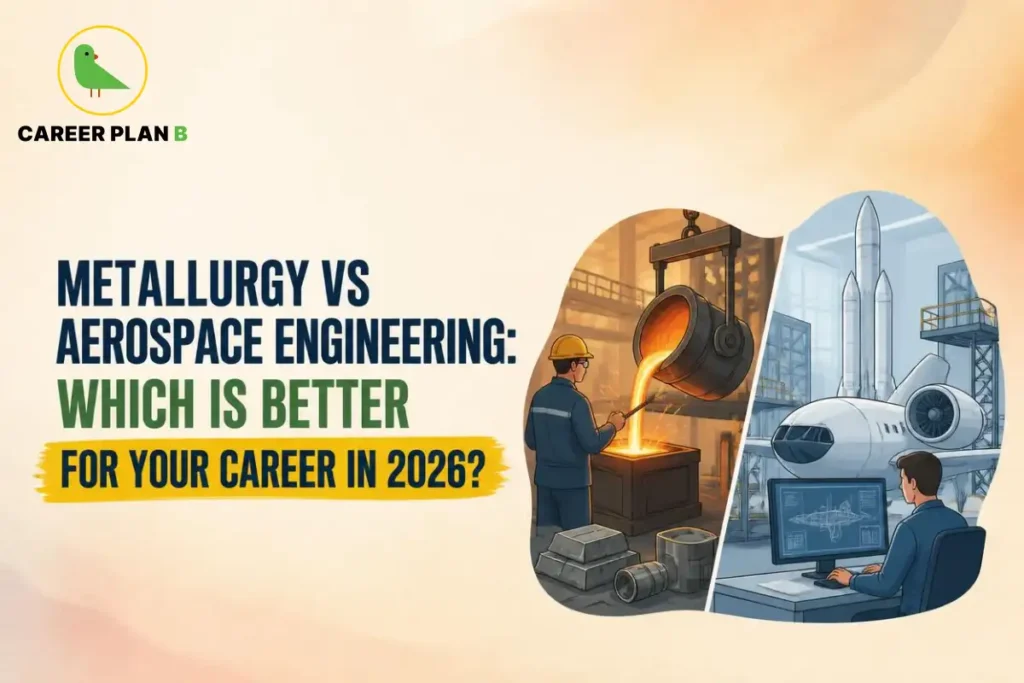
Introduction
Aerospace engineering directly designs the aircraft and rockets capturing the public imagination, while metallurgy quietly supplies the specific alloys that make those same aircraft and rockets survive flight without failing catastrophically. This genuine interdependence sits right at the heart of Metallurgy vs Aerospace Engineering: Which is Better for 2026?, a question worth answering with real data rather than assuming aerospace automatically wins simply because it sounds more glamorous. Many students default toward aerospace purely on prestige, without comparing actual eligibility requirements, competition levels, or documented salary data between these two genuinely interdependent fields. This blog breaks down both branches honestly, covering eligibility, scope, and salary in genuine depth, so you can decide with real clarity.
What Each Field Actually Focuses On in Practice
Aerospace Engineering: Designing Aircraft, Rockets, and Propulsion Systems
Aerospace engineering focuses on developing lighter aircraft, efficient propulsion systems, reusable rockets, and autonomous drones, sitting directly at the intersection of technology and imagination. This branch covers structural design, aerodynamics, propulsion, and increasingly, satellite and launch vehicle systems, giving graduates access to both traditional aviation and India’s rapidly expanding space technology sector. Consequently, an aerospace engineering career India now stretch well beyond traditional government organizations into private startups, defence projects, and international collaborations.
Metallurgical Engineering: Supplying the Materials That Make Flight Possible
Metallurgical engineering, by contrast, focuses on developing and refining the specific alloys and materials that aerospace vehicles are actually built from, work that happens largely behind the scenes rather than in the design studio itself. This branch develops heat-resistant superalloys, lightweight titanium structures, and materials capable of surviving extreme thermal and mechanical stress during flight and re-entry. Therefore, a metallurgical engineering career in India contributes to aerospace success indirectly but genuinely, supplying the physical foundation aerospace engineers design around.
Which Branch Offers Broader Institute Access?
So which of these two branches genuinely offers more room to enter? Aerospace engineering maintains a notably narrow, prestige-heavy institute base, concentrated at the Indian Institute of Space Science and Technology, select IITs, and a handful of other specialized institutions. Metallurgical engineering similarly stays concentrated at select IITs, NITs, and specialized institutes, though its footprint differs slightly, with IIT (BHU) Varanasi and NIT Rourkela known specifically for strong metallurgy programmes, distinct from aerospace’s own separate cluster of top institutes. Both branches, in this sense, share a genuinely narrower college pool than broader branches like mechanical or civil engineering, raising the stakes of college choice considerably for either path.
Eligibility and GATE Routes for Both Branches
Entry Requirements After Class 12
Both branches require Class 12 with Physics, Chemistry, and Mathematics, followed by entrance exams like JEE Main or JEE Advanced, leading directly into a four-year B.Tech program. Programs need approval from the All India Council for Technical Education (AICTE), the Government of India’s apex technical education regulator, ensuring your degree carries proper recognition from either path.
How GATE-PSU Recruitment Compares Between the Two
The Graduate Aptitude Test in Engineering remains the standard postgraduate and PSU recruitment route for both fields. Aerospace graduates access HAL and DRDO through GATE-linked Management Trainee and Scientist Entry Test routes, while metallurgical graduates access SAIL, NALCO, and DRDO through the dedicated Metallurgical Engineering GATE paper. You can verify official exam details for GATE PSU recruitment through the GATE official website, maintained by the IIT hosting the exam that year, which conducts separate papers for each specialization.
Career Scope: Where Each Path Leads in 2026
Aerospace Engineering’s ISRO, HAL, and Private Startup Boom
Aerospace engineers find opportunities across ISRO, with centres spread across Bengaluru, Thiruvananthapuram, Sriharikota, Ahmedabad, and Hyderabad, alongside HAL, India’s largest aerospace and defence manufacturer building Tejas fighter jets and helicopter components. ISRO recruitment happens through the ISRO Centralised Recruitment Board via written tests and interviews, and you can track official openings through ISRO’s official careers portal, maintained by the Department of Space, Government of India. Beyond government routes, private startups like Skyroot and Agnikul are creating genuinely new opportunities, reflecting India’s privatizing space sector and its rapidly expanding aerospace engineering scope.
Metallurgical Engineering’s Steel, Defence, and Emerging-Sector Growth
Metallurgical engineers, meanwhile, find opportunities across steel manufacturers; defence PSUs, including DRDO’s Defence Metallurgical Research Laboratory; and, increasingly, semiconductor materials, EV battery recycling, and additive manufacturing research. Notably, ISRO’s own official recruitment eligibility explicitly names metallurgy as an accepted qualifying discipline alongside aerospace and mechanical engineering, confirming that metallurgists genuinely work within aerospace organizations too, just in materials-focused rather than design-focused roles.
Have Any Doubts?
Salary Comparison: Metallurgical vs Aerospace Engineering
| Career Stage | Aerospace Engineering | Metallurgical Engineering |
|---|---|---|
| Entry-Level (Private) | INR 4 – 8 lakh | INR 4 – 6 lakh |
| Entry-Level (PSU/GATE) | INR 7.5 – 13 lakh (HAL/DRDO/ISRO) | INR 5 – 17 lakh (varies by PSU) |
| Mid-Level | INR 10 – 20 lakh | INR 6 – 10 lakh |
| Senior-Level | INR 20 – 40+ lakh (aerospace MNCs) | INR 10 – 20+ lakh (managerial/research) |
Both aerospace engineering salary India and metallurgical engineer salary India figures show broadly comparable entry-level ranges through the GATE-PSU route, though aerospace engineering’s private-sector ceiling tends to run higher at senior levels, particularly at aerospace MNCs like Boeing India, Airbus, and GE Aviation.
Career Roles and Growth Path
| Career Stage | Aerospace Engineer | Metallurgical Engineer |
|---|---|---|
| Entry-Level | Graduate Engineer Trainee (HAL/ISRO) | Graduate Engineer Trainee / Metallurgist |
| Mid-Level | Design Engineer / Systems Engineer | Quality Control Engineer / Materials Engineer |
| Senior-Level | Program Manager / Senior Design Lead | Senior Metallurgist / Materials R&D Lead |
How Career Plan B Helps
Career Plan B helps students make informed decisions between aerospace and metallurgical engineering careers through personalized guidance, assessments, and structured planning based on their interests, skills, and long-term goals.
Personalized Career Counselling: Provides expert guidance to help students compare aerospace and metallurgical engineering pathways by understanding their interests in areas like aircraft design, space technology, materials research, defence, and advanced manufacturing.
Psychometric & Career Assessment Tests: Helps identify students’ strengths, technical preferences, and suitable career paths by evaluating their aptitude for aerospace systems, materials science, research, design, and engineering roles.
Career Roadmapping: Creates a step-by-step career plan covering college selection, GATE preparation, skill development, internships, higher education options, and career opportunities in ISRO, DRDO, aerospace companies, and materials industries.
Admission & Academic Profile Guidance: Helps students choose the right engineering branch, colleges, and specialization options while improving their academic profile for opportunities in aerospace organizations, PSUs, research institutions, and advanced engineering sectors.
Get In Touch With Us
Frequently Asked Questions
- Which is better, metallurgy or aerospace engineering?
Neither is objectively better; aerospace engineering suits those drawn to design and systems work, while metallurgy suits those drawn to materials science and processing.
- Which branch pays more at the entry level?
Both show broadly comparable entry-level pay through the GATE-PSU route, though metallurgical engineering can offer a wider top-end range depending on the specific PSU.
- Which branch has more government job opportunities?
Aerospace engineering benefits from ISRO’s expanding centres and HAL’s large-scale recruitment, while metallurgical engineering has steady but narrower PSU access through SAIL and NALCO.
- Do aerospace projects actually need metallurgists too?
Yes, ISRO’s official recruitment eligibility explicitly names metallurgy as an accepted discipline, and DRDO’s DMRL develops the specific alloys aerospace projects depend on.
- Which branch has less competition for GATE-based PSU roles?
Both branches see less competition than larger streams like mechanical engineering since fewer institutes offer either specialization nationwide.
Conclusion
Answering Metallurgy vs Aerospace Engineering: Which is Better for 2026? ultimately reveals that these fields aren’t really competitors; they’re genuinely interdependent, with metallurgists supplying the materials aerospace engineers design. Aerospace engineering offers broader private-sector growth through India’s expanding space startup ecosystem and a higher senior-level pay ceiling at aerospace MNCs, while metallurgical engineering offers steady, diversified demand across steel, defence, and emerging sectors like EV batteries and additive manufacturing. Rather than choosing based on which field sounds more exciting, it’s worth reflecting honestly on whether you’re drawn to designing the finished aircraft or to developing the specific materials that make that aircraft survive flight.
If you’re still unsure which path fits you best, a conversation with a Career Plan B counsellor can help you weigh your genuine interests and aptitude clearly before you finalize your entrance exam choices.