Deepti · August 7, 2026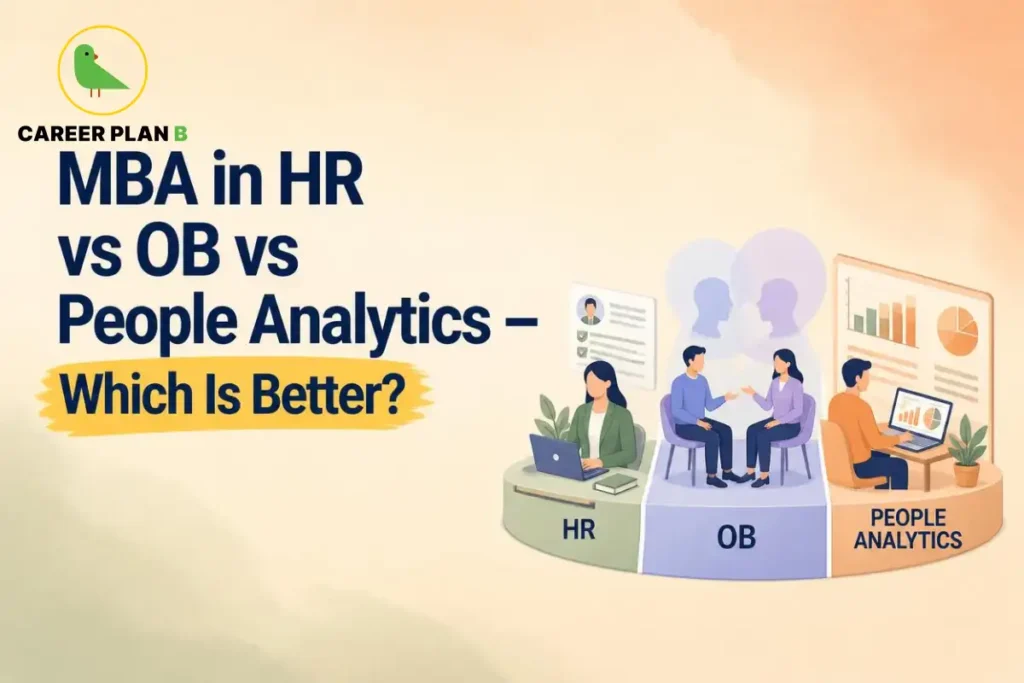
Introduction
Comparing MBA in HR vs OB vs People Analytics requires first clarifying something most comparisons skip: these three aren’t always three fully separate, parallel specialization tracks at Indian B-schools. Organizational Behavior typically sits as a core foundational subject within a broader HR specialization, while People Analytics has emerged as a genuinely distinct, increasingly separate track layered on top of traditional HR training. Therefore, this guide clarifies how these three actually relate to each other, compares realistic salary and career outcomes, and helps you decide which specific combination suits your interests.
We’ll cover what each area genuinely emphasizes and how to structure your specialization choice accordingly. By the end, you should understand this landscape clearly enough to make an informed decision.
How These Three Areas Actually Relate to Each Other
MBA in Human Resource Management covers talent acquisition, employee engagement, learning and development, compensation strategy, performance management, and organizational behavior together as one integrated curriculum, rather than treating OB as a separate standalone specialization most students choose between.
Consequently, if you’re weighing “HR vs OB” as though they’re competing options, understand that OB typically forms a core component within HR’s broader curriculum at most Indian B-schools, not a separate track you’d choose instead of HR.
Where Does People Analytics Fit Into This Picture?
People Analytics, sometimes called HR Analytics, has genuinely emerged as its own increasingly distinct specialization, layering data-driven workforce planning, predictive attrition modeling, and analytics-based decision-making on top of traditional HR fundamentals.
Consequently, People Analytics represents a genuine evolution within the HR field rather than a completely unrelated specialization, and many strong HR programs now embed analytics training directly into their core HR curriculum instead of treating it as fully separate.
MBA in HR: The Broad, Sector-Agnostic Foundation
MBA in HR has become the premier qualification for professionals aspiring to lead organizational transformation, with 89% of CEOs now identifying HR leadership as critical to organizational performance according to SHRM India’s 2025 Workforce Report, alongside strategic HR roles growing 47% year-over-year across Indian companies.
Starting salaries for MBA HR graduates in India range from ₹6-12 LPA, and this specialization remains one of the most sector-agnostic MBA tracks available, since every company with a workforce needs HR leadership regardless of industry.
What Makes HR Genuinely Valuable Despite Its Lower Starting Salary Ceiling?
HR carries the lowest salary ceiling among MBA specializations at entry level, yet it offers genuinely fulfilling work and excellent job security, with senior HR leaders like CHROs at large MNCs earning ₹25-50 lakh.
Consequently, HR rewards long-term career building over quick entry-level compensation, making it particularly suited to candidates who value stability and steady progression over an aggressive early salary ceiling.
Organizational Behavior: A Foundational Skill, Not a Standalone Career Track
Organizational Behavior specifically studies how individuals and groups behave within organizational settings, covering leadership dynamics, team psychology, motivation theory, and change management principles.
Since OB knowledge underpins effective HR practice, virtually every strong HR specialization program embeds substantial OB coursework directly into its curriculum, rather than positioning it as a separate career path graduates choose instead of HR.
Should You Specifically Seek Out “OB-Focused” Programs?
Rather than searching for a standalone OB specialization, evaluate how deeply your target HR program integrates organizational behavior theory into its coursework, since stronger programs weave this foundational knowledge throughout rather than treating it superficially.
Consequently, candidates specifically drawn to leadership psychology and team dynamics should prioritize HR programs known for rigorous OB coursework, rather than searching for OB as an entirely separate specialization track.
People Analytics: The Fastest-Growing, Data-Driven Evolution
People analytics, leadership development, organizational psychology, DEI strategy, and culture building have become core business priorities as workplaces grow increasingly hybrid, digital, and global.
This specialization specifically prepares graduates for roles like Talent Analytics Manager and HR Business Partner, positions that combine traditional people management with data-driven workforce planning. Consequently, People Analytics represents the specific intersection of HR fundamentals with the broader analytics skill set increasingly demanded across every business function.
Does People Analytics Command a Genuinely Different Salary Trajectory?
While core HR salaries range ₹6-12 LPA at entry, professionals who build genuine People Analytics competency alongside their HR fundamentals often access a meaningfully stronger growth trajectory, given the broader market premium for analytics-capable talent.
Consequently, if you’re weighing whether to pursue traditional HR or specifically emphasize People Analytics, building strong analytics skills alongside your HR foundation genuinely strengthens your long-term earning potential without abandoning HR’s core people-focused work.
For Personalized Guidance
Salary and Career Comparison
| Track | Entry Salary Range | Career Ceiling | Career Roles |
|---|---|---|---|
| MBA in HR (includes OB) | ₹6-12 LPA | ₹25-50 LPA (CHRO level) | HR Business Partner, L&D Lead, Compensation Manager |
| Organizational Behavior | Embedded within HR salary range | Same as HR track | Leadership Development, Change Management roles |
| People Analytics | Similar entry, stronger growth trajectory | Higher given analytics market premium | Talent Analytics Manager, HR Data Analyst |
How to Choose Your Specific Path Within This Landscape
Start by recognizing that choosing “HR” as your specialization automatically includes substantial OB training, so your real decision is whether to specifically emphasize People Analytics as an additional layer on top of this HR foundation.
Consequently, if you enjoy working with people and value organizational psychology genuinely, prioritize HR programs with strong OB coursework depth. If you additionally want stronger earning potential and enjoy data-driven decision-making, seek out HR programs that explicitly build People Analytics or HR Analytics coursework into their curriculum.
Which Candidate Profile Suits Each Emphasis Best?
Candidates who are people-oriented or empathetic generally find HR’s core people-management focus, including its OB foundation, genuinely fulfilling regardless of analytics emphasis.
Meanwhile, candidates who enjoy both people dynamics and quantitative problem-solving should specifically seek programs blending HR fundamentals with People Analytics training, since this combination genuinely differentiates you in an increasingly data-driven HR job market.
How Career Plan B Helps
Deciding how to structure your MBA in HR vs OB vs People Analytics path takes more than comparing generic specialization labels alone.
Career Plan B offers Personalized Career Counselling to match your genuine interests and strengths against the right HR-analytics combination, alongside PsycheIntel and Career Assessment Tests, Admission and Academic Profile Guidance, and Career Roadmapping to help you plan your specialization confidently.
Get In Touch With Us
Frequently asked questions
Q1. Is Organizational Behavior a separate MBA specialization from HR?
No, OB typically forms a core component within the broader HR specialization curriculum.
Q2. Does People Analytics pay more than traditional HR roles?
Generally, yes given the broader market premium for analytics-capable talent.
Q3. What is the typical entry-level salary for MBA HR graduates?
₹6-12 LPA, with senior CHRO-level roles reaching ₹25-50 LPA.
Q4. Should I choose a program specifically labeled “OB” instead of “HR”?
No, evaluate how deeply your target HR program integrates OB coursework instead.
Q5. Can I combine HR with People Analytics within one MBA program?
Yes, many strong HR programs now embed analytics training directly into their core curriculum.
Conclusion
Resolving the MBA in HR vs OB vs People Analytics question ultimately means recognizing these aren’t three fully separate, competing paths, since OB forms a foundational part of virtually every strong HR specialization, while People Analytics represents a genuine, increasingly important evolution within that same HR field. Traditional HR offers a sector-agnostic, people-centered career with steady long-term growth toward CHRO-level compensation of ₹25-50 lakh, even though its entry-level ceiling trails other specializations at ₹6-12 lakh. Building genuine People Analytics competency alongside your HR foundation, rather than choosing between them, genuinely strengthens your market positioning given growing corporate demand for data-driven workforce planning.
Rather than searching for these as three separate specialization boxes to choose between, evaluate how deeply your target HR program integrates both organizational behavior theory and analytics training, since that combined depth, not the specific label on your degree, will determine your genuine career differentiation in India’s evolving HR job market.