Team Career Plan B · August 7, 2026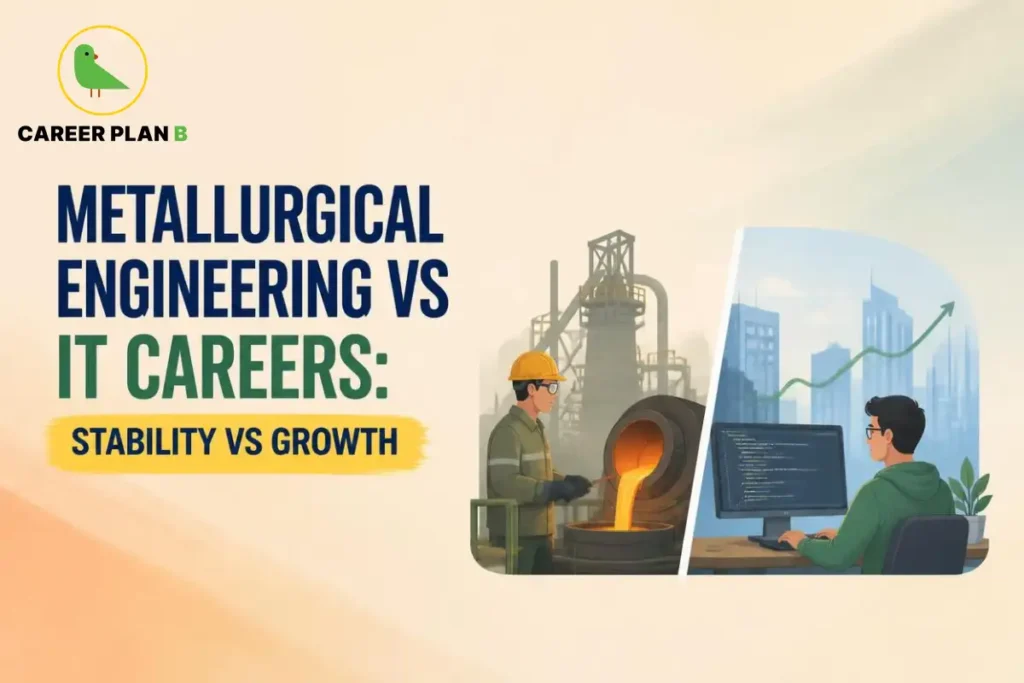
Introduction
Every year, thousands of Indian engineering students face the same dilemma while filling out their counselling forms. Do you choose a hands-on, industrial core branch or the software-driven world of IT? Comparing metallurgical engineering vs IT careers stability vs growth matters because these two paths represent genuinely different bets on what a stable, rewarding career actually looks like.
India’s digital economy continues expanding rapidly under government-led initiatives like Digital India, while the country’s steel sector grows just as steadily under programmes backed by the Ministry of Steel. Both stories are true at once, and understanding what each path genuinely offers helps you make a far more informed choice than following whatever branch feels trendiest this year.
Why This Comparison Comes Up So Often in India
Metallurgical engineering represents one of India’s oldest, most established core branches, while IT represents the country’s fastest-growing, most visible modern industry. Consequently, this core engineering vs IT jobs debate shows up constantly in counselling sessions, since both fields promise something genuinely different: steady industrial demand versus rapid, high-visibility growth.
What Does Job Stability Actually Look Like in Metallurgy?
Metallurgical engineering careers in India tend to follow a slower, more predictable trajectory, built around established public and private sector employers.
Why This Field Rewards Patience
According to the Ministry of Steel, the Production Linked Incentive Scheme for Specialty Steel has already attracted 44 projects from 26 companies, with a committed investment of roughly ₹27,106 crore. This kind of sustained, government-backed investment is exactly why metallurgy job stability remains a genuine strength of this field; steel demand doesn’t disappear overnight the way certain tech trends can. Metallurgical engineering careers India offers typically build gradually through public sector companies like SAIL and Tata Steel, alongside private speciality steel manufacturers, rewarding those who value predictable, long-term career progression over rapid early-career jumps.
What Does Growth Actually Look Like in IT?
IT careers in India, by contrast, tend to offer faster early growth, higher starting flexibility, and genuinely explosive sector-wide expansion.
Why This Field Rewards Speed and Adaptability
According to the Press Information Bureau, India’s digital economy represents a trillion-dollar opportunity, driven by expanding digital public infrastructure and a rapidly growing pool of digitally skilled professionals. The Ministry of Electronics and Information Technology’s Digital India programme has systematically expanded platforms like DigiLocker, UMANG, and the National AI Portal, creating opportunities that didn’t exist five years ago. This kind of rapid IT sector growth India has seen reflects why software careers often reward quick skill-building and adaptability far more than seniority alone.
Have Any Doubts?
Comparing the Two Paths: What the Data Suggests
Since India doesn’t publish standardized occupation-specific wage comparisons between these fields, the table below combines Indian sector investment data with globally benchmarked figures, clearly labelled where U.S. data fills the gap.
| Factor | Metallurgical Engineering | IT Careers |
|---|---|---|
| Indian Sector Backing | ₹27,106 crore (Specialty Steel PLI) | Trillion-dollar digital economy (PIB) |
| Career Pace | Slower, steady progression | Faster early growth, more variable |
| Global Benchmark (US BLS, Materials/Software) | $108,310 median, 6% growth | $133,080 median, 15% growth |
| Job Security Style | Tied to established industrial demand | Tied to skill relevance and market shifts |
This table reflects data from the Ministry of Steel and PIB, alongside globally benchmarked figures from the U.S. Bureau of Labour Statistics for materials engineers and software developers, used here purely as an international reference point rather than Indian-specific data. This comparison of software jobs vs core engineering roles shows IT offering faster growth potential globally, while metallurgy offers steadier, less market-sensitive demand.
Which Path Actually Suits You Better?
So, how do you choose? If you value predictable, long-term career progression tied to India’s industrial base, and you’re comfortable with a slower but steadier climb, metallurgical engineering genuinely rewards that patience. If you’d rather chase faster growth, don’t mind constantly updating your skills, and want maximum flexibility across employers and even countries, IT careers reward that adaptability instead. This engineering career choice India students face doesn’t have a universally correct answer; it depends entirely on what kind of stability or growth actually matters to them.
How Career Plan B Helps
Career Plan B helps students make informed career decisions between core engineering and IT fields through personalized guidance, assessments, and structured career planning based on their interests, skills, and long-term goals.
Personalized Career Counselling: Provides expert guidance to help students compare metallurgical engineering and IT careers based on career goals, work preferences, industry demand, and future opportunities.
Psychometric & Career Assessment Tests: Helps identify students’ strengths, technical interests, problem-solving abilities, and suitability for core engineering roles or technology-driven IT careers.
Career Roadmapping: Creates a step-by-step plan covering branch selection, skill development, certifications, internships, and career growth strategies for either metallurgy or IT pathways.
Admission & Academic Profile Guidance: Helps students choose the right engineering branch, colleges, courses, and academic pathways that align with their career goals in metallurgy, software, or emerging technology fields.
Get In Touch With Us
Frequently Asked Questions
- Is metallurgical engineering still relevant with IT growing so fast in India?
Yes. Steel, mining, and manufacturing remain foundational to India’s economy, and government investment through schemes like the PLI continues supporting steady demand.
- Does IT offer better long-term stability than core engineering?
Not necessarily better, just different. IT offers faster growth but requires constant upskilling, while metallurgy offers steadier, less volatile demand.
- Can a metallurgical engineer switch into IT later?
Yes, though it typically requires additional upskilling in programming or data analysis, since the two fields draw on different technical foundations.
- Which field has better starting salaries in India?
This varies significantly by company and specific role, though IT roles at top companies have historically offered strong early-career compensation growth.
- Which career choice is safer for the next 10 years?
Both offer genuine stability from different angles: metallurgy through established industrial demand and IT through the country’s expanding digital economy.
Conclusion
Weighing metallurgical engineering vs IT careers’ stability vs growth really comes down to what kind of career rhythm suits you. Metallurgy offers steady, industrial-backed progression rooted in India’s manufacturing base, while IT offers faster growth fuelled by the country’s rapidly expanding digital economy.
If you’re still deciding which path fits your strengths and goals, Career Plan B can help you explore both directions and build a realistic plan to get there. Whichever you choose, both fields offer genuine, lasting opportunity within India’s evolving economy.