Team Career Plan B · August 7, 2026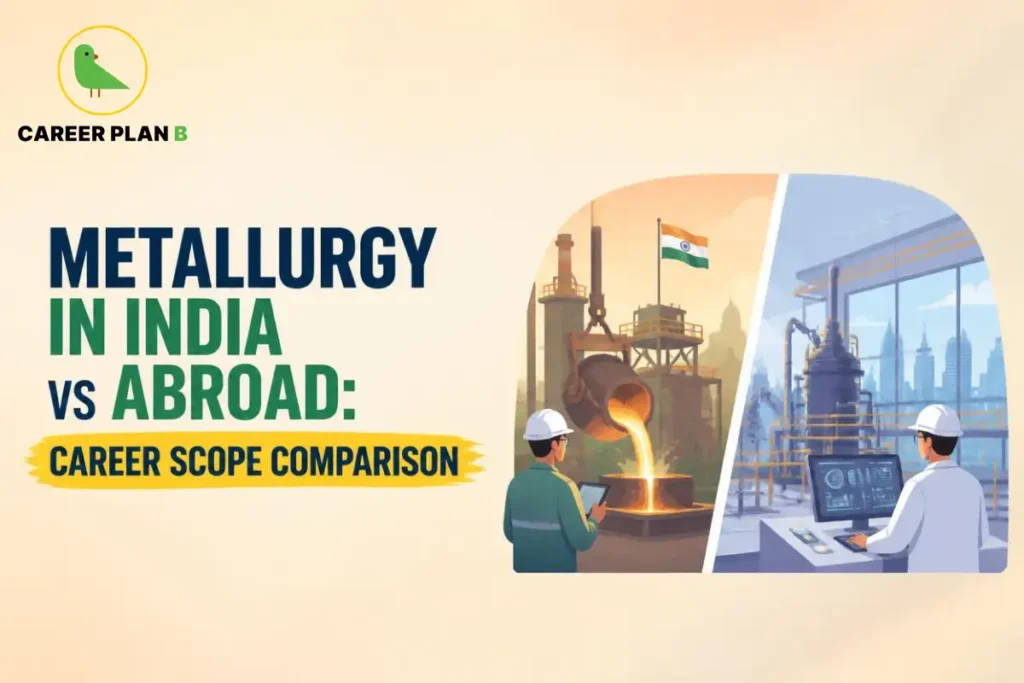
Introduction
For many Indian metallurgical engineering graduates, a genuine question comes up sooner or later. Should you build your career at home or look abroad for better opportunities? Understanding metallurgy in India vs abroad career scope comparison requires looking honestly at both markets, rather than assuming international always means better.
According to Invest India, India’s steel capacity is projected to reach 300 million tonnes by 2030, growing at a compound annual growth rate of 9.4%, making the country the world’s second-largest steel producer. That’s a genuinely strong domestic growth story worth weighing against opportunities overseas.
Why This Comparison Matters More Than Ever
India’s metallurgical sector has expanded rapidly in recent years, while opportunities abroad continue attracting engineers drawn to established industries and higher documented pay. Consequently, understanding both sides of metallurgical engineering India versus international paths helps you make a genuinely informed decision rather than following assumptions.
What Does Career Scope Look Like Within India?
India’s steel and mining sectors have entered a genuine growth phase, backed by sustained government investment and rising domestic demand.
Strong Domestic Growth Momentum
According to Invest India, Indian metallurgical industries attracted cumulative FDI inflows as one of the top sectors for foreign investment, with the sector benefiting from a 100% FDI allowance under the automatic route. Additionally, the Ministry of Steel has launched multiple rounds of its Production Linked Incentive Scheme for Speciality Steel, attracting dozens of projects and committed investment worth thousands of crores. This kind of sustained steel industry growth India has seen makes a compelling case for building a career domestically, particularly given how rapidly capacity is expanding.
Mining and Broader Resource Opportunities
Beyond steel specifically, the Ministry of Mines oversees exploration and development of metals like aluminium, copper, and zinc, recently approving a ₹1,500 crore incentive scheme to promote critical mineral recycling. This broadens India’s steel sector FDI momentum into adjacent mining and mineral processing careers as well, giving domestic engineers a genuinely wide range of employers to consider.
What Does Career Scope Look Like Working Abroad?
Working abroad offers a different set of advantages, particularly around documented pay transparency and access to advanced research infrastructure.
Established Markets with Detailed Wage Data
Unlike India, countries like the United States publish detailed occupation-specific wage data. According to the U.S. Bureau of Labour Statistics, materials engineers earned a median annual wage of $108,310 in 2024, with 6% growth projected through 2034. This kind of transparency makes it easier to benchmark metallurgical engineer opportunities abroad, even though it represents just one country’s market among several viable destinations.
Visa Pathways Worth Understanding
Working abroad as a metallurgist professional requires navigating visa systems that vary significantly by destination. In the U.S., the USCIS H-1B programme allows employers to temporarily employ foreign workers in speciality occupations, though recent policy changes have introduced significant new costs worth researching carefully. In Europe, the European Commission’s EU Blue Card offers highly qualified non-EU workers the chance to live and work across most EU member states, provided they hold a binding job offer and meet minimum salary thresholds.
Have Any Doubts?
Comparing the Two Paths Side by Side
Putting India’s domestic growth story next to international opportunities highlights genuinely different, but both compelling, trajectories.
| Factor | India | Abroad (US/EU) |
|---|---|---|
| Sector Growth | Steel capacity projected to reach 300 MT by 2030 (9.4% CAGR) | Steady 6% growth for materials engineers (US) |
| Wage Transparency | Limited standardized occupational data | Detailed, published wage bands (BLS) |
| Entry Pathway | Direct employment through domestic companies | Requires visa sponsorship (H-1B, EU Blue Card) |
| Key Advantage | Rapid domestic capacity expansion, FDI-backed growth | Established research infrastructure, wage transparency |
This table draws from Invest India, the Ministry of Steel, and, for international benchmarking, the U.S. Bureau of Labour Statistics. This metallurgy job market comparison shows India offering genuinely fast domestic growth, while established markets abroad offer clearer wage documentation and mature research ecosystems.
Which Path Actually Makes Sense for You?
If you’re drawn to being part of India’s rapidly expanding steel and mining capacity, with genuine FDI-backed growth and a clear domestic career ladder, staying home offers real long-term upside. If you’re prioritizing wage transparency, exposure to advanced international research, or simply want global work experience, exploring opportunities abroad through pathways like the H-1B or EU Blue Card remains a solid option, provided you go in with realistic expectations about visa complexity.
How Career Plan B Helps
Career Plan B helps students and professionals make informed decisions about building a metallurgy career in India or abroad through personalized guidance, assessments, and structured career planning.
Personalized Career Counselling: Provides expert guidance to help students compare metallurgy opportunities in India and abroad based on career goals, industry demand, salary expectations, and preferred work environments.
Psychometric & Career Assessment Tests: Helps identify students’ strengths, interests, and suitability for domestic industrial roles or international career opportunities in metallurgy and materials engineering.
Career Roadmapping: Creates a step-by-step plan covering college selection, skill development, higher studies, international preparation, visa pathways, and career growth strategies in India or overseas markets.
Admission & Academic Profile Guidance: Helps students choose the right metallurgy and materials engineering programs, colleges, certifications, and academic pathways to build a strong profile for global career opportunities.
Get In Touch With Us
Frequently Asked Questions
- Is India’s steel sector genuinely growing, or is this just government messaging?
It’s genuinely growing. Invest India data shows India’s steel capacity projected to nearly double by 2030, backed by real FDI inflows and expanding production.
- Do metallurgical engineers abroad earn significantly more than in India?
Documented wages abroad, particularly in the US, appear higher, though this doesn’t account for cost of living differences and India’s own strong growth trajectory.
- Is it hard for Indian metallurgical engineers to get visas abroad?
It’s become more complex recently, particularly with new US H-1B cost requirements, though pathways like the EU Blue Card remain relatively structured for qualified applicants.
- Which offers better long-term career growth, India or abroad?
Both offer genuine growth from different angles: India through rapid domestic capacity expansion and abroad through established, transparent wage structures.
- Should I gain experience in India before working abroad?
Many engineers find this approach beneficial, since domestic experience combined with international exposure often strengthens long-term career prospects either way.
Conclusion
Weighing metallurgy in India vs abroad career scope comparison ultimately comes down to what you value most. India offers genuinely fast-growing domestic opportunity backed by real government investment, while working abroad offers wage transparency and access to established research infrastructure at the cost of navigating more complex visa systems.
If you’re still deciding which path fits your goals, Career Plan B can help you explore both directions and build a realistic plan to get there. Whichever you choose, both paths offer genuine, evolving opportunity for engineers ready to build a meaningful career in metallurgy.