Careerplanb · November 2, 2026
Introduction
Here’s a number that surprises most Class 12 students exploring healthcare careers. Specialisations like Healthcare Technology under the B.Voc framework can pay entry-level salaries up to five lakh rupees annually, genuinely rivalling software development and IT services. This is exactly the story hiding behind a B.Voc in Healthcare Technology, a genuinely underrated three-year path into one of India’s fastest-growing sectors.
So how legitimate is this specific specialisation, and does it actually deliver on that salary promise? This guide breaks down real eligibility, genuine colleges, and honest career scope behind a B.Voc in Healthcare Technology in 2026. By the end, this will look like a genuinely smart alternative to the crowded, exam-heavy medical route.
What Exactly Does B.Voc in Healthcare Technology Actually Cover?
B.Voc, Bachelor of Vocation, is a three-year, UGC-approved undergraduate degree that combines industry-specific skill training with theoretical knowledge under the NSQF and Skill India initiative. The healthcare technology track specifically focuses on practical training, industry exposure, and skill development for medical and diagnostic technology roles, rather than pursuing the traditional MBBS or nursing route.
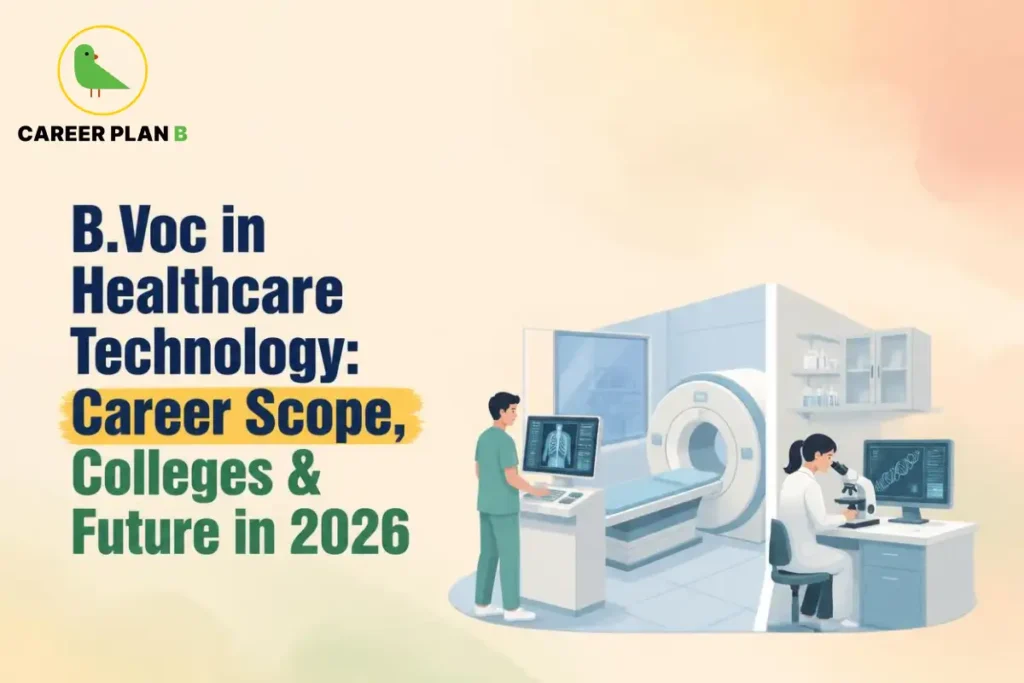
Furthermore, this specialisation genuinely trains students in hands-on diagnostic and medical technology work, spanning areas like medical imaging, laboratory technology, and healthcare administration together. Therefore, it opens doors across the technical, non-clinical side of healthcare, a considerably less crowded path than the doctor or nurse routes everyone defaults to.
Is This Genuinely Equivalent to a BSc Degree?
Yes, genuinely so. B.Voc is UGC-approved and considered equivalent to a BSc, meaning graduates can pursue any postgraduate course requiring a bachelor’s qualification afterward, including an MVoc, MSc, or MBA. Therefore, this shorter, more practical route does not close doors to further academic progression later.
For Personalized Guidance
Healthcare Technology Courses: What Specialisations Actually Exist?
Under the broader healthcare technology umbrella, several genuinely distinct specialisations exist, each leading to different technical roles. Here is a breakdown of the main tracks.
| Specialisation | What It Trains You For | Typical Eligibility |
|---|---|---|
| Medical Imaging Technology | Operating X-ray, CT, MRI, and ultrasound equipment for diagnostic imaging | 10+2 in the Science stream with a minimum of 50% marks (varies by institution) |
| Medical Laboratory Technology (MLT) | Conducting pathology tests, clinical laboratory analysis, and diagnostic investigations | 10+2 in the Science stream, subject to university-specific eligibility criteria |
| Paramedical & Health Care | Providing emergency care, patient support, and assistance in hospitals and healthcare settings | 10+2 from a recognised board; some institutes accept students from any stream |
| Healthcare Administration | Managing hospital operations, medical coding, health records, and healthcare services | 10+2 pass; merit-based admission at most colleges |
Notably, the demand for medical imaging specialists has increased steadily over recent years due to rapid development in science and healthcare, with today’s radiology technicians handling MRI and CT scan work alongside radiotherapy and chemotherapy support for cancer patients. Therefore, this is genuinely a technically deep, expanding specialisation, not a narrow support role.
Do I Need to Clear an Entrance Exam for This Course?
It genuinely depends on the institute. Some colleges admit students purely on 12th board marks through merit-based admission, while others, particularly for medical imaging and paramedical tracks, use entrance exams like AIE CET, with seats allotted based on All India Rank. Therefore, always check your specific target college’s exact admission route before assuming either path applies.
Must read:-Top Vocational & Skill-Based Degree Options: CUET 2026
Which Colleges Actually Offer B.Voc in Healthcare Technology?
Several genuinely accredited institutions across India run dedicated programmes in this specific specialisation. Here is where this pathway genuinely exists today.
- Thakur College of Engineering and Technology (TCET), Mumbai – offers structured B.Voc admissions with clear eligibility and application steps for 2026
- Puran Murti Vidyapeeth, Delhi NCR – runs B.Voc in Paramedical and Health Care with both merit and management quota admission routes
- AIE CET-affiliated institutes – a network of paramedical and healthcare colleges accessible through the AIE CET entrance exam based on All India Rank
Notably, government college fees for B.Voc programmes generally start from around six thousand rupees per year, making this specialisation genuinely affordable compared to many private healthcare degree alternatives.
Healthcare Technology Career: What Roles Can You Actually Pursue?
This field offers genuinely diverse technical roles, extending well beyond the generic “lab technician” label most people imagine. Depending on your specific specialisation, several distinct directions exist.
- Radiology or MRI Technician – operating diagnostic imaging equipment in hospitals and diagnostic centres
- Diagnostic Medical Sonographer – performing ultrasound imaging for patient diagnosis
- Lab Technician / Pathology Technician – conducting clinical tests and analysing samples
- Healthcare Administrator – managing hospital operations, medical coding, and health records
- Paramedical Assistant – supporting emergency care and hospital-based patient assistance
Is There Genuine Job Demand for These Roles?
Yes, genuinely strong demand exists, with numerous job opportunities in government hospitals and public health services specifically for trained paramedics and healthcare technology workers, reflecting India’s expanding healthcare infrastructure.
What Salary Can You Actually Expect?
Compensation genuinely varies based on specific specialisation, employer type, and experience level. However, current data offers a realistic picture for planning your career path.
How Does This Compare to Other B.Voc Specialisations?
Specialisations like Software Development, IT Services, and Healthcare Technology specifically pay higher entry-level salaries, which can reach up to five lakh rupees per year, genuinely outperforming several other B.Voc tracks. Meanwhile, broader B.Voc salary data across all specialisations shows a typical range between two and five lakh rupees annually, meaning healthcare technology genuinely sits at the stronger end of that overall spectrum.
How Should You Actually Choose the Right Programme?
Not every healthcare technology programme delivers equal genuine training depth. Therefore, evaluate your options using these practical criteria before committing three years.
- Decide your specific specialisation early, whether imaging, lab technology, or healthcare administration, since each leads to genuinely different roles
- Check for genuine practical training, since internships and hands-on hospital exposure matter more than classroom theory alone
- Verify UGC recognition and accreditation, ensuring your specific programme carries genuine weight with employers
- Compare admission routes, since some colleges require entrance exams like AIE CET while others admit on merit alone
A Word of Caution Before You Apply
Always verify a specific college’s UGC accreditation and current placement data directly through its official website before enrolling. Additionally, remember that the multiple exit points built into B.Voc, a diploma after year one or an advanced diploma after year two, genuinely protect your time investment if your circumstances change mid-course.
How Career Plan B Helps
Deciding whether a B.Voc in Healthcare Technology genuinely fits your goals takes more than noticing healthcare is a stable sector.This is where Career Plan B can help by offering:
- Personalised Career Counselling: Provides expert guidance based on individual interests, skills, and career goals, helping you decide between healthcare technology and other B.Voc or traditional healthcare routes.
- Psychometric & Career Assessment Tests: Identifies strengths, personality traits, and suitable career opportunities, useful for confirming genuine aptitude for hands-on, technical healthcare work.
- Career Roadmapping: Creates a clear step-by-step plan to achieve academic and professional goals, including which healthcare technology specialisation to pursue.
- Admission & Academic Profile Guidance: Helps in selecting the right courses and colleges and improving academic profiles, so your final choice is genuinely outcome-driven.
Get In Touch With Us
Frequently Asked Questions
1. What is the eligibility for B.Voc in Healthcare Technology?
Most specialisations require 10+2 completion from the Science stream with a minimum of 50% marks, though some paramedical and administration tracks accept any stream.
2. Is a B.Voc in Healthcare Technology equivalent to a BSc degree?
Yes, B.Voc is UGC-approved and considered equivalent to a BSc, allowing graduates to pursue postgraduate courses like MVoc, MSc, or MBA afterward.
3. What is the average starting salary after this specialisation?
Healthcare Technology, alongside Software Development and IT Services, genuinely offers entry-level salaries up to five lakh rupees annually under the B.Voc framework.
4. Do I need to clear an entrance exam for this course?
It depends on the institute. Some colleges admit on merit alone based on Class 12 marks, while others use entrance exams like AIE CET based on All India Rank.
5. What career options exist after completing this programme?
Graduates can work as radiology or MRI technicians, diagnostic medical sonographers, lab technicians, healthcare administrators, or paramedical assistants.
Conclusion
A B.Voc in Healthcare Technology genuinely offers a faster, more affordable, and surprisingly well-paying route into India’s expanding healthcare sector, without the intense competition of NEET or a full medical degree. For students who want hands-on, technically focused healthcare work with real earning potential, this path offers genuine, structured opportunity in 2026.
If you are still weighing this path against traditional medical or nursing routes, thoughtful guidance can bring real clarity before you commit three years of study. The right healthcare technology path, chosen deliberately, can position you exactly where India’s hospitals need skilled people most. Talk to a Career Plan B counsellor today to see if B.Voc in Healthcare Technology is right for you.