Team Career Plan B · August 13, 2026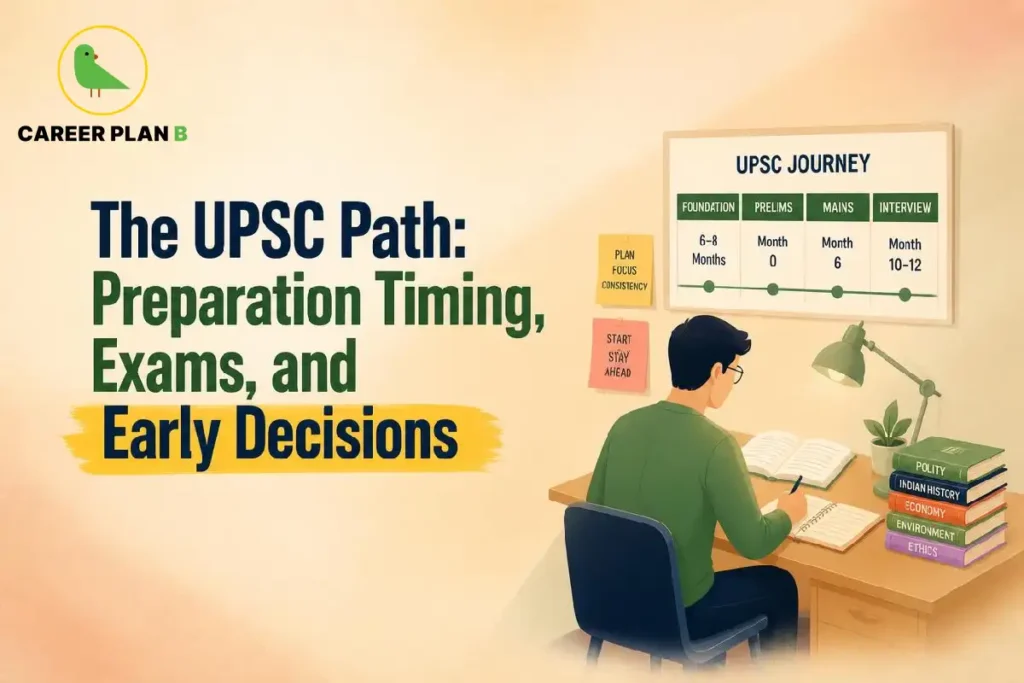
Introduction
The UPSC path is one of India’s most demanding and respected journeys toward public service. Success requires long-term planning, disciplined preparation, and a clear understanding of the examination process. Understanding its stages, eligibility, exam pattern, and timeline early helps students make informed academic and career decisions.
This guide explains what the UPSC examination involves, when students should begin preparing, and the key choices that can influence success over the coming years.
Understanding the UPSC Path: What the Exam Actually Involves
The Civil Services Examination runs across three stages: Preliminary, Main, and a Personality Test. The Preliminary Examination screens candidates through objective questions, and its marks are not counted in the final merit.
Candidates who clear Prelims move to the Main Examination, a set of descriptive papers testing writing and analytical ability. Those who clear Mains attend the Personality Test, with final merit based on combined Mains and Interview marks.
Eligibility: Who Can Take This Path
The UPSC path requires a Bachelor’s degree in any discipline, including final-year students who can apply provisionally. The age limit runs from 21 to 32 years, with relaxation for reserved categories.
Attempt limits vary by category: six for General candidates, nine for OBC, and none for SC/ST within the age window. These rules apply equally regardless of graduation stream, Science, Commerce, or Humanities.
When Should You Start Preparing?
There is no single correct age to begin. Some candidates start seriously during their final year of graduation, while others begin only after working for a few years. What matters more than exact timing is genuine readiness for a sustained, multi-year commitment.
Early exposure to current affairs, reading habits, and analytical writing during school and college years builds a real foundation. The UPSC path rewards consistency built over time far more than a late, intense sprint.
The Exam Timeline: What a Typical UPSC Year Looks Like
The Civil Services Examination follows an annual cycle, with the notification typically released in early February. The Preliminary Examination usually follows in May, and the Main Examination in August of the same year. The scale is genuinely large: UPSC received over 8.19 lakh applications for the 2026 Preliminary Examination alone.
Results and the Personality Test stage follow later in the cycle, with final results typically announced in the following year. Understanding this timeline early helps candidates plan a realistic, structured study schedule around it.
Early Decisions That Shape the UPSC Path
Several decisions well before the exam itself genuinely shape a candidate’s experience. Choosing an optional subject for the Mains examination is one of the most consequential decisions. It should align with genuine interest and available material.
Graduation stream choice also matters less than commonly assumed, since any degree qualifies. What matters more is whether a candidate builds strong writing, analytical, and current-affairs habits well before the exam itself begins.
Step-by-Step Roadmap for Someone Considering This Path
- Confirm your eligibility against the age, education, and attempt-limit criteria for your category.
- Build reading, writing, and current-affairs habits early, ideally starting in college.
- Research optional subjects that align with genuine interest, not just perceived scoring potential.
- Map out the annual exam cycle to plan a realistic, sustained preparation schedule.
- Decide whether to prepare alongside a job or dedicate full-time effort, based on your own circumstances.
Have Any Doubts?
Benefits, Challenges, and What the Data Says
The UPSC path offers a genuine, merit-based route into some of India’s most respected public service roles. Eligibility rules apply transparently and equally across academic streams and backgrounds.
However, no official source this guide cites tracks precise year-by-year selection ratios or success rates across categories. Figures suggesting a specific success percentage often circulate informally rather than from a single verified dataset. Treat such numbers as indicative only.
Common challenges include the multi-year commitment required and the genuine uncertainty around outcomes despite sustained effort. Realistic planning around attempt limits and timelines helps manage this uncertainty better.
How Career Plan B Helps
Deciding whether the UPSC path fits your goals, and when to start, can feel overwhelming without structured guidance. Career Plan B simplifies this through:
- Personalised Career Counselling: helping you assess whether this path genuinely aligns with your strengths and goals
- Psycheintel Career Assessment Tests: identifying your aptitude for the sustained, analytical work this path demands
- Admission and Academic Profile Guidance: helping you understand eligibility, timelines, and early preparation steps
- Structured Career Roadmapping: a clear step-by-step plan from your current stage to a realistic UPSC preparation timeline
For Latest Information
Frequently Asked Questions
Q1.What is the age limit for the UPSC Civil Services Examination?
The age limit is 21 to 32 years for General category candidates, with relaxation for reserved categories.
Q2.Does my graduation stream affect my UPSC eligibility?
No. A Bachelor’s degree in any discipline qualifies, regardless of Science, Commerce, or Humanities background.
Q3.How many attempts are allowed for the UPSC exam?
General category candidates get six attempts, OBC candidates get nine, and SC/ST candidates face no fixed limit.
Q4.When is the best time to start preparing for UPSC?
There is no single correct age. Building reading and analytical habits early, ideally in college, helps regardless of when formal preparation starts.
Q5.Is there official data on UPSC success rates?
No single official dataset this guide cites tracks precise success rates. Treat such figures from other sources as indicative only.
Q6.Can final-year students apply for the UPSC exam?
Yes. Final-year students can apply provisionally for the Preliminary Examination, subject to submitting proof of graduation later.
Conclusion
The UPSC path is a genuine, merit-based route into public service, open to graduates from any academic stream. Understanding its stages, eligibility, and timeline early makes the difference between reactive scrambling and realistic, sustained preparation.
Starting with clarity on eligibility and timing, rather than assumptions, sets up a stronger foundation for this demanding journey.
Connect with Career Plan B today to build a realistic roadmap for the UPSC path.