Careerplanb · November 2, 2026
Introduction
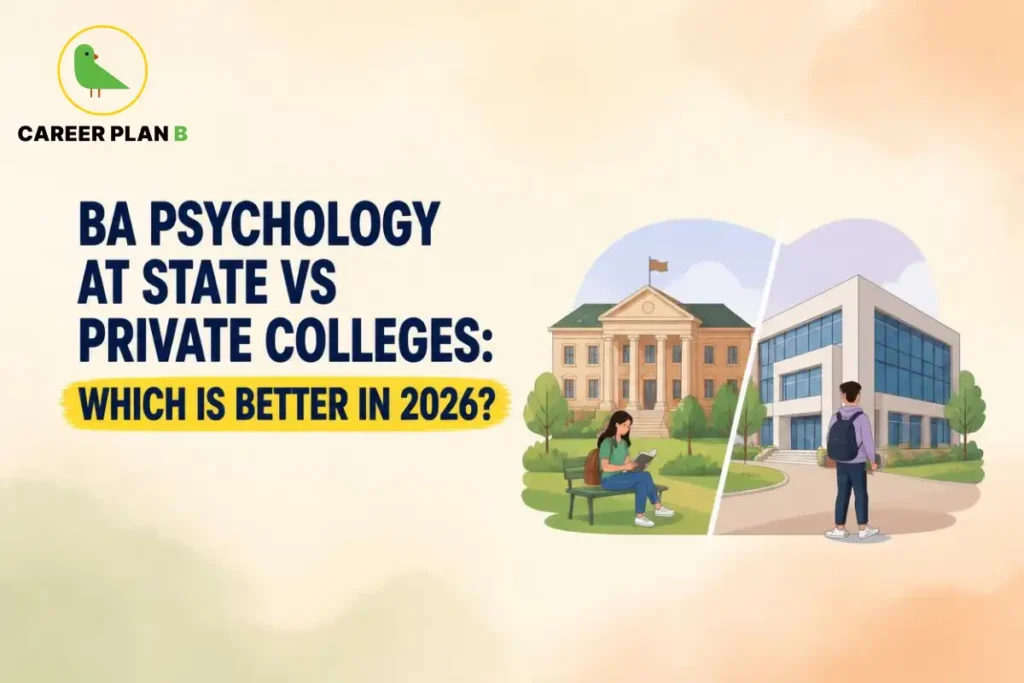
India has only about zero point seven five psychologists per one lakh people, far below what the WHO recommends, while nearly seventy to ninety-two percent of people with mental disorders in India receive no treatment at all. Against that backdrop, one Class 12 student is choosing between Lady Shri Ram College, where fees might run under sixty-one thousand rupees a year, and a private university charging four lakh rupees for the exact same degree title. This is the real tension behind BA Psychology State vs Private Colleges in 2026, and the honest answer genuinely isn’t as simple as “government is cheaper, private is better.”
So which one actually gives you a stronger start, and where does the money genuinely go further? This guide breaks down real fee data, placement patterns, and honest career outcomes behind BA Psychology State vs Private Colleges in 2026. By the end, this decision will feel like a genuinely informed trade-off, not a guess.
What’s the Real Fee Gap Between These Two Paths?
Government colleges charge very low fees compared to their private counterparts, with tuition generally ranging between five thousand and fifty thousand rupees annually. In contrast, private colleges can charge anywhere from eighty thousand rupees to as much as four lakh rupees per year for the exact same three-year BA Psychology degree.
Furthermore, this gap compounds significantly over a full degree. A government college BA Psychology student might spend fifteen thousand to ninety thousand rupees total across three years, while a private college student could genuinely spend two and a half to twelve lakh rupees for the same qualification on paper. Therefore, the financial stakes behind this specific choice are genuinely substantial, not marginal.
For Personalized Guidance
Does a Higher Fee Genuinely Guarantee a Better Education?
Not automatically. Facilities vary depending on whether the college is private or government, but this variation shows up mainly in infrastructure and support services, not necessarily in core academic rigour. Therefore, a higher fee buys you genuinely better labs, counselling support, and campus amenities, not automatically a stronger degree in psychology theory itself.
Read more:-BA Courses with Easy Entry: Psychology, Sociology, Mass Media
BA Psychology Colleges: How Do Admission Routes Actually Differ?
Government and private institutions genuinely follow different admission philosophies, which affects how competitive and how flexible your entry point actually is.
| Factor | Government Colleges | Private Colleges |
|---|---|---|
| Admission Basis | Merit-based or CUET admission, with intense competition at leading institutions. | Merit-based admission or institute-specific entrance tests, generally offering greater flexibility. |
| Total Institutions in India | Approximately 210–311 colleges offer B.A. Psychology programmes. | Approximately 300–471 colleges offer B.A. Psychology programmes. |
| Typical Entrance Route | Primarily through CUET. | CUET or institute-specific entrance examinations such as the Christ University Entrance Test (ET). |
| Scholarship Availability | Government-funded subsidies and state or central scholarship schemes are commonly available. | Merit-based and need-based scholarships are offered selectively by individual institutions. |
Notably, India houses roughly nine hundred forty-three Psychology colleges offering BA courses altogether, split between four hundred seventy-one private and three hundred eleven government institutions. Therefore, private options genuinely outnumber government ones nationally, even though top government colleges remain considerably harder to get into.
Government vs Private Psychology Colleges: Where Does Each Genuinely Win?
Rather than declaring an outright winner, the honest picture genuinely splits by what you’re optimising for.
Why Do Government Colleges Genuinely Win at the Undergraduate Level?
Government colleges genuinely win at the UG level specifically, largely due to their combination of academic rigour, low cost, and, at top institutions, considerable prestige. For instance, a student coming straight from Class 12 might choose between Lady Shri Ram College or Miranda House, both government institutions offering genuinely the best value, or a private option like Christ University, known specifically for stronger infrastructure.
Why Do Private Colleges Genuinely Win on Placement Support?
Private colleges genuinely win in placement support specifically, since these institutions typically invest more heavily in dedicated career services, corporate tie-ups, and structured internship pipelines. Consequently, if your priority is guided entry into corporate HR, counselling startups, or wellness industry roles right after graduation, a private college’s placement infrastructure can genuinely matter more than the fee difference.
What Does the Real Career Outcome Data Actually Show?
This is usually the deciding factor once fees and admission routes are understood. Fortunately, the data here is genuinely encouraging regardless of which path you choose.
What Salary Can You Actually Expect After a BA in Psychology?
BA Psychology graduates in India typically see an average CTC package between four and a half and nine lakh rupees annually across the board. Notably, this figure does not differ dramatically by college type alone, since clinical, industrial-organisational, and corporate wellness roles genuinely offer the highest long-term earning potential regardless of whether your BA came from a government or private institution.
Does the Specific College Genuinely Affect Postgraduate Options?
Somewhat, yes. If you’re targeting a master’s programme afterward, TISS for applied practice, NIMHANS for clinical psychology specifically, or JMI and BHU for affordable excellence, all remain accessible regardless of whether your undergraduate degree came from a government or private college. Therefore, your BA college choice genuinely matters less for postgraduate admission than your actual academic performance and entrance exam preparation.
How Should You Actually Decide Between the Two?
Rather than picking based on reputation alone, work through these questions honestly first.
- Confirm your budget realistically, since the fee gap between government and private can genuinely span several lakh rupees over three years
- Decide how much placement support you’ll genuinely need, since strong self-starters can build their own opportunities regardless of college infrastructure
- Research specific college rigour, not just the government-versus-private label, since quality genuinely varies within both categories
- Plan for postgraduate study early, since your master’s programme will likely matter more for specialised career paths than your BA institution alone
A Word of Caution Before You Decide
Always verify a specific college’s current fee structure, placement record, and faculty credentials directly through its official website before finalising your decision. Additionally, remember that facilities and support services genuinely vary within both government and private categories, so avoid assuming every institution in either group behaves identically.
How Career Plan B Helps
Deciding between BA Psychology State vs Private Colleges genuinely shapes both your finances and your early career trajectory.This is where Career Plan B can help by offering:.
- Personalised Career Counselling: Provides expert guidance based on individual interests, skills, and career goals, helping you weigh cost against placement support honestly.
- Psychometric & Career Assessment Tests: Identifies strengths, personality traits, and suitable career opportunities, useful for confirming genuine interest in psychology before committing either way.
- Career Roadmapping: Creates a clear step-by-step plan to achieve academic and professional goals, including which specialisation and postgraduate path to target.
- Admission & Academic Profile Guidance: Helps in selecting the right courses and colleges and improving academic profiles, so your final choice is genuinely outcome-driven.
Get In Touch With Us
Frequently Asked Questions
1. Are government BA Psychology colleges genuinely cheaper than private ones?
Yes, significantly. Government colleges typically charge five thousand to fifty thousand rupees annually, while private colleges can charge up to four lakh rupees per year.
2. Do private colleges genuinely offer better placement support?
Yes, generally. Private colleges tend to invest more in dedicated career services and corporate tie-ups, while government colleges win specifically on academic rigour and affordability.
3. Does the type of college genuinely affect my starting salary?
Not dramatically. Average BA Psychology salaries range between four and a half and nine lakh rupees regardless of college type, with specialisation mattering more than institution.
4. How many BA Psychology colleges exist in India?
Around nine hundred forty-three colleges offer BA Psychology nationally, split between roughly four hundred seventy-one private and three hundred eleven government institutions.
Conclusion
BA Psychology State vs Private Colleges genuinely comes down to what you’re optimising for, government colleges win on cost and academic prestige at the undergraduate level, while private colleges win on placement support and infrastructure. Neither path guarantees a dramatically different starting salary, so the smarter question is which trade-off genuinely fits your budget and your need for guided career support.
If you are still weighing this decision, thoughtful guidance can bring real clarity before you commit three years and a significant sum of money. The right college for you depends less on the label and more on your specific goals and resources. Talk to a Career Plan B counsellor today to choose the right BA Psychology path for you.