Team5 · July 30, 2026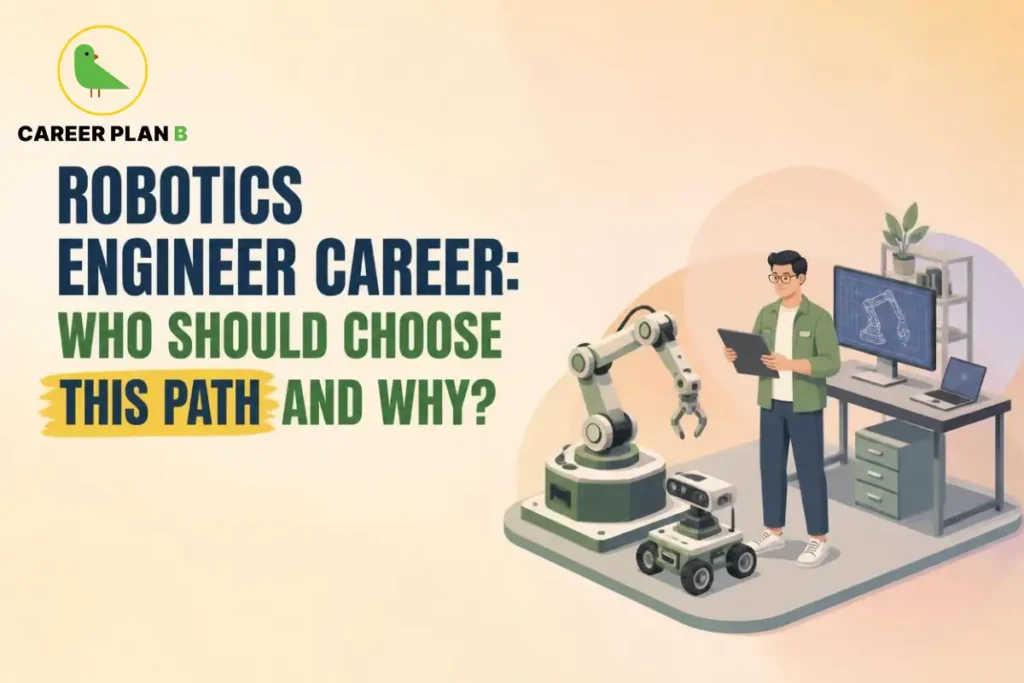
Introduction
Imagine designing a robotic arm that performs surgery with greater precision than any human hand. Or programming an autonomous drone that delivers medicines to remote villages. This is not the plot of a science fiction film; this is the everyday reality of a robotics engineer’s career.
The global robotics market is projected to surpass $218 billion by 2030, according to the International Federation of Robotics. Robots are no longer confined to factory floors; they are in operating rooms, farms, defence systems, and even your living room.
But here is the real question: is a robotics engineering career the right path for you? In this blog, we will break down exactly who thrives in this field, what skills it demands, and how to build your way into one of the most exciting professions of the 21st century.
What Does a Robotics Engineer Actually Do?
A robotics engineer designs, builds, tests, and maintains robotic systems. Their work spans a wide range of industries from automotive manufacturing and aerospace to agriculture, healthcare, and logistics.
On any given day, a robotics engineer might be:
- Designing mechanical structures for a robotic limb
- Writing code to control automated assembly lines
- Testing sensor integration in an autonomous vehicle
- Collaborating with AI teams to improve machine decision-making
The role sits at the crossroads of mechanical engineering, electronics, computer science, and mathematics, making it one of the most interdisciplinary careers available today.
The Overlap Between Artificial Intelligence and Robotics
Modern robotics is deeply intertwined with artificial intelligence and robotics. Machine learning algorithms allow robots to learn from their environment, adapt to new tasks, and make decisions without human input. Engineers who understand both domains are among the most sought-after professionals in the global tech workforce.
So, Who Should Become a Robotics Engineer?
Not every career suits every personality, and that is perfectly fine. Here are the profiles of people who tend to thrive in a robotics engineer career.
You Love Problem-Solving and Building Things
If you were the kind of student who took apart gadgets just to see how they worked and occasionally managed to put them back together, robotics engineering is likely a natural fit. The job is fundamentally about solving complex, real-world problems through creative design and precise engineering.
You Are Comfortable With Both Code and Hardware
Robotics is unique in that it demands fluency in both physical systems and software. If you enjoy programming and enjoy working with circuits, sensors, and motors, this career lets you do both simultaneously every single day.
You Are Curious About How Machines Think
A strong interest in artificial intelligence and robotics, machine learning, and automation is a clear signal. Robotics engineers are increasingly expected to build machines that do not just move but think and adapt.
You Want to Work Across Multiple Disciplines
If sitting in one narrow lane feels too restrictive, robotics engineering is for you. It draws from mechanical engineering, electrical engineering, computer science, and cognitive science, offering a rich, ever-evolving intellectual landscape.
You Are Drawn to High-Impact Work
Robots are solving some of humanity’s hardest challenges, from assisting in disaster relief to enabling surgical precision in remote locations. If you want your work to matter at scale, a career in robotics and automation gives you exactly that platform.
What Skills Does a Robotics Engineer Career Demand?
Understanding robotics engineering skills is essential before committing to the path. These fall into two broad categories:
Technical Skills:
- Programming languages: Python, C++, ROS (Robot Operating System)
- Mechanical design and CAD tools such as SolidWorks and AutoCAD
- Electronics and circuit design
- Control systems and sensor integration
- Machine learning and computer vision fundamentals
- Knowledge of automation and PLC systems
Soft Skills:
- Analytical thinking and logical reasoning
- Attention to detail under pressure
- Team collaboration across engineering disciplines
- Clear communication explaining complex systems to non-technical stakeholders
- Adaptability to rapidly evolving technologies
Educational Pathways: How Do You Get There?
Relevant Degrees:
- B.Tech or B.E. in Robotics, Mechatronics, Mechanical Engineering, or Electronics and Communication Engineering
- M.Tech in Robotics and Automation
- Integrated or dual-degree programmes combining Computer Science with Mechanical Engineering
Top Indian Institutions:
- Indian Institute of Technology, Bombay
- Indian Institute of Technology, Delhi
- BITS Pilani
- For a full list of AICTE-approved institutions offering robotics and automation programmes in India.
Robotics Engineer Job Opportunities and Salary Snapshot
Robotics engineer job opportunities are expanding across industries, growing at remarkable speed.
Industries Actively Hiring Robotics Engineers:
- Automotive manufacturing: Tata Motors, Maruti Suzuki, Hyundai
- Healthcare and surgical robotics
- Defence and aerospace: DRDO, ISRO
- E-commerce and logistics Amazon Robotics, Flipkart
- Agricultural technology and precision farming
- Space exploration and research
Robotics Engineer Salary in India vs Global:
| Role | Average Salary (India) | Global Range |
|---|---|---|
| Junior Robotics Engineer | ₹4–8 LPA | $60,000–$85,000 |
| Robotics Systems Engineer | ₹8–15 LPA | $90,000–$120,000 |
| AI and Robotics Specialist | ₹12–20 LPA | $110,000–$150,000 |
| Senior Robotics Architect | ₹18–30 LPA | $130,000–$180,000 |
Future of Robotics Technology: Is the Demand Real?
The short answer: absolutely, and the data backs it up.
According to the International Federation of Robotics (IFR), the world’s leading authority on industrial and service robotics, the number of operational robots installed globally is growing at double-digit rates year on year. The future of robotics technology is being shaped by rapid advances in AI, edge computing, and miniaturisation. Collaborative robots (cobots), surgical robots, autonomous vehicles, and space robots are all high-growth sub-sectors. India’s The Department of Science and Technology (DST) has also been actively funding robotics research through national science missions. For students entering the field today, the timing could not be more favourable.
Have Any Doubts?
How Career Plan B Helps
Choosing a robotics engineer career is a significant decision, and having the right guidance before you commit makes all the difference. Career Plan B offers personalised career counselling, the PsycheIntel psychometric and career assessment tool, and structured career roadmapping to help you evaluate whether robotics engineering skills genuinely align with your strengths, personality, and academic goals. Whether you are a student standing at the crossroads or a working professional exploring a switch into a career in robotics and automation, Career Plan B provides clarity, direction, and a personalised plan to help you move forward with complete confidence.
For Latest Information
Frequently Asked Questions
- What educational background do I need for a robotics engineer career?
A B.Tech or B.E. in mechanical engineering, Electronics, mechatronics, or Computer Science is the most common entry point. Specialised M.Tech programmes in Robotics and Automation are available at institutions like IIT Bombay and IIT Delhi .
- Is coding mandatory for robotics engineering?
Yes, programming is a core robotics engineering skill. Python and C++ are the most widely used languages, along with ROS.
- What is the scope of a robotics engineer career in India?
India’s robotics sector is growing rapidly. MeitY and DST are actively investing in automation research and digital skilling, while sectors like automotive, defence, and healthcare are expanding their robotics adoption at pace.
- Can I switch to robotics engineering from a different engineering background?
Yes. Many professionals transition from mechanical or electrical engineering into robotics by upskilling in programming, AI, and automation systems.
- How is artificial intelligence changing the robotics engineer career landscape?
Artificial intelligence and robotics are increasingly converging. AI enables robots to learn, adapt, and make real-time decisions, dramatically expanding their capabilities and applications. Engineers proficient in both fields are commanding some of the highest salaries in the industry today.
Conclusion
A robotics engineer career is not for everyone, but for those who love building, coding, problem-solving, and shaping the future, it is one of the most rewarding and future-proof paths available. The future of robotics technology is expanding rapidly; robotics engineer job opportunities are growing across every major industry, and robotics engineer salary figures reflect just how much the world values this expertise. The robots are not taking over. They are simply waiting for the right engineers to build them.
Ready to find out if robotics engineering is truly your calling? Visit Career Plan B for personalised counselling, psychometric assessments, and a career roadmap built entirely around your strengths and goals.