Careerplanb · July 30, 2026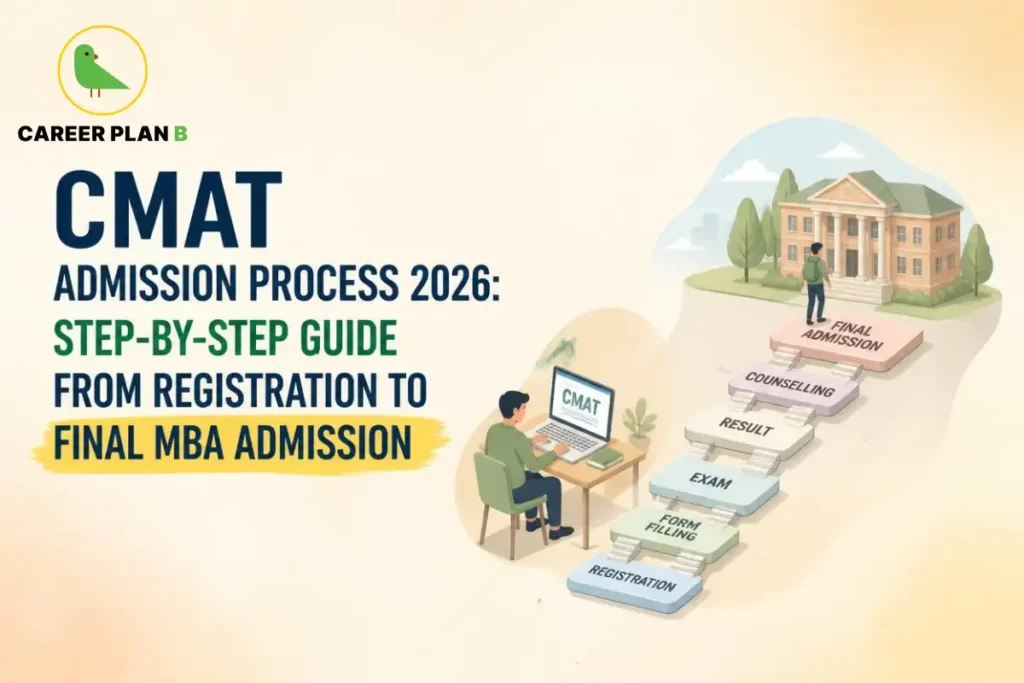
Introduction
Clearing CMAT is step one. Most aspirants treat it like the finish line.
It is not. The exam is a filter. What follows is a multi-stage process that involves downloading your scorecard, applying individually to colleges, attending GD-PI rounds, navigating Maharashtra’s centralised admission process for government colleges, and finally accepting an offer. Each of these stages has deadlines, documents, and decisions that can cost a seat if handled poorly.
CMAT 2026, conducted by the National Testing Agency on January 25, 2026, saw 41,872 students appear for the exam across 259 centres in 110 cities. The result was declared on February 17, 2026. For the 2027 cycle, registration is expected to open in October 2026 and the exam is anticipated in January 2027.
This guide walks you through every stage of the CMAT-based admission process in the right sequence, with official timelines, documents, and practical decisions at each step.
Step 1: Registration on the Official NTA Portal
Everything begins at CMAT. That is the only official website for CMAT registration. No third-party portal accepts CMAT applications on behalf of NTA.
For CMAT 2026, registration opened on October 17, 2025, and closed on November 24, 2025. The deadline to pay the application fee was November 25, 2025. Based on this pattern, CMAT 2027 registration is expected to open in mid-October 2026.
Documents required for registration:
- Scanned passport-sized photograph in JPEG format between 10 and 200 KB
- Scanned signature in JPEG format between 4 and 30 KB
- Valid ID proof for admit card purposes
- Academic details for Class 10, Class 12, and graduation
Registration fee: Rs 2,500 for General and OBC-NCL candidates. Female candidates, SC, ST, PwD, and third-gender candidates pay Rs 1,250. Payment is made online via credit card, debit card, UPI, or net banking at the time of form submission.
Critical tip: NTA allots exam centres based on first preference and a first-come, first-served basis. Completing registration early gives you a better chance of getting your preferred test city. Waiting until the final days risks being allotted a distant centre.
Step 2: Downloading the Admit Card
The CMAT admit card is released by NTA approximately four to five days before the exam date. For CMAT 2026, the admit card was released on January 21, 2026, with the exam on January 25, 2026.
The admit card is downloadable only from the official NTA-CMAT portal. It contains your name, application number, exam centre address, reporting time, exam date, and instructions for the examination day. No physical admit card is dispatched by post.
What to check immediately after downloading:
- Name spelling (must match ID proof exactly)
- Exam centre address and city
- Date and session timing
- Photograph clarity
Any discrepancy in the admit card must be reported to NTA immediately. The examination day does not allow for corrections.
Have Any Doubts?
Step 3: The CMAT Exam: Pattern and Marking Scheme
Understanding the exam pattern is essential before attempting, not just for preparation but for informed strategy on the day itself.
CMAT 2026 was conducted as a Computer-Based Test in a single shift from 9:00 AM to 12:00 Noon. It consisted of 100 MCQs across five sections, each carrying 20 questions.
| Section | No. of Questions | Marks |
|---|---|---|
| Quantitative Techniques and Data Interpretation | 20 | 80 |
| Logical Reasoning | 20 | 80 |
| Language Comprehension | 20 | 80 |
| General Awareness | 20 | 80 |
| Innovation and Entrepreneurship | 20 | 80 |
| Total | 100 | 400 |
Marking scheme: +4 marks for every correct answer, -1 mark for every incorrect answer, and 0 for unattempted questions. There is no sectional time limit. Candidates can move freely across sections within the 180-minute window.
NTA made the Innovation and Entrepreneurship section mandatory in 2022 after replacing its earlier optional status. This section tests candidates on business case reasoning, startup ecosystems, and entrepreneurial thinking, none of which feature prominently in CAT or XAT preparation. Dedicated preparation for this section is necessary.
Step 4: Provisional Answer Key and Objection Window
NTA releases the provisional CMAT answer key a few days after the exam.NTA released the CMAT 2026 answer key on January 31, 2026.
Candidates can challenge any answer they believe is incorrect during the objection window. Each challenge requires a fee of Rs 200 per question, refunded if the objection is accepted. NTA reviews all objections and releases a final answer key incorporating valid corrections.NTA prepares the final CMAT scorecard only after approving the final answer key. As a result, NTA calculates your official percentile using the final corrected answer key instead of the provisional one.
Why this matters: In some years, accepted objections have changed raw scores and shifted percentiles by 0.5 to 1 point. Reviewing the provisional answer key carefully and filing valid objections is worth the effort, particularly for aspirants whose target colleges sit just above their initial estimated percentile.
Step 5: CMAT Result and Scorecard
The CMAT 2026 result was declared on February 17, 2026, on the official portal. The scorecard shows both the raw marks obtained and the percentile score, calculated using the NTA percentile formula.
Steps to download your CMAT scorecard:
- Visit CMAT
- Click the CMAT 2026 Scorecard link on the homepage
- Enter your Application Number and Password or Date of Birth
- Click Submit to view your result
- Download the scorecard and save a printout for admission use
CMAT score validity: One year. A CMAT 2026 scorecard can only be used for the 2026-27 academic year admissions. It is not valid for 2027-28 applications.
Important: There is no re-evaluation of CMAT results. The scorecard is final.Candidates can dispute their scores only through the answer key objection window. NTA does not accept score challenges after declaring the results.
Step 6: Applying to Individual Colleges
This is the step most aspirants underestimate. There is no centralised CMAT counselling by NTA. The role of NTA ends with result declaration.
Every CMAT-accepting college runs its own independent admission process. You must apply separately to each target college through its individual application portal, within its own deadline. Missing one college’s application deadline means losing that option entirely, regardless of your CMAT score.
The first round of MBA admissions at most CMAT-accepting private colleges begins in late February or early March, shortly after the result. The second round typically runs between June and July.
What to include in each college application:
- CMAT 2026 scorecard
- Class 10 and Class 12 mark sheets and certificates
- Graduation degree or provisional certificate
- Work experience certificate if applicable
- Passport-sized photographs as specified
- Category certificate for OBC, SC, ST, or EWS reservations where applicable
Practical strategy: Shortlist 8 to 12 colleges across your realistic CMAT percentile band. Apply to all of them within the first two weeks after result declaration. Do not wait to assess your chances. Deadlines at top CMAT colleges like GIM Goa, BIMTECH, and Welingkar often close in March.
Step 7: GD-PI Rounds at Private CMAT Colleges
Most private CMAT-accepting colleges conduct a Group Discussion and Personal Interview after score-based shortlisting. This is where the MBA seat is actually won or lost.
The GD evaluates communication, team engagement, and structured thinking. Interviewers value candidates who share short, clear contributions and build on others’ points instead of dominating the discussion. Assessors watch whether you listen as actively as you speak.
The PI typically covers three areas. First, academic background: your graduation subject, key concepts, and what you genuinely understood from it. Second, career motivation:Prepare for questions about your specialization and why you chose a particular college. Also, stay updated with current affairs and business news by reading one credible business newspaper daily for four to six weeks before the PI season.
Documents to carry on GD-PI day:
- Printed CMAT scorecard
- All academic mark sheets and certificates (originals and photocopies)
- Work experience letters if applicable
- Two passport-sized photographs
- Any achievement certificates you plan to discuss
Step 8: DTE Maharashtra CAP for Government CMAT Colleges
For JBIMS, SIMSREE, and PUMBA, the admission process is entirely different. These government Maharashtra colleges admit through the Directorate of Technical Education (DTE) Maharashtra’s Centralised Admission Process.
There is no GD-PI at these institutions for MMS seat allocation. Everything is rank-based through the CAP portal.
The CAP process in brief:
- Register on the DTE Maharashtra CAP portal using your CMAT, CAT, or MAH-CET score
- Fill in college and programme preferences in order of priority
- DTE generates provisional allotment lists through multiple CAP rounds
- Accept the allotted seat within the specified window and pay the admission fee
- Report to the college with original documents on the designated date
Critical point for CMAT aspirants: Maharashtra government colleges give preference to MAH-CET scores for Maharashtra domicile candidates. Candidates use CMAT scores to compete for the 15% All India quota seats. Appearing for MAH-CET alongside CMAT dramatically expands your seat options at JBIMS, SIMSREE, and PUMBA.
Step 9: Final Selection, Offer Letter, and Fee Payment
Once a college completes its GD-PI rounds, it releases a final merit list. Your position in that list depends on a composite score that typically includes CMAT percentile, academic record, GD-PI performance, and work experience.
After the merit list, the college sends an offer letter. This offer has a strict acceptance deadline, usually five to seven working days. Failing to accept and pay the initial fee forfeits the seat.
Fee payment at the time of acceptance typically covers the first semester or first year. Read the refund policy carefully before paying. Colleges have different terms for fee refunds if you choose to withdraw before the academic year begins.
CMAT Admission Timeline: 2026 Quick Reference
| Stage | CMAT 2026 Dates |
|---|---|
| Registration Opens | October 17, 2025 |
| Registration Closes | November 24, 2025 |
| Admit Card Released | January 21, 2026 |
| Exam Date | January 25, 2026 |
| Provisional Answer Key | January 31, 2026 |
| Result Declared | February 17, 2026 |
| Private College Applications | February to March 2026 |
| GD-PI Rounds | March to May 2026 |
| DTE Maharashtra CAP | May to July 2026 |
| Final Offers and Fee Payment | June to August 2026 |
How Career Plan B Helps
Navigating the CMAT admission process from registration to final offer requires clear planning at every stage.
Career Plan B’s Personalised Career Counselling helps you build the right college shortlist for your CMAT percentile and career goals.
Psycheintel Career Assessment Tests identify your natural strengths for PI preparation. Admission Guidance covers GD preparation, PI strategy, and DTE Maharashtra CAP navigation, while Career Roadmapping connects your admission decisions to a structured plan from exam day to your first post-MBA role.
Get In Touch With Us
Frequently Asked Questions
Q1. Is there centralised counselling for CMAT like JoSAA for engineering?
No. NTA’s role ends with result declaration. Every college conducts its own admission process independently, and you must apply separately to each one.
Q2. How long is the CMAT scorecard valid?
One year only. A CMAT 2026 score is valid only for 2026-27 admissions and cannot be carried forward to the next cycle.
Q3. Can I challenge the CMAT answer key if I think a question is wrong?
Yes. NTA allows candidates to challenge the provisional answer key after releasing it. Candidates must pay a fee of Rs. 200 per challenge, which NTA refunds if it accepts the objection.
Q4. Do all CMAT colleges conduct GD-PI?
No. Government colleges like JBIMS, SIMSREE, and PUMBA admit through rank-based DTE Maharashtra CAP without a separate GD-PI for MMS shortlisting.
Q5. When should I apply to CMAT colleges after results are declared?
Apply within the first two weeks after result declaration. Most top CMAT college deadlines fall in March, and waiting risks missing them entirely.
Have Any Doubts?
Conclusion
The CMAT exam is one day. The admission process that follows it runs for six months.
Each stage, from scorecard download to individual college applications to GD-PI rounds to DTE CAP counselling, has its own deadline and its own decision. Missing any one of them can close a door that your CMAT score has earned the right to open.
The aspirants who convert strong CMAT scores into strong college admissions are almost always the ones who prepared the process as seriously as they prepared the exam. Know every step. Follow every deadline. Use your scorecard before it expires.