Deepti · August 10, 2026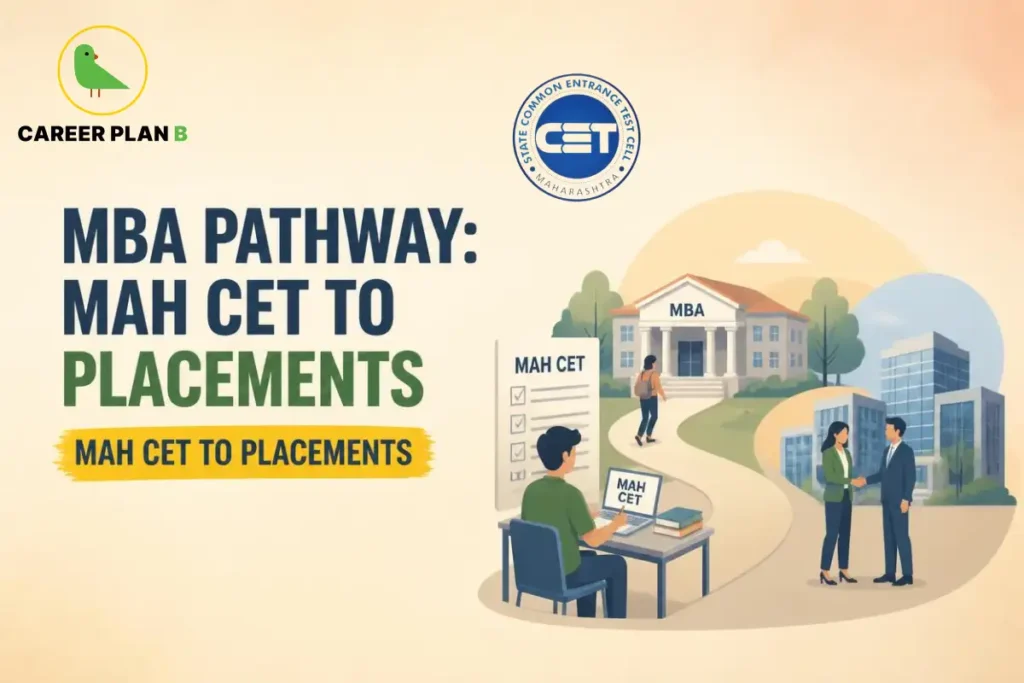
Introduction
Understanding the complete MBA pathway MAH CET to placements means tracing every stage from your first exam registration through your final job offer, since Maharashtra’s MBA ecosystem operates as one connected system rather than isolated steps. MAH MBA CET opens the door, but what happens between clearing the exam and walking into placement season involves counselling rounds, college-specific fee structures, and specialization choices that genuinely shape your eventual outcome. Therefore, this guide walks through the entire journey step by step, covering the exam itself, the CAP counselling process, top college options across fee tiers, and documented placement figures.
We’ll cover what to expect at each stage and how early decisions affect your final placement outcome. By the end, you should understand this complete pathway clearly enough to navigate it confidently.
Stage 1: Understanding MAH MBA CET Itself
MAH MBA CET, conducted by Maharashtra’s State Common Entrance Test Cell, tests Verbal Ability and Reading Comprehension, Logical and Abstract Reasoning, and Quantitative Aptitude, serving as the gateway exam for over 300 MBA-offering institutions statewide.
Consequently, your specific percentile here becomes the single most important input for everything that follows, since it directly determines which colleges become realistically accessible during counselling. Click here to see the Test Details.
What Should You Focus On at This Stage?
Since your MAH CET percentile shapes your entire subsequent pathway, invest genuine preparation effort here rather than treating it as a formality before the “real” decisions happen later, since a stronger percentile widens your options considerably at every subsequent stage.
Consequently, treat this exam with the same seriousness you’d give a national-level test, since the gap between a 90 and a 99 percentile genuinely changes which colleges and outcomes become realistically available to you.
Stage 2: Navigating the CAP Counselling Process
Once your MAH CET results arrive, the Centralized Admission Process begins, where you enter web options ranking your preferred colleges after certificate verification confirms your eligibility and category status.
The counselling portal displays government colleges, self-financed colleges, and private colleges using distinct colour codes, letting you filter and rank your preferences accordingly, with seat allotment happening strictly by merit rank combined with preference order.
Why Does Your Preference Ordering Matter So Much?
Once your rank qualifies for your top-listed college, the system freezes that allotment instantly, meaning you cannot access lower-ranked preferences within the same round even if you’d have preferred them in hindsight.
Consequently, enter your genuine, honest preference order from the start rather than strategically testing a “safe” choice first, since this single decision genuinely shapes which specific college and fee tier you end up in.
Stage 3: Matching Your Percentile to Realistic College Tiers
At the exceptional end, JBIMS Mumbai demands a 99.94-99.99 percentile for Open category admission, delivering a total fee of ₹6.1-6.2 lakh against a 2025 average package of ₹26.12 lakh.
PUMBA Pune requires roughly 96-99 percentile at a similarly low ₹1.2-2 lakh fee, while Welingkar Mumbai, requiring around 97-99 percentile, charges approximately ₹14 lakh against an ₹11.7 lakh average package but offers considerably broader specialization choice across eight tracks including Business Analytics and Healthcare Management.Click here for the Merit List.
What Happens If Your Percentile Falls Below These Top Tiers?
Colleges further down Maharashtra’s over 300-institution network become your realistic targets, generally requiring more moderate percentiles while still offering solid, documented placement outcomes, particularly at government-aided and well-established private institutes.
Consequently, don’t view a percentile below JBIMS or PUMBA’s threshold as closing off strong options entirely, since Maharashtra’s depth means genuine quality exists across a wide percentile range.
For Personalized Guidance
Stage 4: What Your Two Years Inside the Program Actually Involve
Once admitted, your specific specialization choice, whether generalist management at JBIMS and PUMBA or Welingkar’s broader eight-track structure including Business Analytics, Retail Management, and E-Business, shapes which recruiters you’ll eventually access.
Consequently, use these two years deliberately, building genuine depth in your chosen specialization and pursuing internships strategically, since your final placement outcome depends considerably on the specific skills and network you build during this stage, not just your entrance percentile alone.
Does Your College Choice Lock In Your Final Specialization?
Largely yes, since generalist institutes like JBIMS and PUMBA focus on broad management training, while Welingkar’s structure specifically lets you build depth in niche areas like Business Analytics or Healthcare Management from day one.
Therefore, factor this specialization structure into your counselling preferences, not just fee and average package figures, since your career direction should align with what your chosen college’s curriculum actually emphasizes.
Stage 5: The Placement Season Itself
JBIMS‘s 2025 batch achieved 100% placement with over 190 recruiters including Deloitte, EY, and major BFSI players, reflecting decades of established corporate relationships built specifically around Mumbai’s financial ecosystem.
Welingkar’s official 2025 data showed domestic placement averaging ₹11.7 lakh with a highest package of ₹40 lakh, with specialization-specific outcomes documented separately for each of its eight tracks.
Consequently, your specific placement outcome depends heavily on which college and specialization combination you landed in during Stage 3, not a single “Maharashtra MBA” average.
How Should You Prepare for This Final Stage Throughout Your Program?
Build your placement readiness incrementally starting from your first semester, since colleges with strong documented placement infrastructure, like JBIMS’s Personal Interview-free, pure-percentile admission model, and Welingkar’s specialization-specific tracking, reward students who engage with campus recruitment preparation early rather than treating it as a final-semester scramble. Therefore, treat placement season as the culmination of decisions you’ve been making since Stage 1, not an isolated final step.
Complete Pathway Snapshot
| Stage | What Happens | Key Decision Point |
|---|---|---|
| 1. MAH CET Exam | Verbal, Reasoning, Quant sections tested | Preparation intensity shapes your entire pathway |
| 2. CAP Counselling | Web options entry, certificate verification | Honest preference ordering, since Option 1 freezes instantly |
| 3. College Matching | Percentile determines realistic college tier | JBIMS/PUMBA (99+) vs Welingkar (97+) vs broader network |
| 4. Program Duration | Specialization depth building | Generalist (JBIMS/PUMBA) vs specialized (Welingkar) |
| 5. Placements | Recruiter access based on college + specialization | Early, consistent placement preparation |
How Career Plan B Helps
Navigating the complete MBA pathway MAH CET to placements smoothly takes more than focusing on just the exam or just the final placement season.
Career Plan B offers Personalized Career Counselling to help you plan each stage strategically, from exam preparation through specialization choice to placement readiness, alongside PsycheIntel and Career Assessment Tests, Admission and Academic Profile Guidance, and Career Roadmapping to support your entire journey.
Get In Touch With Us
FAQ Section
Q1. Does my MAH CET percentile alone determine my final placement outcome?
No, it determines your college access, but specialization depth and internship effort during the program matter significantly too.
Q2. Can I change my web options after saving them during CAP?
Corrections are possible only within a specific window before final submission and allotment lock in.
Q3. Which college offers the strongest documented placement outcome?
JBIMS Mumbai, with 100% placement and a ₹26.12 lakh average package in 2025.
Q4. Does Welingkar’s broader specialization list affect placement outcomes?
Yes, outcomes vary meaningfully by specific specialization track within Welingkar’s program.
Q5. Should I start placement preparation only in my final semester?
No, engaging with placement readiness from your first semester genuinely improves your eventual outcome.
Conclusion
Tracing the complete MBA pathway MAH CET to placements shows that your final career outcome depends on a connected sequence of decisions, not a single exam score. Your MAH CET percentile determines which of Maharashtra’s over 300 institutions become realistically accessible, from JBIMS’s exceptional 99.94-plus percentile threshold down through PUMBA and Welingkar’s more moderate requirements.
Your CAP counselling preference order then locks in your specific college and fee tier, while your chosen institute’s specialization structure shapes which recruiters you’ll access two years later. Treat each stage as connected rather than isolated, preparing seriously for the exam itself, entering honest preference rankings during counselling, and building genuine specialization depth throughout your program, since this complete pathway, not any single step within it, ultimately determines the placement outcome you’ll reach at the end.