Team5 · July 30, 2026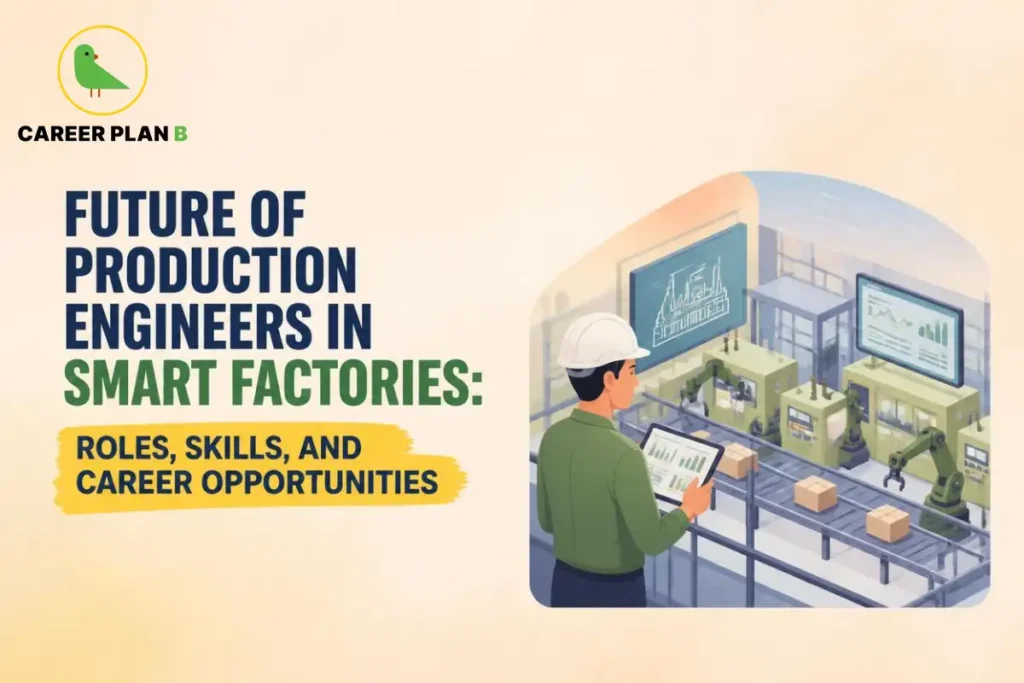
Introduction
Walk into a factory today, and you might not hear the clang of hammers or see rows of workers hunched over assembly lines. Instead, you’ll find robotic arms moving in perfect sync, sensors collecting data in real time, and screens displaying live production metrics. The factory floor has transformed and so has the role of the engineer standing in the middle of it all.
The future of production engineers in smart factories is not a distant concept. It is unfolding right now across India’s manufacturing sector. According to the Government of India’s Invest, India is rapidly positioning itself as a global manufacturing hub under the Make in India initiative, with Industry 4.0 adoption growing across sectors like electronics, defence, automotive, and FMCG.
If you are a production engineer or aspiring to become one this is the most important shift you need to understand. The question is not whether smart factories will change your career. The question is whether you will be ready when they do.
What Is a Smart Factory And Why It Changes Everything?
A smart factory is a digitally connected manufacturing environment where machines, systems, and people communicate through technology to improve efficiency, reduce waste, and increase output quality. It combines the Internet of Things (IoT), Artificial Intelligence (AI), robotics, cloud computing, and real-time data analytics into a single, seamless production ecosystem.
This is the core of what experts call Industry 4.0 the fourth industrial revolution. Unlike previous revolutions driven by steam, electricity, or computers, Industry 4.0 is driven by data and connectivity. And it is reshaping manufacturing technology trends from the ground up.
India’s National Manufacturing Policy, supported by the Ministry of Commerce and Industry, aims to increase the share of manufacturing in GDP to 25% by 2025. Smart factories are central to achieving this goal.
Is the Production Engineer’s Role Dead or Evolving?
Let’s address the fear directly. Many production engineers worry that automation will make their jobs redundant. That fear is understandable but largely misplaced.
Automation replaces repetitive, manual tasks. It does not replace the human judgment needed to design systems, troubleshoot failures, manage processes, and lead teams. In fact, smart factories create more demand for skilled engineers who understand both manufacturing and technology.
What is changing is the nature of production engineer job roles. The engineer who only monitors a single machine is being replaced by the engineer who oversees an entire automated production line, interprets performance data, and makes decisions that improve output at scale. This is an upgrade, not an erasure.
Key Responsibilities of Production Engineers in Smart Factories
Managing Automated Systems and Robotics
Production engineers in smart factories are responsible for setting up, calibrating, and maintaining automated systems including robotic arms, conveyor automation, and CNC-integrated production lines. Understanding CNC and IoT in production engineering is no longer optional it is foundational. Engineers must ensure that machines communicate correctly, that automated processes run without errors, and that downtime is minimised.
Data-Driven Decision Making on the Shop Floor
Every machine in a smart factory generates data. Production engineers are expected to read this data, identify patterns, and use insights to improve efficiency. This could mean spotting a recurring defect in a batch, predicting when a machine needs maintenance, or identifying a bottleneck in the assembly sequence. Data literacy is now as important as technical knowledge.
Integrating IoT and Digital Systems
Smart factories run on connectivity. Production engineers play a key role in integrating IoT devices sensors, actuators, tracking systems with the factory’s central digital infrastructure. They also coordinate with software teams to ensure that digital dashboards and enterprise resource planning (ERP) systems reflect real production realities.
Top Industry 4.0 Skills Every Production Engineer Must Build
Staying relevant in smart manufacturing careers in India requires deliberate upskilling. Here are the most critical Industry 4.0 skills for engineers today:
- PLC (Programmable Logic Controller) Programming: The backbone of automated machinery control
- Industrial IoT: Understanding sensors, connectivity protocols, and edge computing
- Data Analytics and Visualisation: Using tools like Python, Excel, or Power BI to interpret production data
- Lean Manufacturing + Digital Integration: Applying lean principles in digitally connected environments
- Cyber-Physical Systems: Managing systems where physical machines interact with digital software
- Robotics and Automation Engineering: Hands-on understanding of robotic systems on the production floor
- ERP and MES Software: Working with systems like SAP, Oracle, or Siemens Opcenter
The National Skill Development Corporation (NSDC) offers several programmes aligned with Industry 4.0 competencies that production engineers can explore for structured upskilling.
Have Any Doubts?
Career Scope and Job Roles in Smart Manufacturing
The career scope for production engineers in India’s smart manufacturing ecosystem is broad and growing. Here are some of the roles that are emerging or expanding:
- Automation Engineer: Designs and manages automated systems on the production floor
- Process Engineer (Digital): Optimises manufacturing processes using real-time data
- Manufacturing Data Analyst: Translates production data into actionable insights
- CNC Programmer / Manufacturing Technologist: Manages precision machining in computer-controlled environments
- Industrial IoT Engineer: Deploys and manages connected devices across factory systems
- Production Planning Manager: Uses digital tools to forecast demand and plan output
The sectors offering the most growth in automation and engineering jobs include electric vehicles (EVs), aerospace and defence, consumer electronics, pharmaceuticals, and industrial equipment. India’s Production Linked Incentive (PLI) scheme, launched by the Ministry of Commerce and Industry, is actively pushing manufacturing investment across these sectors, which directly translates into more engineering jobs.
How Career Plan B Helps
Navigating the shift to smart manufacturing can feel overwhelming, especially when you are unsure which skills to build or which path to take. Career Plan B helps production engineers and engineering students make sense of it all. Through personalised career counselling, PsycheIntel Career Assessment Tests, and Career Roadmapping, Career Plan B helps you identify your strengths, align them with industry demand, and build a clear plan for your future in smart manufacturing.
For Latest Information
Frequently Asked Questions
- Will automation replace production engineers in smart factories?
No. Automation replaces repetitive tasks, not engineering judgment. Smart factories actually increase the demand for skilled production engineers who can manage, optimise, and troubleshoot automated systems.
- What qualifications do I need to work in a smart factory?
A degree in Mechanical, Production, or Industrial Engineering is a standard entry point. However, additional certifications in PLC programming, IoT, or data analytics significantly improve your prospects. AICTE-recognised programmes and NSDC courses can provide relevant credentials.
- Which industries are hiring production engineers for smart manufacturing roles?
Electric vehicles, defence, consumer electronics, FMCG, pharmaceuticals, and aerospace are among the fastest-growing sectors for smart manufacturing careers in India.
- How do I start building Industry 4.0 skills as a fresher?
Begin with online certifications in PLC programming and industrial IoT. Pair these with foundational knowledge in data analytics. Look for internships or projects in automation-heavy manufacturing companies to gain hands-on experience.
Conclusion
The factory of the future is already here and it needs engineers who are ready to lead it. The future of production engineers in smart factories is not about surviving automation. It is about becoming the person who makes automation work. The engineers who embrace data, digital tools, and continuous learning will not just find jobs they will define the next generation of Indian manufacturing.
If you are at the start of this journey and need clarity on where you stand and where you are headed, Career Plan B is built to help you get there with the right assessment, the right roadmap, and the right guidance for your career in smart manufacturing.
The machines are ready. The question is are you?