Team5 · July 30, 2026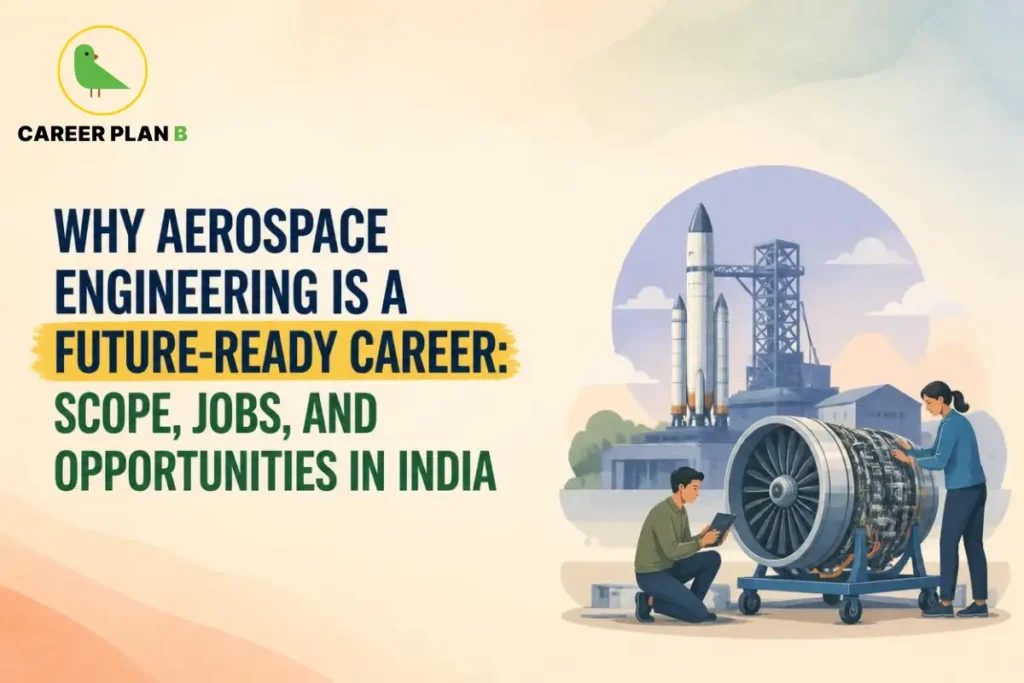
Introduction
In 2023, India made history when Chandrayaan-3 became the first mission in the world to land near the Moon’s south pole. A year later, India’s first solar observatory, Aditya-L1, successfully reached its destination. And with the Gaganyaan human spaceflight mission on the horizon, India is no longer just a participant in the global space race it is one of its most ambitious leaders.
This is exactly Why Aerospace Engineering Is a Future-Ready Career unlike almost any other engineering discipline available to students today. While other industries face uncertainty around automation and job displacement, the aerospace sector is expanding in India and globally. New rockets, new satellites, new aircraft, new defence systems, and an entirely new private space economy are creating sustained demand for skilled aerospace engineers across every level of the profession.
In this blog, we break down what aerospace engineering actually involves, what the career scope looks like in India, which job roles pay what, what skills you need to build, and why the future of this field in India has never looked more promising.
What Is Aerospace Engineering and What Do Aerospace Engineers Do?
Aerospace engineering is the branch of engineering concerned with the design, development, testing, and production of aircraft, spacecraft, satellites, missiles, and related systems. It is one of the most technically demanding and intellectually stimulating fields in all of engineering and one of the most rewarding.
Aerospace engineers work on everything from the aerodynamics of a commercial aircraft wing to the propulsion system of a satellite launch vehicle to the structural integrity of a fighter jet. Key responsibilities include:
- Designing and analysing aircraft and spacecraft structures
- Developing propulsion and engine systems
- Running computational fluid dynamics (CFD) simulations
- Testing and validating systems for safety and performance
- Working on avionics, guidance, and navigation systems
- Collaborating with manufacturing teams for production and assembly
Aeronautical vs Astronautical Engineering What Is the Difference?
Aerospace engineering broadly divides into two sub-disciplines. Aeronautical engineering focuses on aircraft and systems that operate within Earth’s atmosphere commercial planes, fighter jets, helicopters, and drones. Astronautical engineering focuses on spacecraft, satellites, rockets, and systems that operate beyond the atmosphere. In India, most undergraduate programmes offer a combined aerospace engineering degree that covers both areas, with specialisation available at the postgraduate level.
India’s Aerospace Industry Bigger Than You Think
Most students think of ISRO when they hear aerospace engineering in India and ISRO is indeed a crown jewel of Indian science and technology. But the Indian aerospace industry is far larger and more diverse than a single organisation.
ISRO’s Growing Ambitions
The Indian Space Research Organisation has delivered a string of landmark achievements Chandrayaan-3, Aditya-L1, the Mars Orbiter Mission, and over 400 foreign satellite launches through its commercial arm. The upcoming Gaganyaan programme, India’s first crewed spaceflight mission, represents the single largest aerospace engineering undertaking in Indian history and is generating significant hiring across engineering disciplines.
IN-SPACe and the Private Space Revolution
India’s decision to open its space sector to private players through the Indian National Space Promotion and Authorisation Centre IN-SPACe has triggered a wave of aerospace startups. Companies like Skyroot Aerospace, Agnikul Cosmos, Pixxel, and Dhruva Space are building rockets, satellites, and space infrastructure, creating entirely new career pathways for aerospace engineers outside of government organisations.
Aviation Sector Expansion
India’s civil aviation sector is one of the fastest growing in the world. The Airports Authority of India is overseeing the expansion and modernisation of over 100 airports across the country. India’s commercial fleet is expected to triple over the next two decades, and the Maintenance, Repair, and Overhaul (MRO) industry is growing rapidly to support this expansion creating thousands of aviation engineering jobs.
Aerospace Engineering Career Scope in India
The aerospace engineering career scope in India is broad, growing, and backed by both government investment and private sector momentum. Here is a sector-by-sector breakdown of where aerospace engineers work and what they do.
Government Sector Opportunities
The Indian government remains the largest employer of aerospace engineers in the country through its defence, space, and aviation organisations:
- ISRO Indian Space Research Organisation: Spacecraft design, propulsion, satellite systems, mission operations
- HAL Hindustan Aeronautics Limited: Fighter jet manufacturing, helicopter design, aircraft overhaul
- DRDO Defence Research and Development Organisation: Missile systems, UAVs, defence avionics, advanced materials
- NAL National Aerospace Laboratories: Aeronautical research, civil aircraft development, composite materials
- AAI Airports Authority of India: Air traffic management, airport infrastructure, navigation systems
Private Sector and Startups
The private aerospace ecosystem in India is expanding rapidly following IN-SPACe liberalisation. Key private sector employers include:
- Tata Advanced Systems Limited
- Mahindra Defence Systems
- Larsen and Toubro Aerospace and Defence
- Skyroot Aerospace
- Agnikul Cosmos
- Pixxel Space Technologies
- Boeing India and Airbus India engineering centres
Salary Range for Aerospace Engineers in India
- Fresher (0–2 years): ₹3.5 LPA – ₹7 LPA
- Mid-Level (3–6 years): ₹8 LPA – ₹16 LPA
- Senior / Specialist (7+ years): ₹18 LPA – ₹35 LPA+
Engineers working at ISRO, DRDO, or HAL also receive government pay scale benefits, housing allowances, and pension which significantly enhance the overall compensation package beyond the base salary.
Aerospace Engineer Job Roles and Salary
Understanding specific aerospace engineer job roles and salary ranges helps you plan your specialisation early. Here is a breakdown of the most common and in-demand roles:
| Job Role | Primary Sector | Average Salary (India) |
|---|---|---|
| Propulsion Engineer | ISRO, HAL, Private Launch Companies | ₹6 LPA – ₹20 LPA |
| Avionics Engineer | DRDO, HAL, Defence OEMs | ₹5 LPA – ₹18 LPA |
| Structural / Stress Engineer | HAL, NAL, Tata Aerospace | ₹5 LPA – ₹16 LPA |
| Flight Test Engineer | HAL, DRDO, Airlines | ₹6 LPA – ₹20 LPA |
| CFD / Aerodynamics Engineer | ISRO, NAL, R&D Labs | ₹5 LPA – ₹18 LPA |
| Satellite Systems Engineer | ISRO, NewSpace Startups | ₹6 LPA – ₹22 LPA |
| MRO Engineer | Airlines, MRO Companies | ₹4 LPA – ₹14 LPA |
Global Salary Comparison
For aerospace engineers working abroad, the salary picture is significantly different:
- United States: $80,000 – $1,30,000 per year (NASA, Boeing, Lockheed Martin, SpaceX)
- Europe: €55,000 – €90,000 per year (Airbus, ESA, Rolls-Royce)
- UAE: AED 1,20,000 – AED 2,20,000 per year
This global earning potential makes aerospace engineering one of the best engineering branches for space technology and aviation careers with strong international mobility.
Aerospace Engineering Skills and Qualifications You Need
Building the right foundation is one of the most important aerospace engineering skills and qualifications considerations for aspiring engineers. Here is what you need:
Academic Pathway
A B.Tech or B.E. in Aerospace Engineering, Aeronautical Engineering, or Mechanical Engineering is the standard entry point. For research and senior technical roles at ISRO, DRDO, or NAL, an M.Tech or Ph.D. significantly strengthens your profile. AICTE-recognised engineering programmes provide the academic credentials that government and private employers look for.
Key Technical Skills
- Computational Fluid Dynamics (CFD): ANSYS Fluent, OpenFOAM
- Finite Element Analysis (FEA): ANSYS Structural, Nastran, Abaqus
- CAD and 3D Modelling: CATIA, SolidWorks, MATLAB
- Propulsion and thermodynamics fundamentals
- Avionics and embedded systems basics
- Programming: Python, MATLAB, C++
For structured skill-based certification alongside your degree, NSDC-aligned programmes offer industry-recognised credentials in aerospace-adjacent skills including CAD, manufacturing, and systems engineering.
Soft Skills That Matter
- Precision and attention to detail: errors in aerospace engineering can have catastrophic consequences
- Systems thinking: understanding how every component interacts with the whole
- Problem-solving under constraints: designing for weight, cost, safety, and performance simultaneously
- Cross-functional collaboration: working with scientists, designers, manufacturers, and regulators
Have Any Doubts?
Why the Future of Aerospace Industry in India Is Bright
There are five powerful forces driving the future of aerospace industry in India and together, they make a compelling case for why this is one of the best career bets any engineering student can make today.
Gaganyaan India’s Human Spaceflight Mission
ISRO’s Gaganyaan programme aims to send Indian astronauts to space aboard an indigenously built spacecraft. This mission is driving massive investment in spacecraft design, life support systems, launch vehicle development, and mission operations all of which require skilled aerospace engineers across multiple specialisations.
Defence Aerospace Modernisation
India is one of the largest defence spenders in the world, and a significant portion of that spending is directed at aerospace modernisation. The Light Combat Aircraft (LCA) Tejas programme, the Advanced Medium Combat Aircraft (AMCA) project, and India’s expanding missile development programmes under DRDO are all generating sustained demand for defence and aviation engineering jobs in India. The Ministry of Defence’s iDEX initiative is also supporting aerospace defence startups with funding and government contracts.
PLI Scheme for Aerospace and Defence
The Government of India’s Production Linked Incentive scheme for aerospace and defence is attracting global aerospace manufacturers to set up production in India. Companies like Boeing, Airbus, and Safran are expanding their India footprint which means more engineering jobs on Indian soil, aligned with global aerospace standards.
Commercial Aviation Boom
India is projected to become the third-largest aviation market in the world by 2030. The rapid expansion of IndiGo, Air India, and new carriers, combined with fleet growth and the development of new airports, is creating a massive need for MRO engineers, avionics specialists, and aviation systems professionals across the country.
NewSpace Economy
The global NewSpace economy driven by satellite broadband, Earth observation, space tourism, and lunar exploration is creating entirely new aerospace engineering roles in Indian startups that did not exist five years ago. Engineers with skills in small satellite design, launch vehicle propulsion, and space systems engineering are in particularly high demand in this emerging segment.
How Career Plan B Helps
Aerospace engineering is one of the most competitive and technically demanding career paths in India and starting with clarity can make all the difference. Career Plan B offers personalised career counselling, PsycheIntel Career Assessment Tests, and structured Career Roadmapping to help aspiring aerospace engineers assess their strengths, identify the right specialisation whether propulsion, avionics, structures, or space systems and build a step-by-step plan to reach their goals in India’s growing aerospace and defence sector.
For Latest Information
Frequently Asked Questions
- Is aerospace engineering a good career choice in India?
Yes aerospace engineering career scope in India is growing significantly, driven by ISRO’s expanding space programme, India’s defence modernisation, the PLI scheme attracting global aerospace manufacturers, and the rapid growth of private space companies following IN-SPACe liberalisation. It is one of the most future-ready engineering careers available to students today.
- What qualifications do I need to become an aerospace engineer in India?
A B.Tech or B.E. in Aerospace, Aeronautical, or Mechanical Engineering from an AICTE-recognised institution is the standard entry point. For research roles at ISRO, DRDO, or NAL, an M.Tech or higher qualification significantly strengthens your profile. Technical skills in CFD, FEA, CATIA, and MATLAB are highly valued by employers across both government and private sectors.
- What are the top employers for aerospace engineers in India?
ISRO, HAL, DRDO, and NAL are the leading government employers. In the private sector, Tata Advanced Systems, Larsen and Toubro Aerospace, Mahindra Defence Systems, and a growing number of NewSpace startups like Skyroot Aerospace and Agnikul Cosmos are actively hiring. Boeing India and Airbus India engineering centres also offer strong aerospace engineering opportunities.
- How does India’s space programme create aerospace engineering jobs?
ISRO’s ongoing missions including Gaganyaan, Chandrayaan follow-on missions, and commercial satellite launches require continuous hiring of aerospace engineers in propulsion, spacecraft design, avionics, mission operations, and testing. The opening of India’s space sector to private players through IN-SPACe has further multiplied ISRO and aerospace engineering careers by enabling a new generation of space startups to build, launch, and operate their own systems.
Conclusion
The evidence is clear why aerospace engineering is a future-ready career is not a matter of opinion. It is a matter of data, policy, investment, and momentum. India is building rockets, launching satellites, expanding airports, modernising its air force, and opening its space sector to private innovation. Every one of these developments creates demand for skilled, well-trained aerospace engineers who can design, build, test, and operate the systems that will define the next chapter of Indian and global technology.
If you are drawn to the idea of building something that can leave the Earth or simply fly above it and want to build a career with genuine purpose, global relevance, and strong long-term growth, aerospace engineering deserves to be at the top of your list.
Career Plan B can help you assess whether this is the right path for you and build a concrete roadmap to get there with the right guidance, the right assessments, and the right plan from day one.
The sky is not the limit. It is just the beginning.