Team5 · July 31, 2026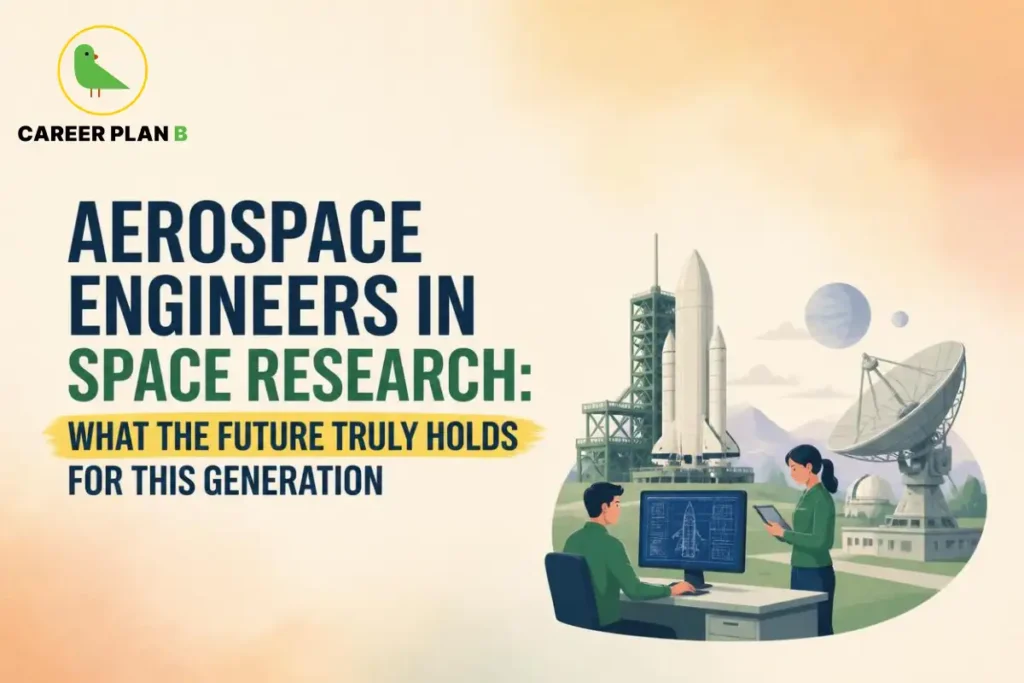
Introduction
On 23rd August 2023, India made history. Chandrayaan-3’s Vikram lander touched down near the lunar south pole a feat no country had achieved before. Millions watched in awe. But behind every second of that mission were hundreds of aerospace engineers in space research, quietly solving problems that had never been solved before.
India’s space story is no longer just about ISRO. It is about a rapidly expanding ecosystem of government missions, private space startups, defence applications, and global collaborations all of which are creating an unprecedented demand for skilled aerospace engineers.
According to the Indian Space Research Organisation (ISRO), India’s space economy is projected to grow from $8.4 billion in 2023 to $44 billion by 2033 a fivefold increase in a single decade. That growth will not happen on its own. It will be built, launch by launch, by the next generation of aerospace engineers in space research.
This blog is your complete guide to understanding what that future looks like the roles, the skills, the institutions, and the career paths available to you right now.
What Role Do Aerospace Engineers Play in Space Research?
Before mapping the future, it helps to understand what aerospace engineers actually do in a space research context because the role is far broader than most students realise.
Aerospace engineers in space research are responsible for:
- Launch Vehicle Design: Designing the rockets, propulsion systems, and structural components that carry payloads to orbit
- Spacecraft Systems Engineering: Integrating navigation, power, thermal control, and communication systems into a functioning spacecraft
- Orbital Mechanics: Calculating trajectories, orbital insertions, and mission planning
- Avionics and Control Systems: Designing the electronics and software that guide a vehicle through space
- Payload Integration: Ensuring scientific instruments, satellites, or crew modules are safely carried and deployed
- Re-entry and Landing Systems: Engineering systems that bring vehicles back to Earth safely
Space research engineering is distinct from commercial aviation aerospace work. The environments are more extreme, the margins for error are near zero, and the technical problems are often entirely new.
Key Specialisations Within Aerospace Engineering for Space
- Propulsion Engineering (chemical, electric, and nuclear propulsion)
- Structural and Materials Engineering for space-grade components
- Guidance, Navigation, and Control (GNC) Systems
- Satellite Communication and Remote Sensing
- Thermal Systems and Heat Shield Design
- Space Mission Analysis and Systems Engineering
India’s Space Ambitions A Golden Era for Aerospace Engineers
The future of aerospace engineering in India has never looked more compelling. India is not just a participant in the global space race it is rapidly becoming one of its most consequential players.
Here is what is driving that momentum:
Active and Upcoming ISRO Missions:
- Gaganyaan India’s first crewed spaceflight programme, targeting human orbital missions
- Chandrayaan-4 a planned lunar sample return mission
- Aditya-L1 India’s first solar observatory mission, successfully launched in 2023
- NISAR a joint NASA-ISRO Earth observation satellite
- Shukrayaan-1 a proposed Venus orbiter mission
Each of these missions requires hundreds of aerospace engineers across design, testing, integration, and operations phases.
IN-SPACe Opening India’s Space to the Private Sector: The Indian National Space Promotion and Authorisation Centre (IN-SPACe) was established under the Department of Space to enable private companies to participate in India’s space activities. This is a watershed moment for aerospace engineering career opportunities in India.
This policy shift means that for the first time, aerospace engineers in India are not limited to a single government employer. An entire private space industry is being built around them.
Aerospace Engineering Career Opportunities Beyond ISRO
ISRO careers for aerospace engineers remain the gold standard in India prestigious, technically rigorous, and deeply meaningful. But they represent only one part of a much larger landscape of space research jobs for engineers.
Indian Private Space Startups: India’s private space sector has exploded since IN-SPACe opened the door. Key players actively hiring aerospace engineers include:
- Skyroot Aerospace India’s first private rocket company, successfully launched Vikram-S in 2022
- Agnikul Cosmos developing semi-cryogenic engines and small launch vehicles
- Pixxel building India’s first private earth observation satellite constellation
- Bellatrix Aerospace developing green propulsion systems for satellites
- Dhruva Space satellite deployment and space logistics
These startups offer faster career progression, equity opportunities, and exposure to cutting-edge problems in a way that large organisations often cannot.
Global Opportunities: Aerospace engineers with strong fundamentals and specialised skills are in demand globally:
- NASA through research collaborations, fellowships, and direct hiring
- ESA (European Space Agency) particularly for mission analysis and spacecraft engineering
- SpaceX, Boeing, Lockheed Martin, Airbus for commercial space and defence aerospace roles
Defence and Dual-Use Applications: DRDO develops missile systems, UAVs, and aerospace defence equipment that require the same core skills as space research. HAL designs and manufactures military and civil aircraft. Both are significant employers of aerospace engineers looking for government sector roles beyond ISRO.
Space Research Jobs for Engineers What Roles Actually Exist?
Here is a practical breakdown of space research jobs for engineers across the ecosystem:
- Propulsion Engineer designs rocket engines and thruster systems
- Structures and Materials Engineer ensures spacecraft survive launch loads and space environments
- GNC Engineer develops guidance, navigation, and control algorithms
- Systems Engineer integrates all spacecraft subsystems into a coherent whole
- Mission Analyst plans orbital trajectories and mission sequences
- Satellite Communications Engineer designs and operates ground-to-space communication links
- Test and Verification Engineer validates that every component performs as designed before launch
Skills Every Aerospace Engineer Needs for the Space Sector
The aerospace engineering skills for space sector work fall into two clear categories technical depth and systems-level thinking.
Core Technical Skills:
- Propulsion and Thermodynamics: Understanding rocket propulsion, combustion, and thermal management
- Orbital Mechanics: Kepler’s laws, orbit transfers, launch windows, and trajectory design
- Structural Analysis: FEA tools like ANSYS or NASTRAN to validate structural integrity
- Software Tools: MATLAB and Simulink for modelling and simulation; STK (Systems Tool Kit) for mission analysis; Python for data analysis and automation
- CAD and Systems Design: SolidWorks, CATIA for hardware design
- Embedded Systems: For avionics and spacecraft control software
Emerging Skills in High Demand:
- AI and machine learning applied to autonomous spacecraft operations
- Smallsat and CubeSat design for the booming commercial satellite sector
- In-space propulsion electric and ion thrusters for satellite station-keeping
- Remote sensing and data analytics for earth observation payloads
Soft Skills That Space Research Demands
Space missions are defined by complexity, long timelines, and catastrophic consequences of failure. The soft skills that matter most are:
- Systems Thinking: The ability to understand how every component decision affects the entire mission
- Precision and Attention to Detail: In space engineering, small errors have enormous consequences
- Cross-disciplinary Collaboration: Working effectively with mechanical, electrical, software, and operations teams
- Resilience and Problem-Solving Under Pressure: Space missions rarely go exactly to plan
Aerospace Engineer Salary in India Government vs Private Space Sector
Understanding the aerospace engineer salary in India across different employers helps set realistic expectations.
ISRO and Government Sector: ISRO scientists and engineers are recruited under structured pay scales. Entry-level Scientist/Engineer SC positions start at approximately:
- Basic Pay: ₹56,100 per month (Level 10 of 7th Pay Commission)
- Total CTC including allowances: ₹8–12 LPA at entry level
- Additional Benefits: HRA, medical coverage, pension under NPS, subsidised housing
Private Space Startups:
- Entry-level: ₹5–9 LPA at funded startups
- Mid-level (3–5 years): ₹12–22 LPA
- Senior roles at well-funded startups: ₹25–40 LPA with equity
Global Roles: Aerospace engineers at NASA-affiliated research positions or major US aerospace firms earn median salaries above $120,000 annually.
Have Any Doubts?
How to Build Your Path Into Space Research
The academic foundation matters enormously in aerospace. Here are the key pathways:
Indian Institute of Space Science and Technology (IIST): India’s dedicated space university, established by the Department of Space, offers B.Tech, M.Tech, and PhD programmes specifically designed to feed into ISRO and the broader space sector. Graduates are sponsored by ISRO with direct recruitment pathways.
IITs and NITs: B.Tech and M.Tech in Aerospace Engineering at IIT Bombay, IIT Madras, IIT Kharagpur, and IIT Kanpur are highly regarded.
AICTE-Approved Institutions: Several private engineering institutions offer AICTE-approved aerospace engineering programmes.
Building Practical Experience:
- Apply for ISRO’s YUVIKA (Young Scientist Programme) for early exposure
- Pursue NPTEL courses in Aerospace Propulsion, Flight Mechanics, and Space Technology
- Participate in student satellite projects, rocketry competitions, and SAE Aero Design events
How Career Plan B Helps
A career among aerospace engineers in space research requires not just the right qualifications it requires a deliberate, well-mapped plan. Career Plan B offers Psycheintel-based career assessment tests to evaluate whether your analytical and technical strengths align with aerospace and space research demands. Through personalised career counselling, academic profile guidance for IIST, IIT, and top aerospace programmes, and structured career roadmapping, Career Plan B helps you identify the exact path ISRO, private space sector, or global opportunities that matches your profile and ambitions.
For Latest Information
Frequently Asked Questions (FAQs)
- What qualifications do I need to become an aerospace engineer in space research?
A B.Tech in Aerospace Engineering from an IIT, IIST, or AICTE-approved institution is the standard entry point. Postgraduate specialisation in propulsion, GNC, or systems engineering significantly strengthens your profile for ISRO and private space sector roles. IIST graduates have a direct recruitment pathway into ISRO.
- Is ISRO the only option for aerospace engineers in India who want to work in space research?
No. India’s private space sector Skyroot, Agnikul, Pixxel, and others is growing rapidly under the IN-SPACe framework. DRDO and HAL also offer aerospace engineering roles in defence-related space and aviation applications. Global opportunities at NASA, ESA, and commercial space companies are also accessible to Indian engineers.
- What is the selection process for ISRO careers for aerospace engineers?
ISRO recruits primarily through its centralised recruitment process for Scientist/Engineer positions, which involves a written test and interview. IIST graduates have a sponsored recruitment pathway. GATE scores are also considered for certain technical roles.
- Which aerospace engineering skills are most in demand for space sector jobs right now?
Propulsion engineering, GNC systems, orbital mechanics, satellite communications, and systems engineering are consistently in high demand. Emerging high-value skills include AI-driven autonomous systems, smallsat design, electric propulsion, and remote sensing data analytics.
- Can aerospace engineers work in both space research and defence sectors?
Yes. Many aerospace engineering fundamentals propulsion, structures, guidance systems, and avionics apply directly across space research and defence applications. DRDO and HAL actively recruit aerospace engineers for missile systems, UAVs, and military aircraft programmes alongside their space-related work.
Conclusion
The golden age of space exploration is not coming it is already here. And India is not watching from the sidelines. With ISRO’s ambitious mission roadmap, a thriving private space ecosystem under IN-SPACe, and global opportunities expanding every year, the future for aerospace engineers in space research has never been more wide open.
But that future belongs to those who prepare for it deliberately with the right skills, the right academic foundation, and the right career strategy.
If you are serious about building a career that reaches beyond the atmosphere, start by understanding your strengths and mapping the right path forward. Visit Career Plan B today and take the first step toward a career that is, quite literally, out of this world.