Team5 · July 31, 2026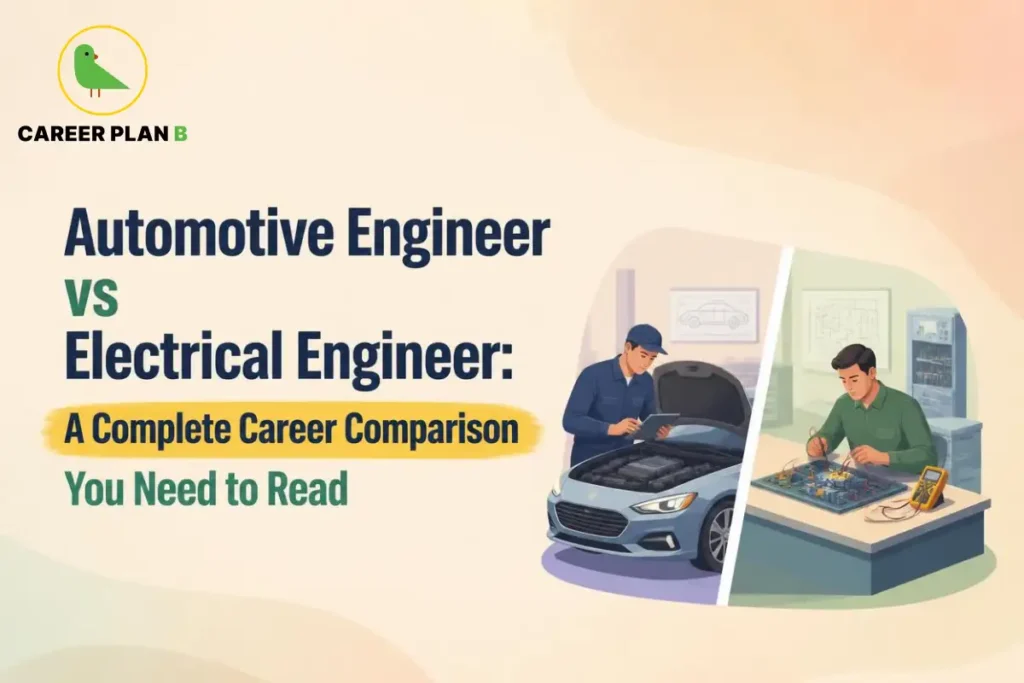
Introduction
Every year, thousands of engineering students sit with their JEE results, college allotment letters, and one big question burning in their minds which branch do I choose, and what kind of future will it give me?
For students drawn to vehicles, machines, and the future of mobility, the choice often narrows down to two compelling options: automotive engineer vs electrical engineer. Both are technically demanding, both are in high demand, and both are being transformed by the electric vehicle revolution which means the lines between them are blurring faster than ever.
But they are not the same field. The skills, the day-to-day work, the industries that hire you, and the career ceilings are genuinely different. Choosing the wrong one or choosing without understanding both can cost you years of misaligned effort.
According to the All India Council for Technical Education (AICTE), mechanical and electrical engineering remain among India’s highest-enrolled engineering branches, producing hundreds of thousands of graduates annually. The competition is real but so is the opportunity, if you pick the right path.
This blog gives you an honest, detailed career comparison for engineering students weighing these two fields covering roles, salaries, industry scope, growth potential, and the key question of which branch suits you better.
What Does an Automotive Engineer Actually Do?
An automotive engineer works on the design, development, testing, and manufacturing of vehicles and their subsystems. This includes everything from the engine and transmission to the chassis, suspension, safety systems, and increasingly, the electric drivetrain.
An automotive engineering career in India can take you across:
- Vehicle Design and R&D: Developing new vehicle concepts, optimising existing platforms, and testing prototypes
- Powertrain Engineering: Working on engines, gearboxes, and increasingly electric motors and battery systems
- Chassis and Suspension: Ensuring vehicle dynamics, ride quality, and handling meet performance targets
- Manufacturing and Production: Overseeing assembly processes, quality control, and supplier management
- Safety Engineering: Crash testing, structural integrity analysis, and regulatory compliance
- NVH (Noise, Vibration, and Harshness): Reducing unwanted sounds and vibrations for better driving comfort
Key Specialisations in Automotive Engineering
- Electric Vehicle (EV) Powertrain Engineering
- Automotive Embedded Systems and Software
- Vehicle Aerodynamics and Thermal Management
- Motorsport Engineering
- Autonomous and Connected Vehicle Systems
What Does an Electrical Engineer Actually Do?
An electrical engineer works with electrical systems, power generation, electronics, control systems, and increasingly, the software that drives them. It is one of the broadest engineering disciplines touching nearly every industry on earth.
Electrical engineering career opportunities span a vastly wider range of sectors compared to automotive:
- Power Generation and Distribution: Working with thermal, hydro, solar, and nuclear power systems
- Electronics and Semiconductor Design: Developing circuits, chips, and embedded systems
- Telecommunications: Designing and maintaining communication networks and systems
- Industrial Automation and Control: Programming PLCs, designing SCADA systems, and automating manufacturing processes
- Renewable Energy: Solar panel systems, wind energy integration, and smart grid development
- EV and Battery Technology: Designing battery management systems (BMS), power electronics, and motor controllers
Key Specialisations in Electrical Engineering
- Power Electronics and Drives
- Embedded Systems and VLSI Design
- Control Systems and Robotics
- Renewable Energy Systems
- Signal Processing and Communications
- Electric Vehicle Technology
Head-to-Head Comparison Difference Between Automotive and Electrical Engineering
Understanding the core difference between automotive and electrical engineering is essential before committing to either path.
| Aspect | Automotive Engineering | Electrical Engineering |
|---|---|---|
| Primary Focus | Vehicle Systems and Mobility | Electrical Systems Across All Industries |
| Core Subjects | Thermodynamics, Vehicle Dynamics, IC Engines, Materials | Circuit Theory, Power Systems, Electronics, Control Systems |
| Key Tools | CATIA, SolidWorks, MATLAB, AVL CRUISE | MATLAB, AutoCAD Electrical, PSCAD, LabVIEW |
| Industries | Automotive OEMs, EV Companies, Motorsport, Defence | Power Sector, IT/Electronics, Defence, Telecom, Manufacturing |
| Industry Breadth | Focused on the Mobility Sector | Spans Virtually Every Industry |
| EV Overlap | High – Powertrain and Vehicle Integration | High – Battery Systems, Motor Controllers, Power Electronics |
| Government Sector | DRDO, ISRO, Defence Vehicles | NTPC, BHEL, PGCIL, DRDO, Railways |
The most important insight in this table is the EV overlap. As vehicles electrify, automotive and electrical engineers are increasingly working on the same problems just from different angles. An automotive engineer focuses on how the electric drivetrain integrates into the vehicle; an electrical engineer focuses on the power electronics, motor control, and battery systems themselves.
Salary Comparison Automotive Engineer vs Electrical Engineer in India
Salary is one of the most practical factors in any career comparison for engineering students, so here is an honest breakdown.
Automotive Engineer Salary in India:
- Entry-level (0–2 years): ₹3.5–6 LPA at Tier-2 OEMs; ₹5–8 LPA at Tata Motors, Mahindra, Maruti Suzuki
- Mid-level (3–6 years): ₹8–15 LPA
- Senior level (7+ years): ₹18–30 LPA at top OEMs and EV companies
- EV Specialists: Premium of 20–35% over traditional automotive roles currently
Electrical Engineer Salary in India:
- Entry-level (0–2 years): ₹3.5–6 LPA in power sector; ₹5–9 LPA in IT/electronics firms
- Mid-level (3–6 years): ₹8–18 LPA
- Senior level (7+ years): ₹20–40 LPA in specialised roles particularly power electronics, VLSI, and automation
Government Sector Pay:
Both branches have strong government sector pathways. PSU salaries are governed by the 7th Pay Commission and IDA pay scales. Key PSU employers for electrical engineers include NTPC, BHEL, and Power Grid Corporation of India (PGCIL).
For automotive engineers, DRDO and HAL offer government sector roles in defence vehicle and aerospace applications.
Global Benchmarks:
According to the U.S. Bureau of Labor Statistics, the median annual salary for automotive engineers is approximately $99,000, while electrical engineers earn a median of $103,000 annually a modest difference at the global level.
Industry Scope and Job Opportunities
Automotive Engineering Career in India Where Are the Jobs?
- OEMs (Original Equipment Manufacturers): Tata Motors, Mahindra, Maruti Suzuki, Hyundai India, Honda, Toyota Kirloskar
- EV Companies: Ola Electric, Ather Energy, Tata EV, Revolt Motors, Bounce Infinity
- Auto Components: Bosch India, Minda Industries, Motherson Group, Valeo India
- Defence Vehicles: DRDO’s Combat Vehicles Research and Development Establishment (CVRDE)
- Motorsport: Mahindra Racing (Formula E), JK Tyre motorsport programmes
India’s automotive industry contributes approximately 7.1% of GDP and is the third-largest automobile market in the world, making it one of the most stable and expansive employers of automotive engineers.
Have Any Doubts?
Electrical Engineering Career Opportunities Where Are the Jobs?
The Electrical engineering’s greatest strength is its sheer breadth of application:
- Power Sector: NTPC, PGCIL, NHPC, state electricity boards
- Renewable Energy: Adani Green, Tata Power Solar, ReNew Power, SECI (Solar Energy Corporation of India)
- Electronics and Semiconductor: Texas Instruments India, Intel, Qualcomm, Samsung Semiconductor India
- Telecom: BSNL, Airtel, Nokia, Ericsson India
- Industrial Automation: ABB India, Siemens India, Honeywell India
- Railways: Indian Railways and RDSO (Research Designs and Standards Organisation)
- Defence: DRDO, BEL (Bharat Electronics Limited)
The sheer diversity of electrical engineering employers means that an electrical engineer who loses a job in one sector can relatively easily transition to another a resilience that automotive engineers, tied more closely to one industry, do not always have.
Which Engineering Branch Has Better Scope Automotive or Electrical?
This is the central question, and the honest answer is: it depends on what you mean by “better scope.”
If scope means industry breadth: Electrical engineering wins clearly. It spans power, electronics, telecom, automation, defence, railways, and more. An electrical engineer is employable across virtually every industry.
If scope means depth and passion in one transformative industry: Automotive engineering is deeply compelling right now. The EV revolution is remaking an entire global industry, and automotive engineers are at the heart of it.
If scope means future-proofing: Both branches are converging. The most in-demand engineers in the EV sector today are those who understand both automotive systems integration and electrical power electronics. Whichever branch you choose, building knowledge in the other gives you a significant edge.
If scope means government sector stability: Electrical engineers have more PSU options NTPC, BHEL, PGCIL, RDSO, state electricity boards compared to automotive engineers, whose government roles are more niche.
The which engineering branch has better scope question ultimately comes down to your strengths. Do you love vehicles and mobility? Automotive is your world. Do you want maximum industry flexibility and are energised by power systems, electronics, or automation? Electrical engineering serves you better.
How Career Plan B Helps
Choosing between automotive engineer vs electrical engineer is not just an academic decision it shapes the next decade of your professional life. Career Plan B offers Psycheintel-based career assessment tests to identify whether your analytical strengths, technical aptitude, and career values align better with automotive or electrical engineering. Through personalised career counselling, academic profile guidance for top engineering institutions, and structured career roadmapping, Career Plan B ensures you choose your branch with data and clarity not pressure or guesswork.
For Latest Information
Frequently Asked Questions (FAQs)
- What is the main difference between automotive and electrical engineering as career paths?
Automotive engineering focuses specifically on vehicle systems design, powertrain, chassis, and manufacturing primarily within the mobility industry. Electrical engineering is broader, covering power systems, electronics, automation, telecom, and more across virtually every industry.
- Which has better job opportunities in India right now automotive or electrical engineering?
Both have strong job markets. Electrical engineering offers more diverse employer options across sectors. Automotive engineering is seeing a surge in demand specifically in EV-related roles. For sheer volume of job opportunities across industries, electrical engineering has the edge. For depth in the automotive and mobility sector, automotive engineering is the stronger choice.
- Can an electrical engineer work in the automotive industry?
Absolutely and increasingly so. EV companies actively recruit electrical engineers for battery management systems, power electronics, motor controller design, and charging infrastructure. The boundary between automotive and electrical engineering is becoming less defined every year in the EV context.
- Which branch is better for government jobs automotive or electrical engineering?
Electrical engineering has significantly more government sector options NTPC, BHEL, PGCIL, Indian Railways, RDSO, state electricity boards, and BEL all actively recruit electrical engineers. Automotive engineers in the government sector are primarily employed through DRDO and HAL in defence-related vehicle and aerospace applications.
- How do I decide between automotive and electrical engineering as a student?
Ask yourself: Are you passionate specifically about vehicles, mobility, and transportation systems? Automotive engineering is your path. Do you want flexibility across multiple industries, or are you drawn to power systems, electronics, or automation? Electrical engineering serves you better.
Conclusion
The automotive engineer vs electrical engineer debate does not have a universal winner it has a right answer for each individual. Both fields are dynamic, well-compensated, and critically important to India’s industrial future. Both are being reshaped by electrification, automation, and the energy transition.
What matters most is not which branch sounds more impressive on paper. It is which one aligns with how your mind works, what problems genuinely excite you, and what kind of career and lifestyle you want to build.
Make that decision deliberately with the right information and the right guidance. Visit Career Plan B today to assess your strengths, explore your options, and map out the engineering career path that is built for you.